
Recent from talks
Saldae
Knowledge base stats:
Talk channels stats:
Members stats:
Saldae
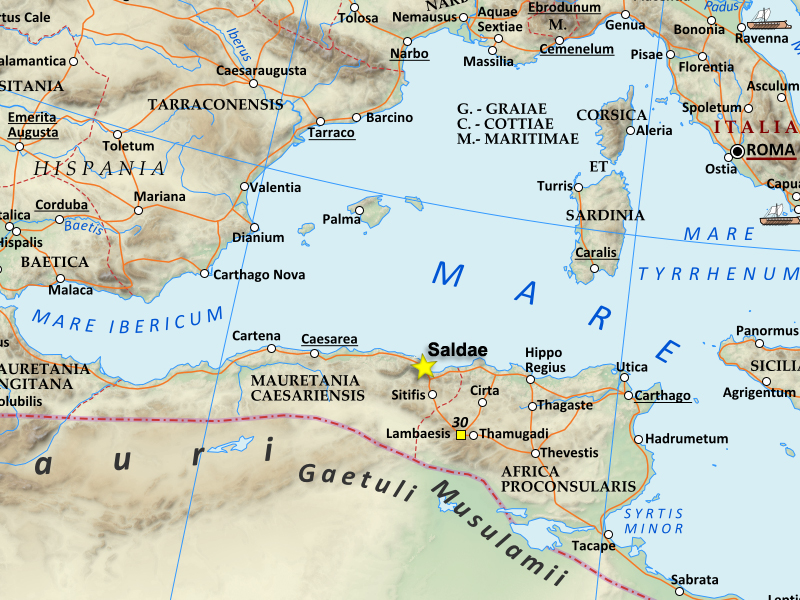
Saldae was an important port city in the ancient Roman Empire, located at today's Béjaïa (in Kabylia, eastern Algeria). It was generally a crossroads between eastern and western segments of Northern Africa, from the time of Carthage to the end of the Byzantine Empire from the continent.
Saldae was first inhabited by Numidian Berbers. A minor port in Carthaginian and in early Roman times, it was a border town between Rome and Juba, located to the east of the ancient Berber kingdoms.
It was made officially a Roman colony -named Civitas Salditana- during the reign of Roman emperor Octavianus Augustus. It is mentioned in Pliny the Elder's Naturalis Historia.
The Princeton Encyclopedia of Classical Sites reports:
The Roman period has left more abundant remains. Vestiges of the ramparts are visible at several places....Of the monuments which have been preserved or noted, particularly interesting are the remains of a temple underneath the church, built on the site of a mosque. The temple was undoubtedly near the forum, whose location is indicated by the bases of statues. In the immediate vicinity the public baths have produced a large ornamental mosaic (a piece of it is on exhibit in the church). Other public baths were on the site of the Civil Hospital. Two similar mosaics were found there; they depict heads of sea god Oceanus flanked by Nereids (nymphs). One is at the Algiers Museum, the other at the town hall of Béjaïa. A third public bath was located near the high school. Cisterns and basins are still visible (indeed, still in use) at several places in the upper town. They were fed by the Toudja aqueduct, which brought water from springs located 21 km to the West....West of the middle town a rounded depression has been supposed variously to have been the site of a circus, an amphitheater, and a theater. No ancient remains are known that settle the question. A single inscription (CIL, VIII, 8938) mentions "ludi circenses".Many Roman sculptures have been found in the area around the town, some carved in the rock, some found in the ground, others as sarcophagi. A sarcophagus with strigils is at the Louvre. Few sculptures come from Saldae itself, mainly some capitals and votive stelae dedicated to Saturn.
The city grew in size with new buildings and the emperor Vespasian settled the city with many Roman veterans, increasing its population and importance in the province of Mauretania Caesariensis, and when that was divided, in the new Late Roman province of Mauretania Sitifensis.
The city was under the Roman ius (law) and its citizens were endowed with full civil rights. Saldae was a center of a Mauretania Caesariensis area fully Romanised, that in the late third century was even fully Christian.
In the 3rd century AD, Gaius Cornelius Peregrinus, a decurion (town councillor) of Saldae, was a tribunus (military tribune, a commander at cohort level) of the auxiliary garrison at Alauna Carvetiorum, in northern Britain. An altar dedicated by him was discovered shortly before 1587 in the north-west corner of the fort, where it had probably been re-used in a late-Roman building ().
Hub AI
Saldae AI simulator
(@Saldae_simulator)
Saldae
Saldae was an important port city in the ancient Roman Empire, located at today's Béjaïa (in Kabylia, eastern Algeria). It was generally a crossroads between eastern and western segments of Northern Africa, from the time of Carthage to the end of the Byzantine Empire from the continent.
Saldae was first inhabited by Numidian Berbers. A minor port in Carthaginian and in early Roman times, it was a border town between Rome and Juba, located to the east of the ancient Berber kingdoms.
It was made officially a Roman colony -named Civitas Salditana- during the reign of Roman emperor Octavianus Augustus. It is mentioned in Pliny the Elder's Naturalis Historia.
The Princeton Encyclopedia of Classical Sites reports:
The Roman period has left more abundant remains. Vestiges of the ramparts are visible at several places....Of the monuments which have been preserved or noted, particularly interesting are the remains of a temple underneath the church, built on the site of a mosque. The temple was undoubtedly near the forum, whose location is indicated by the bases of statues. In the immediate vicinity the public baths have produced a large ornamental mosaic (a piece of it is on exhibit in the church). Other public baths were on the site of the Civil Hospital. Two similar mosaics were found there; they depict heads of sea god Oceanus flanked by Nereids (nymphs). One is at the Algiers Museum, the other at the town hall of Béjaïa. A third public bath was located near the high school. Cisterns and basins are still visible (indeed, still in use) at several places in the upper town. They were fed by the Toudja aqueduct, which brought water from springs located 21 km to the West....West of the middle town a rounded depression has been supposed variously to have been the site of a circus, an amphitheater, and a theater. No ancient remains are known that settle the question. A single inscription (CIL, VIII, 8938) mentions "ludi circenses".Many Roman sculptures have been found in the area around the town, some carved in the rock, some found in the ground, others as sarcophagi. A sarcophagus with strigils is at the Louvre. Few sculptures come from Saldae itself, mainly some capitals and votive stelae dedicated to Saturn.
The city grew in size with new buildings and the emperor Vespasian settled the city with many Roman veterans, increasing its population and importance in the province of Mauretania Caesariensis, and when that was divided, in the new Late Roman province of Mauretania Sitifensis.
The city was under the Roman ius (law) and its citizens were endowed with full civil rights. Saldae was a center of a Mauretania Caesariensis area fully Romanised, that in the late third century was even fully Christian.
In the 3rd century AD, Gaius Cornelius Peregrinus, a decurion (town councillor) of Saldae, was a tribunus (military tribune, a commander at cohort level) of the auxiliary garrison at Alauna Carvetiorum, in northern Britain. An altar dedicated by him was discovered shortly before 1587 in the north-west corner of the fort, where it had probably been re-used in a late-Roman building ().
Recent media