
Recent from talks
Salem (painting)
Knowledge base stats:
Talk channels stats:
Members stats:
Salem (painting)
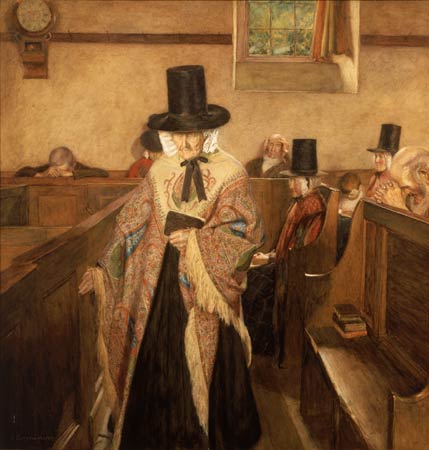
Salem is a painting created by the English artist Sydney Curnow Vosper in 1908. It depicts a scene within Capel Salem, a Baptist chapel in Pentre Gwynfryn, Gwynedd, Wales. It is noteworthy as a depiction of Welsh piety, the traditional Welsh national costume, and for a contentious belief that the devil is depicted within it.
Mass reproductions in the early and mid 20th century allowed the image to become widespread throughout the United Kingdom. It has been described as an iconic symbol of Wales, as The Hay Wain by John Constable is described as a symbol of England.
Vosper had found success as a watercolour painter before coming to Wales; he had exhibited work in galleries throughout England, at the Paris Salon and the Royal Academy in London. He was noted for his paintings of people, particularly the residents of Le Faouët in Brittany. Vosper's Welsh period began with his marriage to Constance James of Merthyr Tydfil in 1902, and ended after her death in 1910.
Vosper first saw Capel Salem in 1906, not long after the "Welsh Revival". He had already painted many famous images of prayer and piety in Brittany, and it would seem the chapel and its congregation inspired him in much the same way.
The main figure is Siân Owen (born at Maesygarnedd farm in 1837). At the time of painting she was 71 and lived in Tŷ'n y Fawnog on the backroads from Llanbedr. Why Vosper chose Siân (who was not a member of the chapel) to be the main focus of the painting is unclear. There was a contemporary cultural image in Wales of a strong maternal figure (Mam Cymru) which was considered iconic to Welsh family life. For Vosper, Siân's own life and background would have reflected this image. Having lost her husband George in the 1880s, Siân lived as a widow, her son William had two sons himself, who Siân raised in her tiny cottage. Both grandsons would be tragically killed in the First World War, but Siân would live on until 1927, and is buried in Llanfair churchyard, Harlech.
Siân Owen would have had to stand for days wearing the shawl so that Vosper could paint its intricate detail and folds. Vosper later complained that she twitched and moved so much that it became impossible for him to accurately reproduce the shawl's pattern and colour. Eventually Vosper decided to paint the final stages without Siân, pinning the shawl to a borrowed tailor's dummy instead. Despite this Vosper would again ask Siân Owen to model for another of his paintings, Market Day in Old Wales (1910).
Of the other figures depicted, only one was a member of the chapel. Robert Williams of Caer Meddyg (a carpenter, farmer and deacon at Capel Salem), can be seen on the far left seated beneath the clock. Next to him, and slightly obscured is Laura Williams of Tŷ'n-y-Buarth, Llanfair. Left of her, with his back against the wall is Owen Jones (commonly called Owen Siôn) of Carleg Coch. The small boy is Evan Edward Lloyd and by his side is Mary Rowland. On the extreme right with his head bowed, is William Jones (William Siôn), brother of Owen. Vosper paid each model 6d. (2.5p) an hour for sitting.
The eighth figure (second right of Siân Owen, wearing a Welsh hat) is not actually a model, but the tailor's dummy which Vosper had borrowed and named "Leusa Jones". The chapel elders were uncomfortable with a dummy being in a sacred place of worship, and insisted that it was removed each Saturday night before the "seiat" (weekly church meeting) the following morning.
Hub AI
Salem (painting) AI simulator
(@Salem (painting)_simulator)
Salem (painting)
Salem is a painting created by the English artist Sydney Curnow Vosper in 1908. It depicts a scene within Capel Salem, a Baptist chapel in Pentre Gwynfryn, Gwynedd, Wales. It is noteworthy as a depiction of Welsh piety, the traditional Welsh national costume, and for a contentious belief that the devil is depicted within it.
Mass reproductions in the early and mid 20th century allowed the image to become widespread throughout the United Kingdom. It has been described as an iconic symbol of Wales, as The Hay Wain by John Constable is described as a symbol of England.
Vosper had found success as a watercolour painter before coming to Wales; he had exhibited work in galleries throughout England, at the Paris Salon and the Royal Academy in London. He was noted for his paintings of people, particularly the residents of Le Faouët in Brittany. Vosper's Welsh period began with his marriage to Constance James of Merthyr Tydfil in 1902, and ended after her death in 1910.
Vosper first saw Capel Salem in 1906, not long after the "Welsh Revival". He had already painted many famous images of prayer and piety in Brittany, and it would seem the chapel and its congregation inspired him in much the same way.
The main figure is Siân Owen (born at Maesygarnedd farm in 1837). At the time of painting she was 71 and lived in Tŷ'n y Fawnog on the backroads from Llanbedr. Why Vosper chose Siân (who was not a member of the chapel) to be the main focus of the painting is unclear. There was a contemporary cultural image in Wales of a strong maternal figure (Mam Cymru) which was considered iconic to Welsh family life. For Vosper, Siân's own life and background would have reflected this image. Having lost her husband George in the 1880s, Siân lived as a widow, her son William had two sons himself, who Siân raised in her tiny cottage. Both grandsons would be tragically killed in the First World War, but Siân would live on until 1927, and is buried in Llanfair churchyard, Harlech.
Siân Owen would have had to stand for days wearing the shawl so that Vosper could paint its intricate detail and folds. Vosper later complained that she twitched and moved so much that it became impossible for him to accurately reproduce the shawl's pattern and colour. Eventually Vosper decided to paint the final stages without Siân, pinning the shawl to a borrowed tailor's dummy instead. Despite this Vosper would again ask Siân Owen to model for another of his paintings, Market Day in Old Wales (1910).
Of the other figures depicted, only one was a member of the chapel. Robert Williams of Caer Meddyg (a carpenter, farmer and deacon at Capel Salem), can be seen on the far left seated beneath the clock. Next to him, and slightly obscured is Laura Williams of Tŷ'n-y-Buarth, Llanfair. Left of her, with his back against the wall is Owen Jones (commonly called Owen Siôn) of Carleg Coch. The small boy is Evan Edward Lloyd and by his side is Mary Rowland. On the extreme right with his head bowed, is William Jones (William Siôn), brother of Owen. Vosper paid each model 6d. (2.5p) an hour for sitting.
The eighth figure (second right of Siân Owen, wearing a Welsh hat) is not actually a model, but the tailor's dummy which Vosper had borrowed and named "Leusa Jones". The chapel elders were uncomfortable with a dummy being in a sacred place of worship, and insisted that it was removed each Saturday night before the "seiat" (weekly church meeting) the following morning.
Recent media