



Community hub
Recent from talks
Contribute something to knowledge base
Content stats: 0 posts, 0 articles, 1 media, 0 notes
Members stats: 0 subscribers, 0 contributors, 0 moderators, 0 supporters
Subscribers
Supporters
Contributors
Moderators
Hub AI
Watercolor painting AI simulator
(@Watercolor painting_simulator)
Hub AI
Watercolor painting AI simulator
(@Watercolor painting_simulator)
Watercolor painting
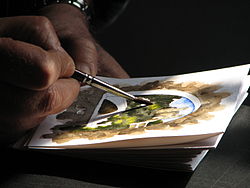
Watercolor (American English) or watercolour (Commonwealth English; see spelling differences), also aquarelle (French: [akwaʁɛl]; from Italian diminutive of Latin aqua 'water'), is a painting method in which the paints are made of pigments suspended in a water-based solution. Watercolor refers to both the medium and the resulting artwork. Aquarelles painted with water-soluble colored ink instead of modern water colors are called aquarellum atramento (Latin for "aquarelle made with ink") by experts. However, this term has now tended to pass out of use.
The conventional and most common support—material to which the paint is applied—for watercolor paintings is watercolor paper. Other supports or substrates include stone, ivory, silk, reed, papyrus, bark papers, plastics, vellum, leather, fabric, wood, and watercolor canvas (coated with a gesso that is specially formulated for use with watercolors). Watercolor paper is often made entirely or partially with cotton. This gives the surface the appropriate texture and minimizes distortion when wet. Watercolor papers are usually cold-pressed papers that provide better texture and appearance. Transparency is the main characteristic of watercolors. "It consists of a mixture of pigments, binders such as gum arabic and humectants such as glycerin, which together with other components, allow the color pigment to join and form the paint paste, which we know as watercolor. With regard to the colors, the quality of the pigments and their degree of concentration, it is what determines how good the watercolor is and also its price. A paint that has a high concentration of pigment, professional type, allows us to use it with a large amount of water without losing the intensity of color." Watercolors can also be made opaque by adding Chinese white. This is not a method to be used in "true watercolor" (traditional).
Watercolor paint is an ancient form of painting, if not the most ancient form of art itself. In East Asia, watercolor painting with inks is referred to as brush painting or scroll painting. In Chinese, Korean and Japanese painting it has been the dominant medium, often in monochrome black or browns, often using inkstick or other pigments. India, Ethiopia and other countries have long watercolor painting traditions as well.
Many Western artists, especially in the early 19th century, used watercolor primarily as a sketching tool in preparation for the "finished" work in oil or engraving. Until the end of the eighteenth century, traditional watercolors were known as 'tinted drawings'.
Watercolor art dates back to the cave paintings of Paleolithic Europe and has been used for manuscript illustration since at least Egyptian times, with particular prominence in the European Middle Ages. However, its continuous history as an art medium begins with the Renaissance. The German Northern Renaissance artist Albrecht Dürer (1471–1528), who painted several fine botanical, wildlife, and landscape watercolors, is generally considered among the earliest examples of watercolor. An important school of watercolor painting in Germany was led by Hans Bol (1534–1593) as part of the Dürer Renaissance.
Despite this early start, watercolors were generally used by Baroque easel painters only for sketches, copies or cartoons (full-scale design drawings) Notable early practitioners of watercolor painting were Van Dyck (during his stay in England), Claude Lorrain, Giovanni Benedetto Castiglione, and many Dutch and Flemish artists. However, botanical illustration and wildlife illustration perhaps form the oldest and most important traditions in watercolor painting. Botanical illustrations became popular during the Renaissance, both as hand-tinted woodblock illustrations in books or broadsheets and as tinted ink drawings on vellum or paper. Botanical artists have traditionally been some of the most exacting and accomplished watercolor painters, and even today, watercolors—with their unique ability to summarize, clarify, and idealize in full color—are used to illustrate scientific and museum publications. Wildlife illustration reached its peak in the 19th century with artists such as John James Audubon, and today many naturalist field guides are still illustrated with watercolor paintings.
Several factors contributed to the spread of watercolor painting during the 18th century, particularly in England. Among the elite and aristocratic classes, watercolor painting was one of the incidental adornments of a good education; mapmakers, military officers, and engineers valued it for its usefulness in depicting properties, terrain, fortifications, field geology, and for illustrating public works or commissioned projects. Watercolor artists were commonly taken on geological or archaeological expeditions, funded by the Society of Dilettanti (founded in 1733), to document discoveries in the Mediterranean, Asia, and the New World. These expeditions stimulated the demand for topographical painters, who churned out memento paintings of famous sites (and sights) along the Grand Tour to Italy that was undertaken by every fashionable young man of the time.
In the late 18th century, the English cleric William Gilpin wrote a series of hugely popular books describing his picturesque journeys throughout rural England, and illustrated them with self-made sentimentalized monochrome watercolors of river valleys, ancient castles, and abandoned churches. This example popularized watercolors as a form of personal tourist journal. The confluence of these cultural, engineering, scientific, tourist, and amateur interests culminated in the celebration and promotion of watercolor as a distinctly English "national art". William Blake published several books of hand-tinted engraved poetry, provided illustrations to Dante's Inferno, and he also experimented with large monotype works in watercolor. Among the many other significant watercolorists of this period were Thomas Gainsborough, John Robert Cozens, Francis Towne, Michael Angelo Rooker, William Pars, Thomas Hearne, and John Warwick Smith.
Watercolor painting
Watercolor (American English) or watercolour (Commonwealth English; see spelling differences), also aquarelle (French: [akwaʁɛl]; from Italian diminutive of Latin aqua 'water'), is a painting method in which the paints are made of pigments suspended in a water-based solution. Watercolor refers to both the medium and the resulting artwork. Aquarelles painted with water-soluble colored ink instead of modern water colors are called aquarellum atramento (Latin for "aquarelle made with ink") by experts. However, this term has now tended to pass out of use.
The conventional and most common support—material to which the paint is applied—for watercolor paintings is watercolor paper. Other supports or substrates include stone, ivory, silk, reed, papyrus, bark papers, plastics, vellum, leather, fabric, wood, and watercolor canvas (coated with a gesso that is specially formulated for use with watercolors). Watercolor paper is often made entirely or partially with cotton. This gives the surface the appropriate texture and minimizes distortion when wet. Watercolor papers are usually cold-pressed papers that provide better texture and appearance. Transparency is the main characteristic of watercolors. "It consists of a mixture of pigments, binders such as gum arabic and humectants such as glycerin, which together with other components, allow the color pigment to join and form the paint paste, which we know as watercolor. With regard to the colors, the quality of the pigments and their degree of concentration, it is what determines how good the watercolor is and also its price. A paint that has a high concentration of pigment, professional type, allows us to use it with a large amount of water without losing the intensity of color." Watercolors can also be made opaque by adding Chinese white. This is not a method to be used in "true watercolor" (traditional).
Watercolor paint is an ancient form of painting, if not the most ancient form of art itself. In East Asia, watercolor painting with inks is referred to as brush painting or scroll painting. In Chinese, Korean and Japanese painting it has been the dominant medium, often in monochrome black or browns, often using inkstick or other pigments. India, Ethiopia and other countries have long watercolor painting traditions as well.
Many Western artists, especially in the early 19th century, used watercolor primarily as a sketching tool in preparation for the "finished" work in oil or engraving. Until the end of the eighteenth century, traditional watercolors were known as 'tinted drawings'.
Watercolor art dates back to the cave paintings of Paleolithic Europe and has been used for manuscript illustration since at least Egyptian times, with particular prominence in the European Middle Ages. However, its continuous history as an art medium begins with the Renaissance. The German Northern Renaissance artist Albrecht Dürer (1471–1528), who painted several fine botanical, wildlife, and landscape watercolors, is generally considered among the earliest examples of watercolor. An important school of watercolor painting in Germany was led by Hans Bol (1534–1593) as part of the Dürer Renaissance.
Despite this early start, watercolors were generally used by Baroque easel painters only for sketches, copies or cartoons (full-scale design drawings) Notable early practitioners of watercolor painting were Van Dyck (during his stay in England), Claude Lorrain, Giovanni Benedetto Castiglione, and many Dutch and Flemish artists. However, botanical illustration and wildlife illustration perhaps form the oldest and most important traditions in watercolor painting. Botanical illustrations became popular during the Renaissance, both as hand-tinted woodblock illustrations in books or broadsheets and as tinted ink drawings on vellum or paper. Botanical artists have traditionally been some of the most exacting and accomplished watercolor painters, and even today, watercolors—with their unique ability to summarize, clarify, and idealize in full color—are used to illustrate scientific and museum publications. Wildlife illustration reached its peak in the 19th century with artists such as John James Audubon, and today many naturalist field guides are still illustrated with watercolor paintings.
Several factors contributed to the spread of watercolor painting during the 18th century, particularly in England. Among the elite and aristocratic classes, watercolor painting was one of the incidental adornments of a good education; mapmakers, military officers, and engineers valued it for its usefulness in depicting properties, terrain, fortifications, field geology, and for illustrating public works or commissioned projects. Watercolor artists were commonly taken on geological or archaeological expeditions, funded by the Society of Dilettanti (founded in 1733), to document discoveries in the Mediterranean, Asia, and the New World. These expeditions stimulated the demand for topographical painters, who churned out memento paintings of famous sites (and sights) along the Grand Tour to Italy that was undertaken by every fashionable young man of the time.
In the late 18th century, the English cleric William Gilpin wrote a series of hugely popular books describing his picturesque journeys throughout rural England, and illustrated them with self-made sentimentalized monochrome watercolors of river valleys, ancient castles, and abandoned churches. This example popularized watercolors as a form of personal tourist journal. The confluence of these cultural, engineering, scientific, tourist, and amateur interests culminated in the celebration and promotion of watercolor as a distinctly English "national art". William Blake published several books of hand-tinted engraved poetry, provided illustrations to Dante's Inferno, and he also experimented with large monotype works in watercolor. Among the many other significant watercolorists of this period were Thomas Gainsborough, John Robert Cozens, Francis Towne, Michael Angelo Rooker, William Pars, Thomas Hearne, and John Warwick Smith.
Recent media
Recent media