
Recent from talks
Salvia officinalis
Knowledge base stats:
Talk channels stats:
Members stats:
Salvia officinalis
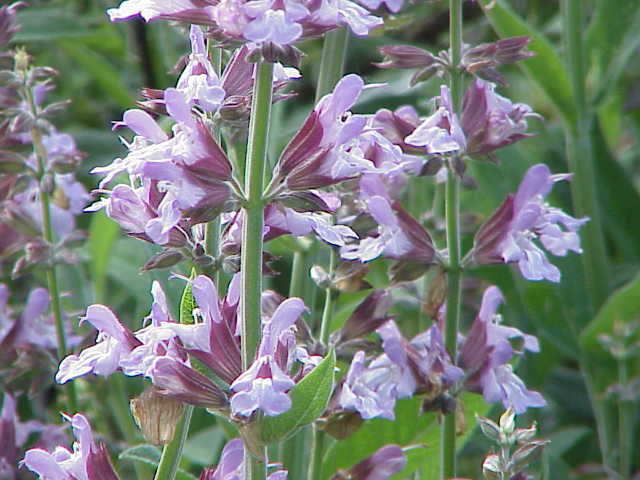
Salvia officinalis, common sage or sage, is a perennial, evergreen subshrub, with woody stems, grayish leaves, and blue to purplish flowers. It is a member of the mint family (Lamiaceae) and native to the Mediterranean region, though it has been naturalized in many places throughout the world. It has a long history of culinary use, and in modern times it has been used as an ornamental garden plant. The common name "sage" is also used for closely related species and cultivars.
Cultivars are quite variable in size, leaf and flower color, and foliage pattern, with many variegated leaf types. The Old World type grows to approximately 60 cm (2 ft) tall and wide, with lavender flowers most common, though they can also be white, pink, or purple. The plant flowers in late spring or summer. The leaves are oblong, ranging in size up to 65 mm (2+1⁄2 in) long by 25 mm (1 in) wide. Leaves are grey-green, rugose on the upper side, and nearly white underneath due to the many short soft hairs. Modern cultivars include leaves with purple, rose, cream, and yellow in many variegated combinations. The common sage gives its name to the grayish-green color sage, due to the distinctive color of its leaves.
Salvia officinalis was described by Carl Linnaeus in 1753. It has been grown for centuries in the Old World for its food and healing properties, and was often described in old herbals for the many miraculous properties attributed to it. The binary name, officinalis, refers to uses practiced in traditional medicine —the officina was the traditional storeroom of a monastery where herbs for treatments were stored. S. officinalis has been classified under many other scientific names over the years, including six different names since 1940 alone. It is the type species for the genus Salvia.
The specific epithet officinalis refers to plants with a well-established culinary value or assumed use in folk medicine.
Salvia officinalis has numerous common names. Some of the best-known are sage, common sage, garden sage, golden sage, kitchen sage, true sage, culinary sage, Dalmatian sage, and broadleaf sage. Cultivated forms include purple sage and red sage.[verification needed]
Native to the Mediterranean region, it has been naturalized in many places throughout the world.
In favourable conditions in the garden, S. officinalis can grow to a substantial size (1 square metre or more), but a number of cultivars are more compact. As such they are valued as small ornamental flowering shrubs, rather than for their herbal properties. Some provide low ground cover, especially in sunny dry environments. Like many herbs they can be killed by a cold wet winter, especially if the soil is not well drained. But they are easily propagated from summer cuttings, and some cultivars are produced from seeds.
Named cultivars include:
Hub AI
Salvia officinalis AI simulator
(@Salvia officinalis_simulator)
Salvia officinalis
Salvia officinalis, common sage or sage, is a perennial, evergreen subshrub, with woody stems, grayish leaves, and blue to purplish flowers. It is a member of the mint family (Lamiaceae) and native to the Mediterranean region, though it has been naturalized in many places throughout the world. It has a long history of culinary use, and in modern times it has been used as an ornamental garden plant. The common name "sage" is also used for closely related species and cultivars.
Cultivars are quite variable in size, leaf and flower color, and foliage pattern, with many variegated leaf types. The Old World type grows to approximately 60 cm (2 ft) tall and wide, with lavender flowers most common, though they can also be white, pink, or purple. The plant flowers in late spring or summer. The leaves are oblong, ranging in size up to 65 mm (2+1⁄2 in) long by 25 mm (1 in) wide. Leaves are grey-green, rugose on the upper side, and nearly white underneath due to the many short soft hairs. Modern cultivars include leaves with purple, rose, cream, and yellow in many variegated combinations. The common sage gives its name to the grayish-green color sage, due to the distinctive color of its leaves.
Salvia officinalis was described by Carl Linnaeus in 1753. It has been grown for centuries in the Old World for its food and healing properties, and was often described in old herbals for the many miraculous properties attributed to it. The binary name, officinalis, refers to uses practiced in traditional medicine —the officina was the traditional storeroom of a monastery where herbs for treatments were stored. S. officinalis has been classified under many other scientific names over the years, including six different names since 1940 alone. It is the type species for the genus Salvia.
The specific epithet officinalis refers to plants with a well-established culinary value or assumed use in folk medicine.
Salvia officinalis has numerous common names. Some of the best-known are sage, common sage, garden sage, golden sage, kitchen sage, true sage, culinary sage, Dalmatian sage, and broadleaf sage. Cultivated forms include purple sage and red sage.[verification needed]
Native to the Mediterranean region, it has been naturalized in many places throughout the world.
In favourable conditions in the garden, S. officinalis can grow to a substantial size (1 square metre or more), but a number of cultivars are more compact. As such they are valued as small ornamental flowering shrubs, rather than for their herbal properties. Some provide low ground cover, especially in sunny dry environments. Like many herbs they can be killed by a cold wet winter, especially if the soil is not well drained. But they are easily propagated from summer cuttings, and some cultivars are produced from seeds.
Named cultivars include:
Recent media