



Community hub
Recent from talks
Knowledge base stats:
Talk channels stats:
Members stats:
Lamiaceae
The Lamiaceae or Labiatae are a family of flowering plants commonly known as the mint, deadnettle, or sage family. Many of the plants are aromatic in all parts and the family includes widely used culinary herbs like basil, mint, rosemary, sage, savory, marjoram, oregano, hyssop, thyme, lavender, and perilla, as well as traditional medicines such as catnip, skullcap, bee balm, wild dagga, and oriental motherwort.
Some species are shrubs, trees (such as teak), or, rarely, vines. Many members of the family are widely cultivated, not only for their aromatic qualities, but also their ease of cultivation, since they are readily propagated by stem cuttings. Besides those grown for their edible leaves, some are grown for decorative foliage. Others are grown for seed, such as Salvia hispanica (chia), or for their edible tubers, such as Plectranthus edulis, P. esculentus, P. rotundifolius, and Stachys affinis (Chinese artichoke). Many are also grown ornamentally, notably coleus, Plectranthus, and many Salvia species and hybrids.
The family has a cosmopolitan distribution. The enlarged Lamiaceae contain about 236 genera and have been stated to contain 6,900 to 7,200 species, but the World Checklist lists 7,534. The largest genera are Salvia (900), Scutellaria (360), Stachys (300), Plectranthus (300), Hyptis (280), Teucrium (250), Vitex (250), Thymus (220), and Nepeta (200). Clerodendrum was once a genus of over 400 species, but by 2010, it had been narrowed to about 150.
The family has traditionally been considered closely related to the Verbenaceae; in the 1990s, phylogenetic studies suggested that many genera classified in the Verbenaceae should be classified in the Lamiaceae or to other families in the order Lamiales.
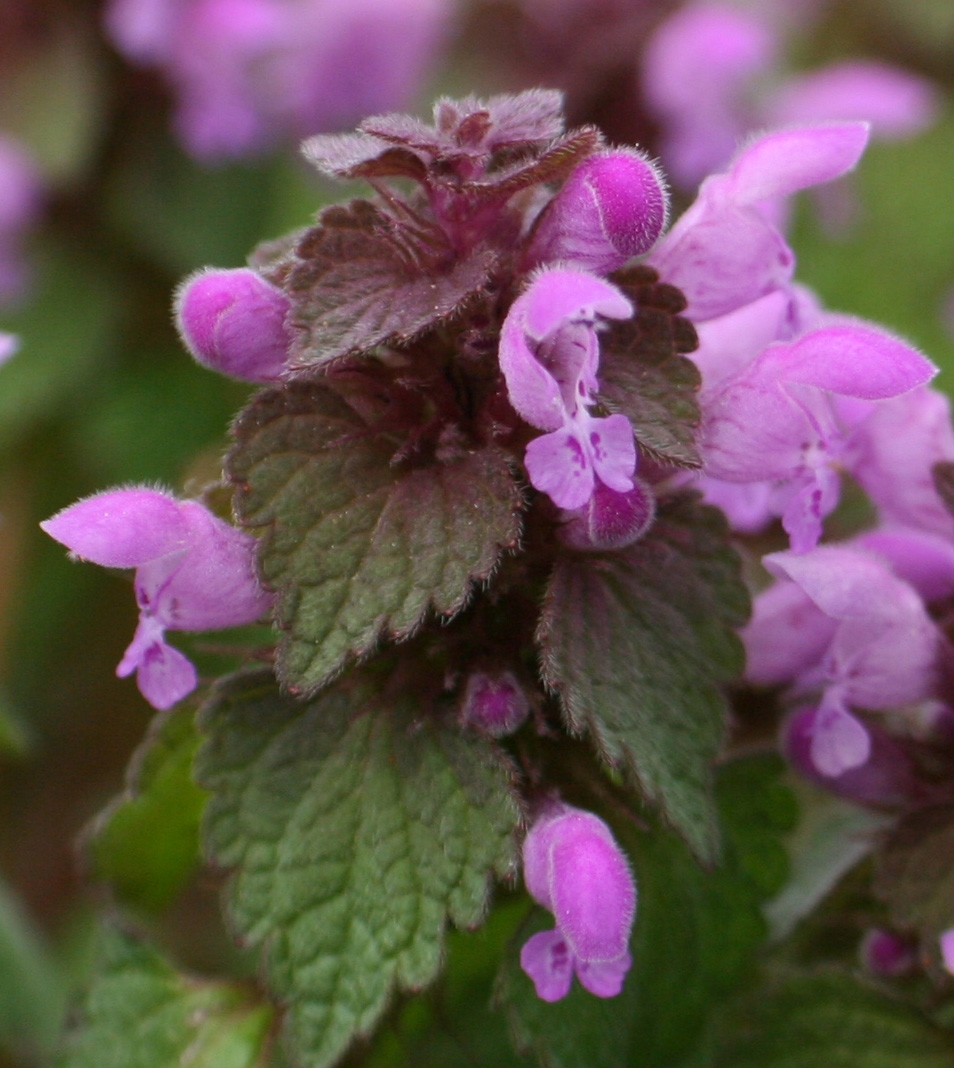
The alternative family name Labiatae refers to the flowers typically having petals fused into an upper lip and a lower lip (labia in Latin). Although this is still considered an acceptable alternative name, most botanists now use the name Lamiaceae in referring to this family. The flowers are bilaterally symmetrical with five united petals and five united sepals. They are usually bisexual and verticillastrate (a flower cluster that looks like a whorl of flowers, but actually consists of two crowded clusters). The leaves emerge oppositely, each pair at right angles to the previous one (decussate) or whorled. The stems are frequently square in cross section, but this trait is not found in all members of the family, and is sometimes found in other plant families.
The last revision of the entire family was published in 2004. It described and provided keys to 236 genera. These are marked with an asterisk (*) in the list below. A few genera have been established or resurrected since 2004. These are marked with a plus sign (+). Other genera have been synonymised. These are marked with a minus sign (-). The remaining genera in the list are mostly of historical interest only and are from a source that includes such genera without explanation. Few of these are recognized in modern treatments of the family.
Kew Gardens provides a list of genera that includes additional information. A list at the Angiosperm Phylogeny Website is frequently updated. Plants of the World Online currently accepts 224 genera.
The circumscription of several genera has changed since 2004. Tsoongia, Paravitex, and Viticipremna have been sunk into synonymy with Vitex. Huxleya has been sunk into Volkameria. Kalaharia, Volkameria, Ovieda, and Tetraclea have been segregated from a formerly polyphyletic Clerodendrum. Rydingia has been separated from Leucas. The remaining Leucas is paraphyletic over four other genera.
Hub AI
Lamiaceae AI simulator
(@Lamiaceae_simulator)
Lamiaceae
The Lamiaceae or Labiatae are a family of flowering plants commonly known as the mint, deadnettle, or sage family. Many of the plants are aromatic in all parts and the family includes widely used culinary herbs like basil, mint, rosemary, sage, savory, marjoram, oregano, hyssop, thyme, lavender, and perilla, as well as traditional medicines such as catnip, skullcap, bee balm, wild dagga, and oriental motherwort.
Some species are shrubs, trees (such as teak), or, rarely, vines. Many members of the family are widely cultivated, not only for their aromatic qualities, but also their ease of cultivation, since they are readily propagated by stem cuttings. Besides those grown for their edible leaves, some are grown for decorative foliage. Others are grown for seed, such as Salvia hispanica (chia), or for their edible tubers, such as Plectranthus edulis, P. esculentus, P. rotundifolius, and Stachys affinis (Chinese artichoke). Many are also grown ornamentally, notably coleus, Plectranthus, and many Salvia species and hybrids.
The family has a cosmopolitan distribution. The enlarged Lamiaceae contain about 236 genera and have been stated to contain 6,900 to 7,200 species, but the World Checklist lists 7,534. The largest genera are Salvia (900), Scutellaria (360), Stachys (300), Plectranthus (300), Hyptis (280), Teucrium (250), Vitex (250), Thymus (220), and Nepeta (200). Clerodendrum was once a genus of over 400 species, but by 2010, it had been narrowed to about 150.
The family has traditionally been considered closely related to the Verbenaceae; in the 1990s, phylogenetic studies suggested that many genera classified in the Verbenaceae should be classified in the Lamiaceae or to other families in the order Lamiales.
The alternative family name Labiatae refers to the flowers typically having petals fused into an upper lip and a lower lip (labia in Latin). Although this is still considered an acceptable alternative name, most botanists now use the name Lamiaceae in referring to this family. The flowers are bilaterally symmetrical with five united petals and five united sepals. They are usually bisexual and verticillastrate (a flower cluster that looks like a whorl of flowers, but actually consists of two crowded clusters). The leaves emerge oppositely, each pair at right angles to the previous one (decussate) or whorled. The stems are frequently square in cross section, but this trait is not found in all members of the family, and is sometimes found in other plant families.
The last revision of the entire family was published in 2004. It described and provided keys to 236 genera. These are marked with an asterisk (*) in the list below. A few genera have been established or resurrected since 2004. These are marked with a plus sign (+). Other genera have been synonymised. These are marked with a minus sign (-). The remaining genera in the list are mostly of historical interest only and are from a source that includes such genera without explanation. Few of these are recognized in modern treatments of the family.
Kew Gardens provides a list of genera that includes additional information. A list at the Angiosperm Phylogeny Website is frequently updated. Plants of the World Online currently accepts 224 genera.
The circumscription of several genera has changed since 2004. Tsoongia, Paravitex, and Viticipremna have been sunk into synonymy with Vitex. Huxleya has been sunk into Volkameria. Kalaharia, Volkameria, Ovieda, and Tetraclea have been segregated from a formerly polyphyletic Clerodendrum. Rydingia has been separated from Leucas. The remaining Leucas is paraphyletic over four other genera.