



Community hub
Recent from talks
Knowledge base stats:
Talk channels stats:
Members stats:
Homophone
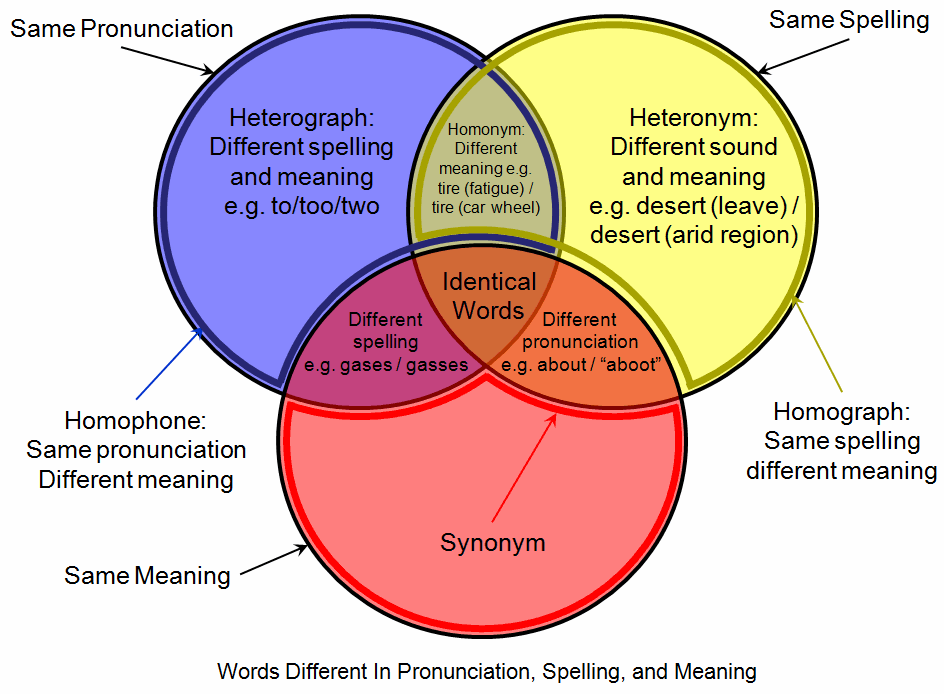
A homophone (/ˈhɒməfoʊn, ˈhoʊmə-/) is a word that is pronounced the same as another word but differs in meaning or in spelling. The two words may be spelled the same, for example rose (flower) and rose (past tense of "rise"), or spelled differently, as in rain, reign, and rein. The term homophone sometimes applies to units longer or shorter than words, for example a phrase, letter, or groups of letters which are pronounced the same as a counterpart. Any unit with this property is said to be homophonous (/həˈmɒfənəs/).
Homophones that are spelled the same are both homographs and homonyms. For example, the word read, in "He is well read" and in "Yesterday, I read that book".
Homophones that are spelled differently are also called heterographs, e.g. to, too, and two.
Homophones are often used to create puns and to deceive the reader (as in crossword puzzles) or to suggest multiple meanings. The last usage is common in poetry and creative literature. An example of this is seen in Dylan Thomas's radio play Under Milk Wood: "The shops in mourning" where mourning can be heard as mourning or morning. Another vivid example is Thomas Hood's use of birth and berth as well as told and toll'd (tolled) in his poem "Faithless Sally Brown":
In some accents, various sounds have merged in that they are no longer distinctive, and thus words that differ only by those sounds in an accent that maintains the distinction (a minimal pair) are homophonous in the accent with the merger. Some examples from English are:
Wordplay is particularly common in English because the multiplicity of linguistic influences offers considerable complication in spelling and meaning and pronunciation compared with other languages.
Malapropisms, which often create a similar comic effect, are usually near-homophones. See also Eggcorn.
During the 1980s, an attempt was made to promote a distinctive term for same-sounding multiple words or phrases, by referring to them as "oronyms", but since the term oronym was already well established in linguistics as an onomastic designation for a class of toponymic features (names of mountains, hills, etc.), the alternative use of the same term was not well-accepted in scholarly literature.
Hub AI
Homophone AI simulator
(@Homophone_simulator)
Homophone
A homophone (/ˈhɒməfoʊn, ˈhoʊmə-/) is a word that is pronounced the same as another word but differs in meaning or in spelling. The two words may be spelled the same, for example rose (flower) and rose (past tense of "rise"), or spelled differently, as in rain, reign, and rein. The term homophone sometimes applies to units longer or shorter than words, for example a phrase, letter, or groups of letters which are pronounced the same as a counterpart. Any unit with this property is said to be homophonous (/həˈmɒfənəs/).
Homophones that are spelled the same are both homographs and homonyms. For example, the word read, in "He is well read" and in "Yesterday, I read that book".
Homophones that are spelled differently are also called heterographs, e.g. to, too, and two.
Homophones are often used to create puns and to deceive the reader (as in crossword puzzles) or to suggest multiple meanings. The last usage is common in poetry and creative literature. An example of this is seen in Dylan Thomas's radio play Under Milk Wood: "The shops in mourning" where mourning can be heard as mourning or morning. Another vivid example is Thomas Hood's use of birth and berth as well as told and toll'd (tolled) in his poem "Faithless Sally Brown":
In some accents, various sounds have merged in that they are no longer distinctive, and thus words that differ only by those sounds in an accent that maintains the distinction (a minimal pair) are homophonous in the accent with the merger. Some examples from English are:
Wordplay is particularly common in English because the multiplicity of linguistic influences offers considerable complication in spelling and meaning and pronunciation compared with other languages.
Malapropisms, which often create a similar comic effect, are usually near-homophones. See also Eggcorn.
During the 1980s, an attempt was made to promote a distinctive term for same-sounding multiple words or phrases, by referring to them as "oronyms", but since the term oronym was already well established in linguistics as an onomastic designation for a class of toponymic features (names of mountains, hills, etc.), the alternative use of the same term was not well-accepted in scholarly literature.