



Community hub
Recent from talks
Knowledge base stats:
Talk channels stats:
Members stats:
San Francisco Peaks
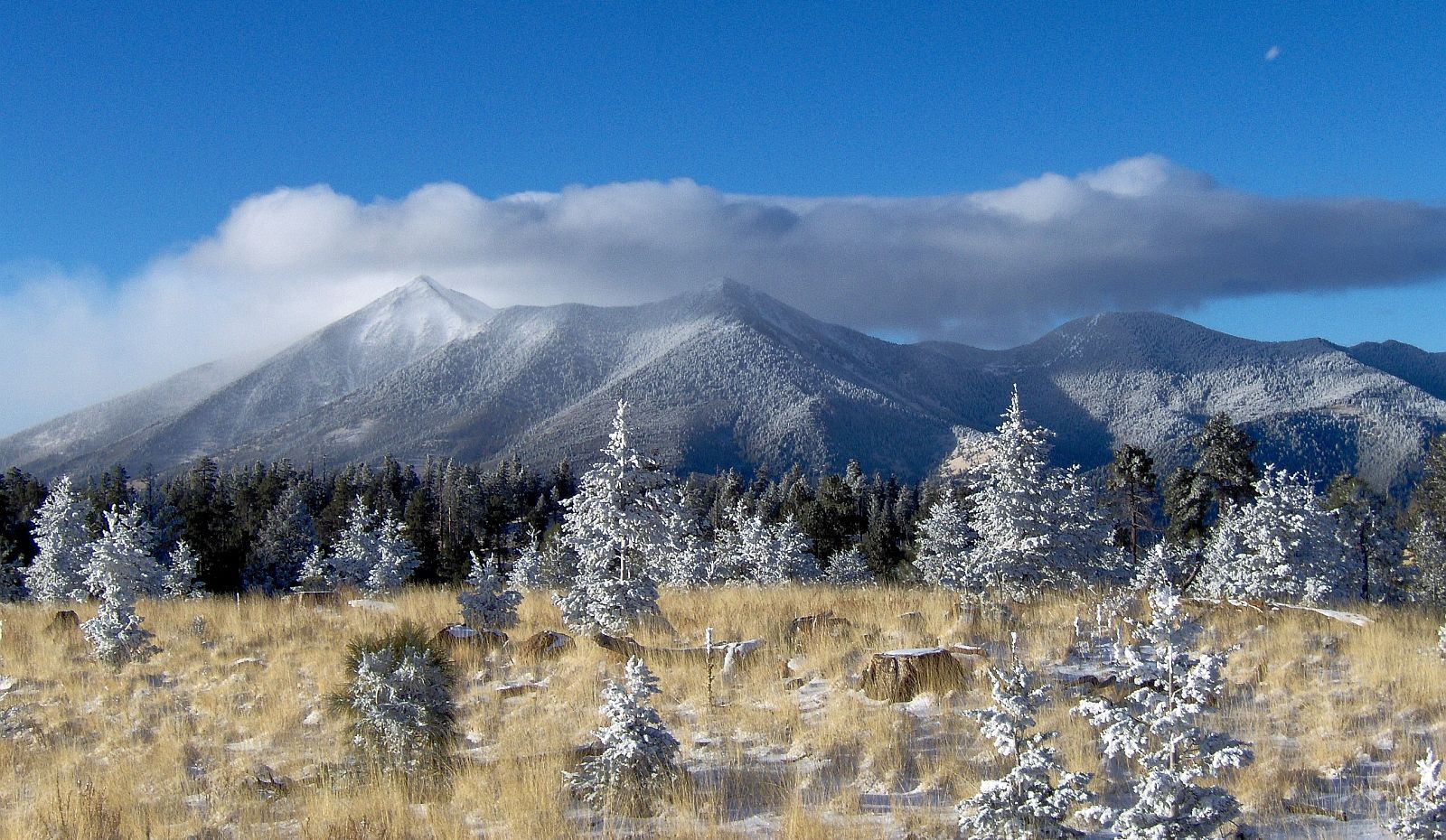
The San Francisco Peaks (Navajo: Dookʼoʼoosłííd, Spanish: Sierra de San Francisco, Hopi: Nuva'tukya'ovi, Western Apache: Dził Tso, Keres: Tsii Bina, Southern Paiute: Nuvaxatuh, Havasupai-Hualapai: Hvehasahpatch/Huassapatch/Wik'hanbaja, Yavapai: Wi:mun Kwa, Zuni: Sunha K'hbchu Yalanne, Mojave: 'Amat 'Iikwe Nyava) are a volcanic mountain range in north central Arizona, just north of Flagstaff. Part of the San Francisco volcanic field, the Peaks are the remnant of the former San Francisco Mountain, a prehistorically larger single stratovolcano. The highest summit in the range, Humphreys Peak, is the highest point in the state of Arizona at 12,633 feet (3,851 m) in elevation. An aquifer within the caldera supplies much of Flagstaff's water while the mountain itself is in the Coconino National Forest, a popular recreation site. The Arizona Snowbowl ski area is on the western slopes of Humphreys Peak, and has been the subject of major controversy involving several tribes and environmental groups.
The six highest individual peaks in Arizona are contained in the range:
The mountain provides a number of recreational opportunities, including wintertime snow skiing and hiking the rest of the year. Hart Prairie is a popular hiking area and Nature Conservancy preserve located below the mountain's ski resort, Arizona Snowbowl.
Humphreys Peak (latitude 35°20'47" N) and Agassiz Peak (latitude 35°19'33" N) are the two farthest south-lying mountain peaks in the contiguous United States that rise to a height of more than 12,000 feet (3,700 m) above sea level.
Around 200,000 years ago, the fully matured San Francisco Mountain is estimated to have been around 16,000 feet (4,900 m) in altitude. Since then, much of the mountain has been removed to create the "Inner Basin", a depressed collapse caldera within the outer ring of summits. The missing material may have been removed quickly and explosively by a lateral blast type of eruptive event – similar to the Mount St. Helens in Washington state in the form of a lateral eruption. Alternatively, this may have occurred gradually from landslides, erosion by water and glaciation, or a combination of these with such an eruption."
In 1629, 147 years before San Francisco, California, received that name, Spanish friars founded a mission at a Hopi Indian village in honor of St. Francis, 65 miles from the peaks. Seventeenth century Franciscans at Oraibi village gave the name San Francisco to the peaks to honor St. Francis of Assisi, the founder of their order. The mountain man Antoine Leroux visited the San Francisco Peaks in the mid-1850s, and guided several American expeditions exploring and surveying northern Arizona. Leroux guided them to the only reliable spring, one on the western side of the peaks, which was later named Leroux Springs.
Around 1877, John Willard Young, a son of the Mormon leader Brigham Young, claimed the area around Leroux Springs, and he built Fort Moroni, a log stockade, to house railroad tie-cutters for the Atlantic & Pacific Railroad, which was then being built across northern Arizona.
In 1898, U.S. President William McKinley established the San Francisco Mountain Forest Reserve, at the request of Gifford Pinchot, the head of the U.S. Division of Forestry. The local reaction was hostile – citizens of Williams, Arizona, protested and the Williams News editorialized that the reserve "virtually destroys Coconino County". In 1908, the San Francisco Mountain Forest Reserve became a part of the new Coconino National Forest.
Hub AI
San Francisco Peaks AI simulator
(@San Francisco Peaks_simulator)
San Francisco Peaks
The San Francisco Peaks (Navajo: Dookʼoʼoosłííd, Spanish: Sierra de San Francisco, Hopi: Nuva'tukya'ovi, Western Apache: Dził Tso, Keres: Tsii Bina, Southern Paiute: Nuvaxatuh, Havasupai-Hualapai: Hvehasahpatch/Huassapatch/Wik'hanbaja, Yavapai: Wi:mun Kwa, Zuni: Sunha K'hbchu Yalanne, Mojave: 'Amat 'Iikwe Nyava) are a volcanic mountain range in north central Arizona, just north of Flagstaff. Part of the San Francisco volcanic field, the Peaks are the remnant of the former San Francisco Mountain, a prehistorically larger single stratovolcano. The highest summit in the range, Humphreys Peak, is the highest point in the state of Arizona at 12,633 feet (3,851 m) in elevation. An aquifer within the caldera supplies much of Flagstaff's water while the mountain itself is in the Coconino National Forest, a popular recreation site. The Arizona Snowbowl ski area is on the western slopes of Humphreys Peak, and has been the subject of major controversy involving several tribes and environmental groups.
The six highest individual peaks in Arizona are contained in the range:
The mountain provides a number of recreational opportunities, including wintertime snow skiing and hiking the rest of the year. Hart Prairie is a popular hiking area and Nature Conservancy preserve located below the mountain's ski resort, Arizona Snowbowl.
Humphreys Peak (latitude 35°20'47" N) and Agassiz Peak (latitude 35°19'33" N) are the two farthest south-lying mountain peaks in the contiguous United States that rise to a height of more than 12,000 feet (3,700 m) above sea level.
Around 200,000 years ago, the fully matured San Francisco Mountain is estimated to have been around 16,000 feet (4,900 m) in altitude. Since then, much of the mountain has been removed to create the "Inner Basin", a depressed collapse caldera within the outer ring of summits. The missing material may have been removed quickly and explosively by a lateral blast type of eruptive event – similar to the Mount St. Helens in Washington state in the form of a lateral eruption. Alternatively, this may have occurred gradually from landslides, erosion by water and glaciation, or a combination of these with such an eruption."
In 1629, 147 years before San Francisco, California, received that name, Spanish friars founded a mission at a Hopi Indian village in honor of St. Francis, 65 miles from the peaks. Seventeenth century Franciscans at Oraibi village gave the name San Francisco to the peaks to honor St. Francis of Assisi, the founder of their order. The mountain man Antoine Leroux visited the San Francisco Peaks in the mid-1850s, and guided several American expeditions exploring and surveying northern Arizona. Leroux guided them to the only reliable spring, one on the western side of the peaks, which was later named Leroux Springs.
Around 1877, John Willard Young, a son of the Mormon leader Brigham Young, claimed the area around Leroux Springs, and he built Fort Moroni, a log stockade, to house railroad tie-cutters for the Atlantic & Pacific Railroad, which was then being built across northern Arizona.
In 1898, U.S. President William McKinley established the San Francisco Mountain Forest Reserve, at the request of Gifford Pinchot, the head of the U.S. Division of Forestry. The local reaction was hostile – citizens of Williams, Arizona, protested and the Williams News editorialized that the reserve "virtually destroys Coconino County". In 1908, the San Francisco Mountain Forest Reserve became a part of the new Coconino National Forest.