



Community hub
Recent from talks
Contribute something to knowledge base
Content stats: 0 posts, 0 articles, 1 media, 0 notes
Members stats: 0 subscribers, 0 contributors, 0 moderators, 0 supporters
Subscribers
Supporters
Contributors
Moderators
Hub AI
Kaempferia galanga AI simulator
(@Kaempferia galanga_simulator)
Hub AI
Kaempferia galanga AI simulator
(@Kaempferia galanga_simulator)
Kaempferia galanga
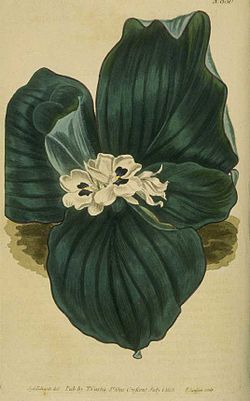
Kaempferia galanga, commonly known as kencur, aromatic ginger, sand ginger, cutcherry, is a monocotyledonous plant in the ginger family, and one of four plants called galangal. It is found primarily in open areas in Indonesia, southern China, Taiwan, Cambodia, and India, but is also widely cultivated throughout Southeast Asia.
Kaempferia galanga is used as a spice in cooking in Indonesia, where it is called kencur ('cekur' in Malaysia), and especially in Javanese and Balinese cuisines. Beras kencur, which combines dried K. galanga powder with rice flour, is a particularly popular jamu herbal drink. Its leaves are also used in the Malay rice dish, nasi ulam.
Unlike the similar Boesenbergia rotunda (Thai กระชาย krachai), K. galanga is not commonly used in Thai cuisine, but can be bought as a dried rhizome or in powder form at herbal medicine stalls. It is known in Thai as proh horm (เปราะหอม) or waan horm (ว่านหอม), and in Khmer as prâh (ប្រោះ) or prâh krâ-oup (ប្រោះក្រអូប). It is also used in Chinese cooking and Chinese medicine, and is sold in Chinese groceries under the name sha jiang (Chinese: 沙 姜; pinyin: shajiang), while the plant itself is referred to as shan nai (Chinese: 山 柰; pinyin: shannai). Kaempferia galanga has a peppery camphorous taste.
K. galanga is differentiated from other galangals by the absence of stem and dark brown, rounded rhizomes, while the other varieties all have stems and pale rosebrown rhizomes.[citation needed] It is also sometimes called lesser galangal, which properly refers to Alpinia officinarum.
The rhizomes of aromatic ginger have been reported to contain cineol, borneol, 3-carene, camphene, kaempferol, kaempferide, cinnamaldehyde, p-methoxycinnamic acid, ethyl cinnamate, and ethyl p-methoxycinnamate.[citation needed] A study made a list of chemicals classified based on their different chemical groups
Extracts of the plant kill larvae of several species of mosquito including some that are disease vectors. As a result of these findings, research is underway to evaluate the plant extract's use as an insect repellent, with preliminary findings suggesting it is not an irritant to the skin of rats.
The rhizomes of the plant, which contain essential oils, have been used in traditional Chinese medicine as a decoction or powder. Its alcoholic maceration has also been applied as liniment for rheumatism. The extract causes central nervous system depression, a decrease in motor activity, and a decrease in respiratory rate.
The decoctions and the sap of the leaves may have hallucinogenic properties, which may be due to unidentified chemical components of the plant’s essential oil fraction.
Kaempferia galanga
Kaempferia galanga, commonly known as kencur, aromatic ginger, sand ginger, cutcherry, is a monocotyledonous plant in the ginger family, and one of four plants called galangal. It is found primarily in open areas in Indonesia, southern China, Taiwan, Cambodia, and India, but is also widely cultivated throughout Southeast Asia.
Kaempferia galanga is used as a spice in cooking in Indonesia, where it is called kencur ('cekur' in Malaysia), and especially in Javanese and Balinese cuisines. Beras kencur, which combines dried K. galanga powder with rice flour, is a particularly popular jamu herbal drink. Its leaves are also used in the Malay rice dish, nasi ulam.
Unlike the similar Boesenbergia rotunda (Thai กระชาย krachai), K. galanga is not commonly used in Thai cuisine, but can be bought as a dried rhizome or in powder form at herbal medicine stalls. It is known in Thai as proh horm (เปราะหอม) or waan horm (ว่านหอม), and in Khmer as prâh (ប្រោះ) or prâh krâ-oup (ប្រោះក្រអូប). It is also used in Chinese cooking and Chinese medicine, and is sold in Chinese groceries under the name sha jiang (Chinese: 沙 姜; pinyin: shajiang), while the plant itself is referred to as shan nai (Chinese: 山 柰; pinyin: shannai). Kaempferia galanga has a peppery camphorous taste.
K. galanga is differentiated from other galangals by the absence of stem and dark brown, rounded rhizomes, while the other varieties all have stems and pale rosebrown rhizomes.[citation needed] It is also sometimes called lesser galangal, which properly refers to Alpinia officinarum.
The rhizomes of aromatic ginger have been reported to contain cineol, borneol, 3-carene, camphene, kaempferol, kaempferide, cinnamaldehyde, p-methoxycinnamic acid, ethyl cinnamate, and ethyl p-methoxycinnamate.[citation needed] A study made a list of chemicals classified based on their different chemical groups
Extracts of the plant kill larvae of several species of mosquito including some that are disease vectors. As a result of these findings, research is underway to evaluate the plant extract's use as an insect repellent, with preliminary findings suggesting it is not an irritant to the skin of rats.
The rhizomes of the plant, which contain essential oils, have been used in traditional Chinese medicine as a decoction or powder. Its alcoholic maceration has also been applied as liniment for rheumatism. The extract causes central nervous system depression, a decrease in motor activity, and a decrease in respiratory rate.
The decoctions and the sap of the leaves may have hallucinogenic properties, which may be due to unidentified chemical components of the plant’s essential oil fraction.
Recent media
Recent media