
Recent from talks
Santa Muerte
Knowledge base stats:
Talk channels stats:
Members stats:
Santa Muerte
Nuestra Señora de la Santa Muerte (Spanish: [ˈnwestɾa seˈɲoɾa ðe la ˈsanta ˈmweɾte]; Spanish for Our Lady of Holy Death), often shortened to Santa Muerte, is a new religious movement, female deity, folk-Catholic saint, and folk saint in Mexican folk Catholicism and neopaganism. A personification of death, she is associated with healing, protection, and safe delivery to the afterlife by her devotees. Despite condemnation by the Catholic Church and Evangelical pastors, her following has become increasingly prominent since the turn of the 21st century.
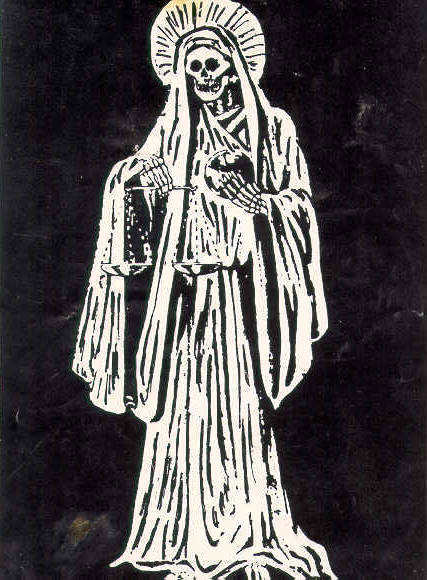
Santa Muerte almost always appears as a female skeletal figure, clad in a long robe and holding one or more objects, usually a scythe and a globe. Her robe can be of any color, as more specific images of the figure vary widely from devotee to devotee and according to the ritual being performed or the petition being made.
Her present day following was first reported in Mexico by American anthropologists in the 1940s and was an occult practice until the early 2000s. Most prayers and other rituals have been traditionally performed privately at home. Since the beginning of the 21st century, worship has become more public, starting in Mexico City after a believer named Enriqueta Romero founded her famous Mexico City shrine in 2001. The number of believers in Santa Muerte has grown over the past two decades[when?] to an estimated 12 million followers who are concentrated in Mexico, Central America, and the United States, with a smaller contingent of followers in South America, Canada and Europe. Santa Muerte has two similar male counterparts in Latin America, the skeletal folk saints San La Muerte of Argentina and Paraguay and Rey Pascual of Guatemala and Chiapas, Mexico. According to R. Andrew Chesnut, Ph.D. in Latin American history and professor of religious studies, Santa Muerte is at the center of the single fastest-growing new religious movement in the Americas.
Santa Muerte can be translated into English as either "Saint Death" or "Holy Death", although R. Andrew Chesnut, Ph.D. in Latin American history and professor of Religious studies, believes that the former is a more accurate translation because it "better reveals" her identity as a folk saint. A variant of this is Santísima Muerte, which is translated as "Most Holy Death" or "Most Saintly Death", and devotees often call her Santisma Muerte during their rituals.
Santa Muerte is also known by a wide variety of other monikers: the Skinny Lady (La Flaquita or La Flaca), the Bony Lady (la Huesuda), the White Girl (la Niña Blanca), the White Sister (la Hermana Blanca), the Pretty Girl (la Niña Bonita), the Powerful Lady (la Dama Poderosa), the Godmother (la Madrina), Señora de las Sombras ("Lady of Shadows"), Señora Blanca ("White Lady"), Señora Negra ("Black Lady"), Niña Santa ("Holy Girl"), Santa Sebastiana ("Saint Sebastienne", i.e. "Holy Sebastian") or Doña Bella Sebastiana ("Beautiful Lady Sebastienne").
After the Spanish conquest of the Aztec Empire, the worship of Mictēcacihuātl (or Mictlancihuatl), the skeletal Aztec goddess of death, diminished but was never eradicated. Judith Katia Perdigón Castañeda has found references dating to 18th-century Mexico. According to one account, recorded in the annals of the Spanish Inquisition, Chichimecs in central Mexico tied up a skeletal figure, whom they addressed as "Santa Muerte", and threatened it with lashings if it did not perform miracles or grant their wishes. Another syncretism between pre-Columbian and Christian beliefs involving death can be seen in Day of the Dead commemorations. During these commemorations, many Mexicans flock to cemeteries to sing and pray for friends and family members who have died. Children partake in the festivities by eating chocolate or candy in the shape of skulls. Perdigón Castañeda, Thompson, Kingsbury, and Chesnut have countered the argument that Santa Muerte's origins are not Indigenous proposed by Malvido, Lomnitz, and Kristensen; stating that Santa Muerte's origins derive from authentic Indigenous beliefs. For Malvido this stems from Indigenist discourse originating in the 1930s. Nevertheless, ethnoarchaeological research by Kingsbury and Chesnut as well as archival work by Perdigón Castañeda, has established clear links between pre-Columbian death deity worship and Santa Muerte supplication.
In contrast to the Day of the Dead, overt veneration of Santa Muerte remained clandestine until the early 2000s. When it went public in sporadic occurrences, reaction was often harsh, and included the desecration of shrines and altars. At the beginning of the 20th century, José Guadalupe Posada created a similar, but secular, figure by the name of Catrina, a female skeleton dressed in fancy clothing of the period. Posada began to evoke the idea that the universality of death generated a fundamental equality amongst all human beings. His paintings of skeletons in daily life and of La Catrina were meant to represent the arbitrary and violent nature of an unequal society.
Modern artists began to reestablish Posada's styles as a national artistic objective to push the limits of upper-class tastes; an example of Posada's influence is Diego Rivera's mural painting Dream of a Sunday Afternoon in the Alameda Central, which features La Catrina. The image of the skeleton and the Day of the Dead ritual that used to be held underground became commercialized and domesticated. The skeletal images became that of folklore, encapsulating Posada's viewpoint that death is an equalizer.
Hub AI
Santa Muerte AI simulator
(@Santa Muerte_simulator)
Santa Muerte
Nuestra Señora de la Santa Muerte (Spanish: [ˈnwestɾa seˈɲoɾa ðe la ˈsanta ˈmweɾte]; Spanish for Our Lady of Holy Death), often shortened to Santa Muerte, is a new religious movement, female deity, folk-Catholic saint, and folk saint in Mexican folk Catholicism and neopaganism. A personification of death, she is associated with healing, protection, and safe delivery to the afterlife by her devotees. Despite condemnation by the Catholic Church and Evangelical pastors, her following has become increasingly prominent since the turn of the 21st century.
Santa Muerte almost always appears as a female skeletal figure, clad in a long robe and holding one or more objects, usually a scythe and a globe. Her robe can be of any color, as more specific images of the figure vary widely from devotee to devotee and according to the ritual being performed or the petition being made.
Her present day following was first reported in Mexico by American anthropologists in the 1940s and was an occult practice until the early 2000s. Most prayers and other rituals have been traditionally performed privately at home. Since the beginning of the 21st century, worship has become more public, starting in Mexico City after a believer named Enriqueta Romero founded her famous Mexico City shrine in 2001. The number of believers in Santa Muerte has grown over the past two decades[when?] to an estimated 12 million followers who are concentrated in Mexico, Central America, and the United States, with a smaller contingent of followers in South America, Canada and Europe. Santa Muerte has two similar male counterparts in Latin America, the skeletal folk saints San La Muerte of Argentina and Paraguay and Rey Pascual of Guatemala and Chiapas, Mexico. According to R. Andrew Chesnut, Ph.D. in Latin American history and professor of religious studies, Santa Muerte is at the center of the single fastest-growing new religious movement in the Americas.
Santa Muerte can be translated into English as either "Saint Death" or "Holy Death", although R. Andrew Chesnut, Ph.D. in Latin American history and professor of Religious studies, believes that the former is a more accurate translation because it "better reveals" her identity as a folk saint. A variant of this is Santísima Muerte, which is translated as "Most Holy Death" or "Most Saintly Death", and devotees often call her Santisma Muerte during their rituals.
Santa Muerte is also known by a wide variety of other monikers: the Skinny Lady (La Flaquita or La Flaca), the Bony Lady (la Huesuda), the White Girl (la Niña Blanca), the White Sister (la Hermana Blanca), the Pretty Girl (la Niña Bonita), the Powerful Lady (la Dama Poderosa), the Godmother (la Madrina), Señora de las Sombras ("Lady of Shadows"), Señora Blanca ("White Lady"), Señora Negra ("Black Lady"), Niña Santa ("Holy Girl"), Santa Sebastiana ("Saint Sebastienne", i.e. "Holy Sebastian") or Doña Bella Sebastiana ("Beautiful Lady Sebastienne").
After the Spanish conquest of the Aztec Empire, the worship of Mictēcacihuātl (or Mictlancihuatl), the skeletal Aztec goddess of death, diminished but was never eradicated. Judith Katia Perdigón Castañeda has found references dating to 18th-century Mexico. According to one account, recorded in the annals of the Spanish Inquisition, Chichimecs in central Mexico tied up a skeletal figure, whom they addressed as "Santa Muerte", and threatened it with lashings if it did not perform miracles or grant their wishes. Another syncretism between pre-Columbian and Christian beliefs involving death can be seen in Day of the Dead commemorations. During these commemorations, many Mexicans flock to cemeteries to sing and pray for friends and family members who have died. Children partake in the festivities by eating chocolate or candy in the shape of skulls. Perdigón Castañeda, Thompson, Kingsbury, and Chesnut have countered the argument that Santa Muerte's origins are not Indigenous proposed by Malvido, Lomnitz, and Kristensen; stating that Santa Muerte's origins derive from authentic Indigenous beliefs. For Malvido this stems from Indigenist discourse originating in the 1930s. Nevertheless, ethnoarchaeological research by Kingsbury and Chesnut as well as archival work by Perdigón Castañeda, has established clear links between pre-Columbian death deity worship and Santa Muerte supplication.
In contrast to the Day of the Dead, overt veneration of Santa Muerte remained clandestine until the early 2000s. When it went public in sporadic occurrences, reaction was often harsh, and included the desecration of shrines and altars. At the beginning of the 20th century, José Guadalupe Posada created a similar, but secular, figure by the name of Catrina, a female skeleton dressed in fancy clothing of the period. Posada began to evoke the idea that the universality of death generated a fundamental equality amongst all human beings. His paintings of skeletons in daily life and of La Catrina were meant to represent the arbitrary and violent nature of an unequal society.
Modern artists began to reestablish Posada's styles as a national artistic objective to push the limits of upper-class tastes; an example of Posada's influence is Diego Rivera's mural painting Dream of a Sunday Afternoon in the Alameda Central, which features La Catrina. The image of the skeleton and the Day of the Dead ritual that used to be held underground became commercialized and domesticated. The skeletal images became that of folklore, encapsulating Posada's viewpoint that death is an equalizer.
Recent media