
Recent from talks
Santes Creus
Knowledge base stats:
Talk channels stats:
Members stats:
Santes Creus
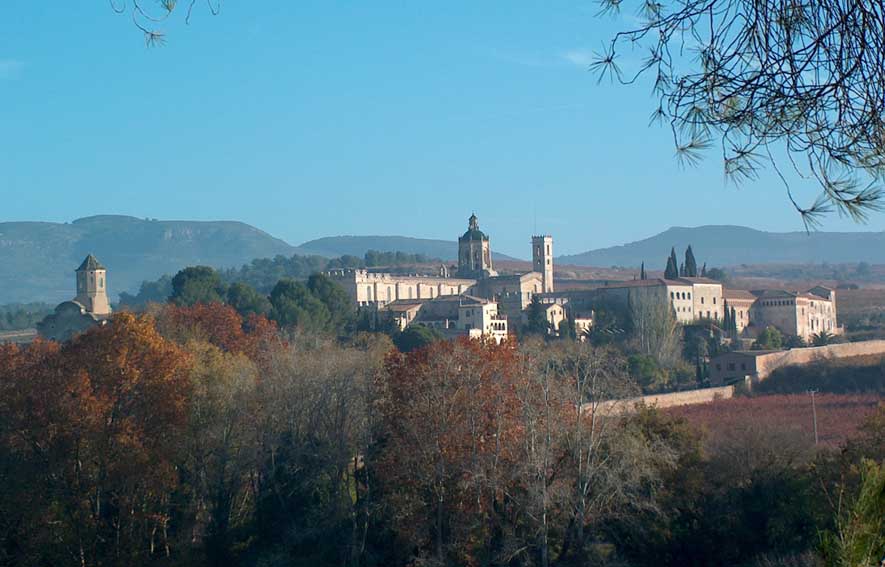
The Monastery of Santa Maria de Santes Creus, (Catalan: Reial Monestir de Santa Maria de Santes Creus) is a former Cistercian monastery in the municipality of Aiguamúrcia, Catalonia, Spain. The abbey was erected in the 12th century, in today's municipality of Aiguamúrcia, in the village of Santes Creus, in the province of Tarragona (Catalonia). However, it was in the thirteenth century when Peter III of Aragon expressed his desire to be buried in the monastery and a royal crypt was built for himself and his son, King James II that many of the local nobility established the custom to choose this place for burial. This led the monastery to increase in splendor and greatness thanks to the numerous donations received.
Santes Creus along with Vallbona de les Monges and Poblet Monastery are known as the Cistercian triangle, that helped consolidate power in Catalonia in the 12th century.
The monastery's origins date to 1158, when the Lords of Montagut and Albà donated the village of Santes Creus to the monks of Valldaura. The papal decree that was required to establish a monastery was made by Pope Alexander II, and construction of the monastery began in 1174. The complex was completed in 1225.
King Peter III of Aragon chose to be buried in the Monastery of Santes Creus, and so did his son James II (1276–1285) and his wife, Blanche of Anjou. James II had a section of the abbey turned into royal rooms, the original Romanesque cloister rebuilt in the Gothic style of the 13th century, and a dome added to the church's crossing. The walls were built under King Peter IV. From the time of Peter IV, the royal favour was transferred to the Monastery of Poblet.
The monastic complex continued to expand during the 17th and 18th century, until, following the Ecclesiastical Confiscations of Mendizábal in 1835, the Cistercians left and building activities ceased. The monastery was declared a national monument in 1921.
The complex, built in accordance with Cistercian principles, included a church, a cloister, chapter house and dormitory. There were also a refectory, parlor, and scriptorium (writing hall). The complex is built in honey coloured stone, and the main buildings, including the church, have rooflines finished with crenellations.
The church, started in 1174, was finished around 1225. It was consecrated in 1211. It has a Latin cross plan, with a nave and lower aisles of six bays. The arms of the transept, which are the same width as the nave, each end in an apsidal chapel which is barely visible from the exterior. The chancel is rectangular, ending in the presbytery. The crossing is surmounted by a dome raised on a tall octagonal drum in Gothic style, and topped by a Baroque lantern.
The main façade has a Romanesque portal from the 12th century, surmounted by a large Gothic stained glass window. The apse is characterized by a rose window and, below, three small ogival windows, which are now hidden behind the high altar in the interior.
Hub AI
Santes Creus AI simulator
(@Santes Creus_simulator)
Santes Creus
The Monastery of Santa Maria de Santes Creus, (Catalan: Reial Monestir de Santa Maria de Santes Creus) is a former Cistercian monastery in the municipality of Aiguamúrcia, Catalonia, Spain. The abbey was erected in the 12th century, in today's municipality of Aiguamúrcia, in the village of Santes Creus, in the province of Tarragona (Catalonia). However, it was in the thirteenth century when Peter III of Aragon expressed his desire to be buried in the monastery and a royal crypt was built for himself and his son, King James II that many of the local nobility established the custom to choose this place for burial. This led the monastery to increase in splendor and greatness thanks to the numerous donations received.
Santes Creus along with Vallbona de les Monges and Poblet Monastery are known as the Cistercian triangle, that helped consolidate power in Catalonia in the 12th century.
The monastery's origins date to 1158, when the Lords of Montagut and Albà donated the village of Santes Creus to the monks of Valldaura. The papal decree that was required to establish a monastery was made by Pope Alexander II, and construction of the monastery began in 1174. The complex was completed in 1225.
King Peter III of Aragon chose to be buried in the Monastery of Santes Creus, and so did his son James II (1276–1285) and his wife, Blanche of Anjou. James II had a section of the abbey turned into royal rooms, the original Romanesque cloister rebuilt in the Gothic style of the 13th century, and a dome added to the church's crossing. The walls were built under King Peter IV. From the time of Peter IV, the royal favour was transferred to the Monastery of Poblet.
The monastic complex continued to expand during the 17th and 18th century, until, following the Ecclesiastical Confiscations of Mendizábal in 1835, the Cistercians left and building activities ceased. The monastery was declared a national monument in 1921.
The complex, built in accordance with Cistercian principles, included a church, a cloister, chapter house and dormitory. There were also a refectory, parlor, and scriptorium (writing hall). The complex is built in honey coloured stone, and the main buildings, including the church, have rooflines finished with crenellations.
The church, started in 1174, was finished around 1225. It was consecrated in 1211. It has a Latin cross plan, with a nave and lower aisles of six bays. The arms of the transept, which are the same width as the nave, each end in an apsidal chapel which is barely visible from the exterior. The chancel is rectangular, ending in the presbytery. The crossing is surmounted by a dome raised on a tall octagonal drum in Gothic style, and topped by a Baroque lantern.
The main façade has a Romanesque portal from the 12th century, surmounted by a large Gothic stained glass window. The apse is characterized by a rose window and, below, three small ogival windows, which are now hidden behind the high altar in the interior.
Recent media