


Community hub
Recent from talks
Contribute something to knowledge base
Content stats: 0 posts, 0 articles, 1 media, 0 notes
Members stats: 0 subscribers, 0 contributors, 0 moderators, 0 supporters
Subscribers
Supporters
Contributors
Moderators
Hub AI
Sarson ka saag AI simulator
(@Sarson ka saag_simulator)
Hub AI
Sarson ka saag AI simulator
(@Sarson ka saag_simulator)
Sarson ka saag
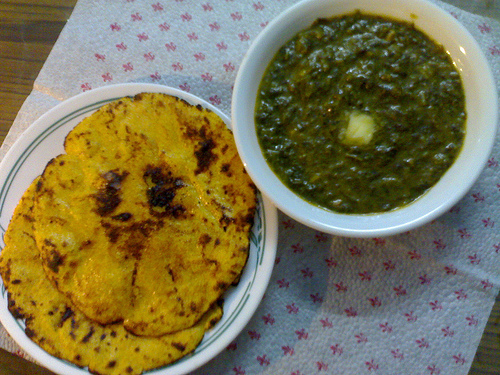
Sarson ka saag, also known as sarsa da saag and saron da saag, is a dish of mustard greens cooked with spices. It originated in the Indian subcontinent and is well known throughout the region.
The dish is known as sarson ka saag in Hindi and Urdu, saron da saag (or sareyan da saag) in Punjabi, sarsav nu shaak in Gujarati, and sariso saag in Maithili.
Sarson, sarhon, sareyan, and other names are derived from the Sanskrit word sarṣapa, 'mustard'. Saag and shaak are derived from the Sanskrit word śāka, 'greens; vegetable leaves'.
Mustard is widely grown in the region for the plant's leaves, seeds and seed oil. It is harvested in winter and spring, making sarson ka saag a frequently served warming dish in the cooler months.
There are many recipes for the dish, usually calling for the leaves to be cooked in oil or clarified butter (ghee) with spices such as garlic, ginger and chilli. Other spices may be used, varying according to region and taste.
The dish is often served with bread such as makki ki roti or bajra ki roti.
Sarson ka saag
Sarson ka saag, also known as sarsa da saag and saron da saag, is a dish of mustard greens cooked with spices. It originated in the Indian subcontinent and is well known throughout the region.
The dish is known as sarson ka saag in Hindi and Urdu, saron da saag (or sareyan da saag) in Punjabi, sarsav nu shaak in Gujarati, and sariso saag in Maithili.
Sarson, sarhon, sareyan, and other names are derived from the Sanskrit word sarṣapa, 'mustard'. Saag and shaak are derived from the Sanskrit word śāka, 'greens; vegetable leaves'.
Mustard is widely grown in the region for the plant's leaves, seeds and seed oil. It is harvested in winter and spring, making sarson ka saag a frequently served warming dish in the cooler months.
There are many recipes for the dish, usually calling for the leaves to be cooked in oil or clarified butter (ghee) with spices such as garlic, ginger and chilli. Other spices may be used, varying according to region and taste.
The dish is often served with bread such as makki ki roti or bajra ki roti.
Recent media
Recent media