
Recent from talks
Ghee
Knowledge base stats:
Talk channels stats:
Members stats:
Ghee
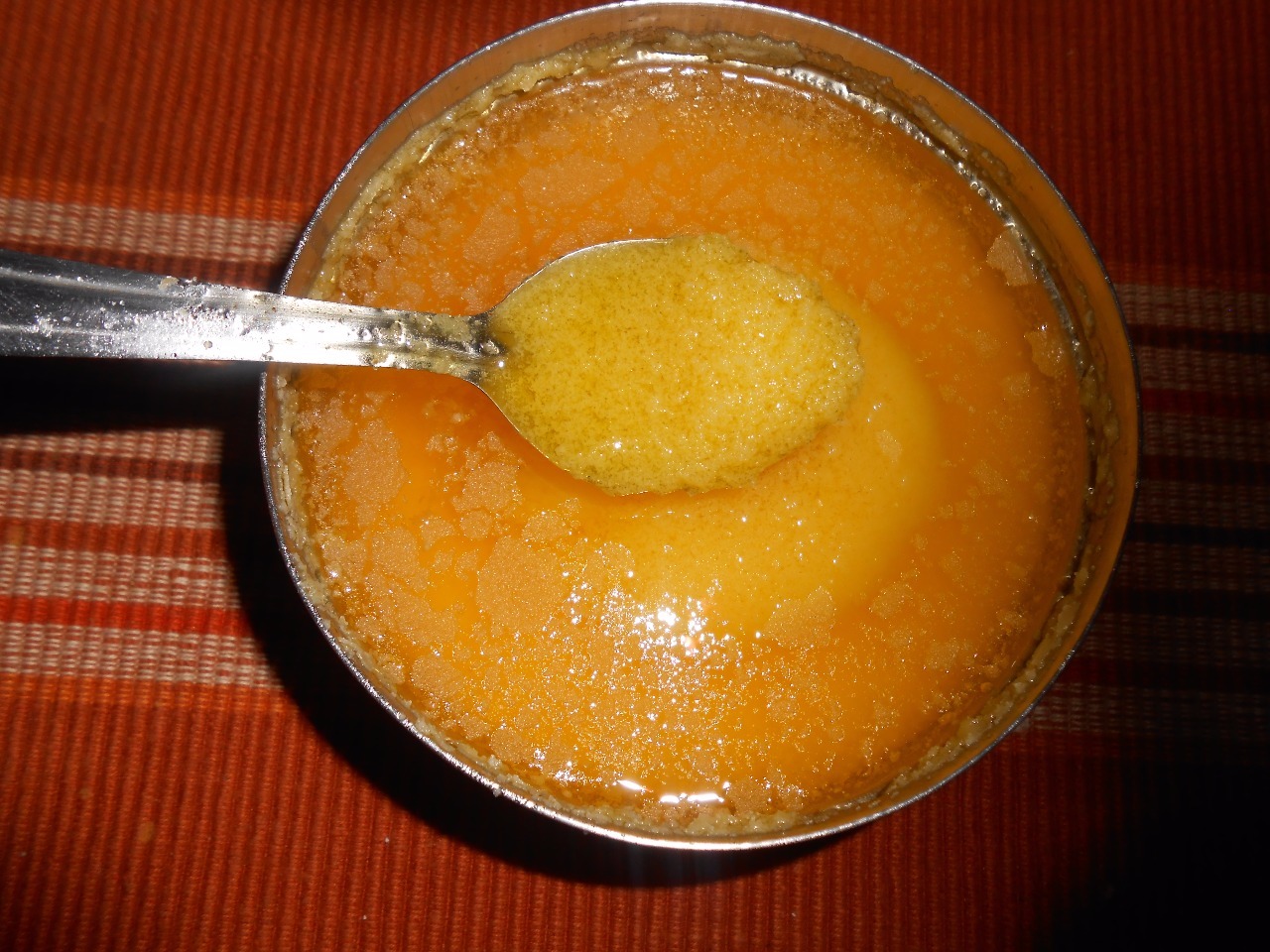
Ghee is a type of clarified butter, originating from India. It is commonly used for cooking, as a traditional medicine, and for Hindu religious rituals.
Ghee is typically prepared by simmering butter, skimming any impurities from the surface, then pouring and retaining the clear liquid fat while discarding the solid residue that settles at the bottom. Spices can be added for flavour. The texture, colour, and taste of ghee depend on the quality of the butter, the milk used in the process, and the duration of boiling.
The word ghee is borrowed from the Hindi word घी (ghī), which comes from Sanskrit: घृत (ghṛta-, IPA: [ɡʱr̩tɐ]) 'clarified butter'; traditionally derived from the root घृ, ghṛ-, 'to sprinkle', and so cognate with the Ancient Greek word χριστός (khristós, 'rubbed, anointed'), from which the English word Christ is derived.
Traditionally, ghee is made from bovine milk, either cow or water buffalo, and has been used in rituals since the Vedic period. It is a sacred requirement in Vedic yajña and homa (fire rituals), through the medium of Agni (fire) to offer oblations to various deities (See: Yajurveda).
Fire rituals are utilised for ceremonies such as marriage and funerals. Ghee is required in Vedic worship of mūrtis (divine deities), with aarti (offering of ghee lamp) called diyā or dīpa and for Pañcāmṛta (Panchamruta) where ghee along with mishri, honey, milk, and dahi (curd) is used for bathing the deities on the appearance day of Krishna on Janmashtami, Śiva (Shiva) on Mahā-śivarātrī (Maha Shivaratri). There is a hymn to ghee. In the Mahabharata, the Kaurava were born from pots of ghee.
Ghee is also used in bhang in order to heat the cannabis to cause decarboxylation, making the drink psychoactive.
In Buddhist scripture, stages of dairy production are used as metaphors for stages of enlightenment. The highest-stage product, sarpir-maṇḍa, is theorised to be ghee or clarified butter.
Ghee is common in cuisines from the Indian subcontinent, including traditional rice preparations (such as biryani). In Maharashtra, polis or Indian flatbreads are accompanied with ghee. In Rajasthan, ghee often accompanies baati. All over North India, roti is served with ghee. In Karnataka and Tamil Nadu, ghee is provided alongside dosa and kesari bhath. In Bengal (both West Bengal and Bangladesh) and Gujarat, khichdi is a traditional evening meal of rice with lentils, cooked in a curry made from dahi (curd), cumin seeds, curry leaves, cornflour, turmeric, garlic, salt and ghee. It is also an ingredient in kadhi and Indian sweets, such as Mysore pak, and varieties of halva and laddu. Indian restaurants typically incorporate large amounts of ghee, sometimes brushing naan and roti with it, either during preparation or just before serving. In the state of Odisha ghee is widely used in Odia dishes such as khechedi and dalma. The sattvic food prepared in most temples in Odisha has ghee as a major ingredient in its culinary tradition. Ghee is used in South Indian cuisine for tempering curries and in the preparation of rice dishes and sweets. North Indians also add ghee to rice before eating it with pickles, dal and curries. North Indians are among the biggest consumers of ghee. Vegetarian dishes of Andhra Pradesh especially use ghee for the preparation of savoury and sweet dishes alike. Ghee is important to traditional North Indian cuisine, with parathas, daals and curries often using ghee instead of oil for a richer taste. The type of ghee, in terms of animal source, tends to vary with the dish; for example, ghee prepared from cow's milk (Bengali: গাওয়া ঘী, gaoa ghi) is traditional with rice or roti or as a finishing drizzle atop a curry or dal, whereas buffalo milk ghee is more typical for general cooking purposes.
Hub AI
Ghee AI simulator
(@Ghee_simulator)
Ghee
Ghee is a type of clarified butter, originating from India. It is commonly used for cooking, as a traditional medicine, and for Hindu religious rituals.
Ghee is typically prepared by simmering butter, skimming any impurities from the surface, then pouring and retaining the clear liquid fat while discarding the solid residue that settles at the bottom. Spices can be added for flavour. The texture, colour, and taste of ghee depend on the quality of the butter, the milk used in the process, and the duration of boiling.
The word ghee is borrowed from the Hindi word घी (ghī), which comes from Sanskrit: घृत (ghṛta-, IPA: [ɡʱr̩tɐ]) 'clarified butter'; traditionally derived from the root घृ, ghṛ-, 'to sprinkle', and so cognate with the Ancient Greek word χριστός (khristós, 'rubbed, anointed'), from which the English word Christ is derived.
Traditionally, ghee is made from bovine milk, either cow or water buffalo, and has been used in rituals since the Vedic period. It is a sacred requirement in Vedic yajña and homa (fire rituals), through the medium of Agni (fire) to offer oblations to various deities (See: Yajurveda).
Fire rituals are utilised for ceremonies such as marriage and funerals. Ghee is required in Vedic worship of mūrtis (divine deities), with aarti (offering of ghee lamp) called diyā or dīpa and for Pañcāmṛta (Panchamruta) where ghee along with mishri, honey, milk, and dahi (curd) is used for bathing the deities on the appearance day of Krishna on Janmashtami, Śiva (Shiva) on Mahā-śivarātrī (Maha Shivaratri). There is a hymn to ghee. In the Mahabharata, the Kaurava were born from pots of ghee.
Ghee is also used in bhang in order to heat the cannabis to cause decarboxylation, making the drink psychoactive.
In Buddhist scripture, stages of dairy production are used as metaphors for stages of enlightenment. The highest-stage product, sarpir-maṇḍa, is theorised to be ghee or clarified butter.
Ghee is common in cuisines from the Indian subcontinent, including traditional rice preparations (such as biryani). In Maharashtra, polis or Indian flatbreads are accompanied with ghee. In Rajasthan, ghee often accompanies baati. All over North India, roti is served with ghee. In Karnataka and Tamil Nadu, ghee is provided alongside dosa and kesari bhath. In Bengal (both West Bengal and Bangladesh) and Gujarat, khichdi is a traditional evening meal of rice with lentils, cooked in a curry made from dahi (curd), cumin seeds, curry leaves, cornflour, turmeric, garlic, salt and ghee. It is also an ingredient in kadhi and Indian sweets, such as Mysore pak, and varieties of halva and laddu. Indian restaurants typically incorporate large amounts of ghee, sometimes brushing naan and roti with it, either during preparation or just before serving. In the state of Odisha ghee is widely used in Odia dishes such as khechedi and dalma. The sattvic food prepared in most temples in Odisha has ghee as a major ingredient in its culinary tradition. Ghee is used in South Indian cuisine for tempering curries and in the preparation of rice dishes and sweets. North Indians also add ghee to rice before eating it with pickles, dal and curries. North Indians are among the biggest consumers of ghee. Vegetarian dishes of Andhra Pradesh especially use ghee for the preparation of savoury and sweet dishes alike. Ghee is important to traditional North Indian cuisine, with parathas, daals and curries often using ghee instead of oil for a richer taste. The type of ghee, in terms of animal source, tends to vary with the dish; for example, ghee prepared from cow's milk (Bengali: গাওয়া ঘী, gaoa ghi) is traditional with rice or roti or as a finishing drizzle atop a curry or dal, whereas buffalo milk ghee is more typical for general cooking purposes.
Recent media