
Recent from talks
Satay
Knowledge base stats:
Talk channels stats:
Members stats:
Satay
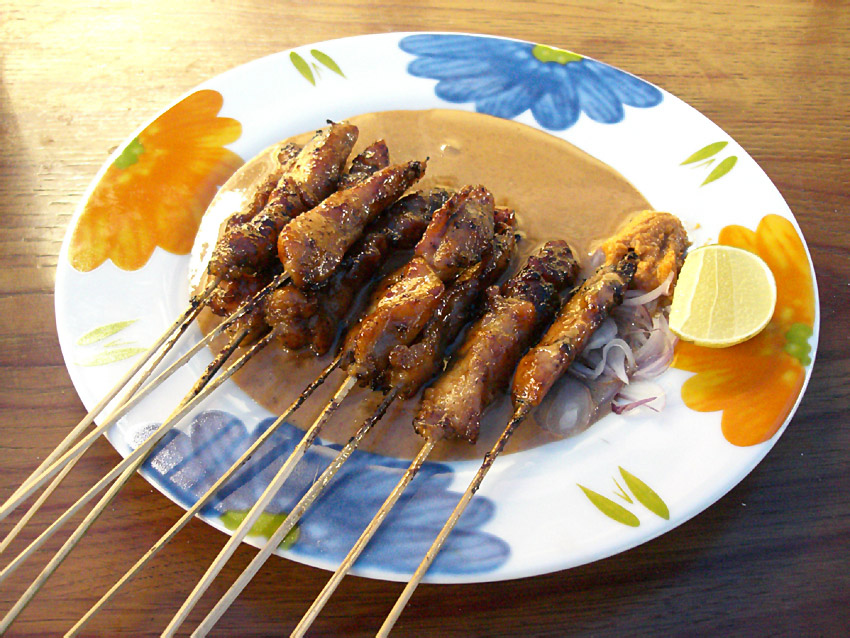
Satay (/ˈsɑːteɪ/ ⓘ SAH-tay, in the US also /ˈsæteɪ/ ⓘ SA-tay), or sate is a Southeast Asian dish consisting of small pieces of seasoned meat, seafood or vegetables skewered on sticks and grilled over charcoal. It is typically served with a sauce, most commonly peanut-based and accompanied by rice cakes, cucumber or pickled vegetables. Common ingredients include chicken, beef, goat, pork and seafood, while regional and vegetarian variations are also found.
The dish evolved through a blend of foreign and local culinary influences. Middle Eastern kebabs introduced by Muslim traders, South Asian cooking techniques brought by Tamil and Gujarati merchants, and Chinese practices such as bamboo skewering and bite-sized portions were adapted in the port cities of Java, Sumatra and the Malay Peninsula. Combined with the use of regional ingredients and spices including lemongrass, turmeric, galangal, and peanuts, these influences gave rise to a distinctly Southeast Asian style of grilled skewered meat.
Satay is widely consumed across Indonesia, Malaysia, Singapore, Brunei, Thailand and the southern Philippines, where it forms part of everyday meals, street food and festive occasions. Regional adaptations reflect local ingredients and cooking traditions, incorporating elements such as sweet soy sauce, coconut milk, turmeric and spice pastes, often served with ketupat, lontong or pickled condiments. The dish is prepared by hawkers, restaurants and home cooks alike, and has become a familiar feature of night markets and public celebrations.
Through migration and cultural exchange, satay has gained international recognition, with notable adaptations in the Netherlands, Suriname, South Africa and Sri Lanka. It is regarded as a national dish in Indonesia and Malaysia and remains a prominent element of hawker and street-food culture in Singapore, Thailand and Brunei. The dish is also maintained within overseas communities such as the Indo-Dutch in the Netherlands, the Sri Lankan Malays and the Javanese Surinamese, where it continues to represent a link to their Southeast Asian culinary heritage.
According to the Oxford English Dictionary and the Collins English Dictionary, the English word satay derives from the Malay and Indonesian word satai, also taken from saté or sate in Javanese, and is ultimately traced to the Tamil word catai (சதை), a regional variant of tacai meaning "flesh". The Cambridge English Dictionary defines satay more generally as a Southeast Asian dish of small pieces of meat or fish cooked on skewers and typically served with a spicy peanut sauce. Alternative explanations for the word’s origin include a possible derivation from the Hokkien or Min Nan phrase sa tae bak (三疊肉), meaning "three pieces of meat".
The culinary technique underlying satay is widely regarded as the result of multiple streams of foreign influence that reached Maritime Southeast Asia through long-distance trade and migration. The skewered and grilled meat dishes of the Middle East, particularly Turkish and Arab kebabs, spread eastward along established trade routes. Muslim merchants introduced these practices to South Asia, where they were adapted into local culinary traditions. Tamil and Gujarati Muslim traders, who were active in the Indian Ocean trading networks, prepared seasoned and grilled meats that bore similarities to kebabs, and these foodways accompanied them when they established communities in Southeast Asian port cities.
Chinese migrants also contributed to the evolution of the dish. Their culinary techniques emphasised the use of bamboo skewers and the preparation of meat in small, bite-sized portions suited to quick grilling over charcoal fires. These methods complemented South Asian and Middle Eastern influences, resulting in a hybrid style of preparation that was well suited to the demands of street vending and communal dining in the region.
By the early modern period, the combined influences of Middle Eastern, South Asian and Chinese food traditions had taken root in the Malay archipelago and surrounding regions. Java, Sumatra and the Malay Peninsula were central nodes of maritime trade, attracting Muslim merchants from Gujarat, Tamil Nadu and the Arabian Peninsula, alongside large communities of Chinese migrants. In these multicultural port towns, local populations were exposed to diverse methods of preparing and seasoning meat.
Hub AI
Satay AI simulator
(@Satay_simulator)
Satay
Satay (/ˈsɑːteɪ/ ⓘ SAH-tay, in the US also /ˈsæteɪ/ ⓘ SA-tay), or sate is a Southeast Asian dish consisting of small pieces of seasoned meat, seafood or vegetables skewered on sticks and grilled over charcoal. It is typically served with a sauce, most commonly peanut-based and accompanied by rice cakes, cucumber or pickled vegetables. Common ingredients include chicken, beef, goat, pork and seafood, while regional and vegetarian variations are also found.
The dish evolved through a blend of foreign and local culinary influences. Middle Eastern kebabs introduced by Muslim traders, South Asian cooking techniques brought by Tamil and Gujarati merchants, and Chinese practices such as bamboo skewering and bite-sized portions were adapted in the port cities of Java, Sumatra and the Malay Peninsula. Combined with the use of regional ingredients and spices including lemongrass, turmeric, galangal, and peanuts, these influences gave rise to a distinctly Southeast Asian style of grilled skewered meat.
Satay is widely consumed across Indonesia, Malaysia, Singapore, Brunei, Thailand and the southern Philippines, where it forms part of everyday meals, street food and festive occasions. Regional adaptations reflect local ingredients and cooking traditions, incorporating elements such as sweet soy sauce, coconut milk, turmeric and spice pastes, often served with ketupat, lontong or pickled condiments. The dish is prepared by hawkers, restaurants and home cooks alike, and has become a familiar feature of night markets and public celebrations.
Through migration and cultural exchange, satay has gained international recognition, with notable adaptations in the Netherlands, Suriname, South Africa and Sri Lanka. It is regarded as a national dish in Indonesia and Malaysia and remains a prominent element of hawker and street-food culture in Singapore, Thailand and Brunei. The dish is also maintained within overseas communities such as the Indo-Dutch in the Netherlands, the Sri Lankan Malays and the Javanese Surinamese, where it continues to represent a link to their Southeast Asian culinary heritage.
According to the Oxford English Dictionary and the Collins English Dictionary, the English word satay derives from the Malay and Indonesian word satai, also taken from saté or sate in Javanese, and is ultimately traced to the Tamil word catai (சதை), a regional variant of tacai meaning "flesh". The Cambridge English Dictionary defines satay more generally as a Southeast Asian dish of small pieces of meat or fish cooked on skewers and typically served with a spicy peanut sauce. Alternative explanations for the word’s origin include a possible derivation from the Hokkien or Min Nan phrase sa tae bak (三疊肉), meaning "three pieces of meat".
The culinary technique underlying satay is widely regarded as the result of multiple streams of foreign influence that reached Maritime Southeast Asia through long-distance trade and migration. The skewered and grilled meat dishes of the Middle East, particularly Turkish and Arab kebabs, spread eastward along established trade routes. Muslim merchants introduced these practices to South Asia, where they were adapted into local culinary traditions. Tamil and Gujarati Muslim traders, who were active in the Indian Ocean trading networks, prepared seasoned and grilled meats that bore similarities to kebabs, and these foodways accompanied them when they established communities in Southeast Asian port cities.
Chinese migrants also contributed to the evolution of the dish. Their culinary techniques emphasised the use of bamboo skewers and the preparation of meat in small, bite-sized portions suited to quick grilling over charcoal fires. These methods complemented South Asian and Middle Eastern influences, resulting in a hybrid style of preparation that was well suited to the demands of street vending and communal dining in the region.
By the early modern period, the combined influences of Middle Eastern, South Asian and Chinese food traditions had taken root in the Malay archipelago and surrounding regions. Java, Sumatra and the Malay Peninsula were central nodes of maritime trade, attracting Muslim merchants from Gujarat, Tamil Nadu and the Arabian Peninsula, alongside large communities of Chinese migrants. In these multicultural port towns, local populations were exposed to diverse methods of preparing and seasoning meat.
Recent media