
Recent from talks
Saya San
Knowledge base stats:
Talk channels stats:
Members stats:
Saya San
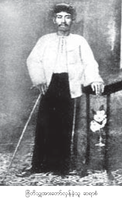
Saya San (Burmese: ဆရာစံ, Burmese pronunciation: [sʰəjà sã]; 24 October 1876 – 28 November 1931), born with the name Yar Kyaw, was a Burmese physician and monk who led the Saya San Rebellion (1930–1932) against British colonial rule in Burma (now known as Myanmar). Saya San launched a peasant revolt, proclaiming himself the king and organizing the "Galon Army". The colonial government suppressed the rebellion and Saya San fled to the Shan Hills, but he was captured in August 1931 and executed on 28 November 1931. This uprising is regarded as a pivotal anti-colonial movement in Southeast Asia. Saya San and the rebellion continue to be important subjects of academic study, especially within Asian historical research.
Saya San was born on 24 October 1876 in Shwebo, a center of monarchist sentiment and the birthplace of the Konbaung dynasty, which ruled Myanmar (Burma) from 1752 until the Third Anglo-Burmese War in 1886. His parents, U Kyaye and Daw Hpet, lived in Thayetkon with their five children. Exposed to Buddhism early on at the local monastery and later at Hpo Hmu monastery, he left for Nga Kaung Inn to pursue mat and basket selling. He married Ma Kay and had two children, Ko Po Thin and Ma Sein. Facing economic hardship, he moved to Moulmein in Lower Burma to look for better opportunities. He worked as a carpenter, fortuneteller, and traditional healer, authoring treatises questioning Western medicine.
Saya San's transition to political activism is unclear, but it is believed he joined the General Council of Burmese Associations (GCBA) in the 1920s. Rising through the ranks, he chaired a commission in 1924 investigating peasant living conditions.
Also known as the Galon Rebellion and Galon Peasant Rebellion.
In the 9th century, the Tibeto-Burman speaking Burmese began migrating to the Irrawaddy River from present-day Yunnan's Nanzhao Kingdom and then established the Pagan Kingdom in 1057. The prerogative influence of the Pagan dynasty over the region of modern-day Myanmar began to wane in the 13th century. Kublai Khan's Mongol forces invaded northern Burma and sacked the city of Pagan itself, and the kingdom fell in 1287. In the second half of the 16th century, the Taungoo dynasty reunified the country, and founded what was briefly the largest empire in the history of Southeast Asia. In the 18th century, the Konbaung dynasty restored the Burmese hegemony and went to war with its neighbors. The kingdom fought three wars with the British. In 1885, the kingdom was defeated in the Third Anglo-Burmese War, and King Thebaw was deported to India. Eventually, Burma was fully annexed into the British Raj in 1886, but the colonial government authorities immediately faced several uprisings that erupted throughout the former Burmese Kingdom, challenging sovereignty.
By the 1890s, colonial officials had determined that the main pacification campaigns were successful, and they could concentrate on building a socio-economic infrastructure that supported their interest in the vast tea, mineral, and agricultural bounties in the colony. Attached as a province of India, British Burma was subjected to administrative policies established in New Delhi as well as the vast array of procedural structures that characterized the Indian Civil Service. The new dominions were divided into districts and assigned a commissioner with a small support staff. Through the prism and experience of British India, the Burmese people, culture, language, and history were constructed by imperial surveys that now sought to map the new territories. Indigenous healing practices, rituals, folktales, notions of authority, and village life were organized and categorized according to how well the district officer understood what he was observing. When the British government annexed the Kingdom of Burma in 1885–1886, they transferred the Burmese royal throne to a museum in Calcutta. Meanwhile, the Palace of Mandalay was converted into a gentlemen's club, which was seen as offensive by the Burmese. Colonial rule changed the social landscape of ancient Burma in a manner that caused much resentment.
The colonial government had faced numerous outbreaks of resistance movements throughout 1885–1895. These opposition movements became more intensive and extensive. Some of these rebellions were led by former members of the court, like the Myinzaing Prince son of King Mindon, who continued to wield considerable influence over troops and villagers in provincial centers that had once been in alliance with the throne. Other pockets of resistance were led by local headmen and monks but were limited by size and scope. Furthermore, these minor revolts were often short-lived either due to a lack of support or the overwhelming technical advantage of the colonial government.
In the late 1890s, a small group of Buddhist associations with contemporary forms of organization and structure were founded by lay members in an effort to preserve the religion and its place in society.
Hub AI
Saya San AI simulator
(@Saya San_simulator)
Saya San
Saya San (Burmese: ဆရာစံ, Burmese pronunciation: [sʰəjà sã]; 24 October 1876 – 28 November 1931), born with the name Yar Kyaw, was a Burmese physician and monk who led the Saya San Rebellion (1930–1932) against British colonial rule in Burma (now known as Myanmar). Saya San launched a peasant revolt, proclaiming himself the king and organizing the "Galon Army". The colonial government suppressed the rebellion and Saya San fled to the Shan Hills, but he was captured in August 1931 and executed on 28 November 1931. This uprising is regarded as a pivotal anti-colonial movement in Southeast Asia. Saya San and the rebellion continue to be important subjects of academic study, especially within Asian historical research.
Saya San was born on 24 October 1876 in Shwebo, a center of monarchist sentiment and the birthplace of the Konbaung dynasty, which ruled Myanmar (Burma) from 1752 until the Third Anglo-Burmese War in 1886. His parents, U Kyaye and Daw Hpet, lived in Thayetkon with their five children. Exposed to Buddhism early on at the local monastery and later at Hpo Hmu monastery, he left for Nga Kaung Inn to pursue mat and basket selling. He married Ma Kay and had two children, Ko Po Thin and Ma Sein. Facing economic hardship, he moved to Moulmein in Lower Burma to look for better opportunities. He worked as a carpenter, fortuneteller, and traditional healer, authoring treatises questioning Western medicine.
Saya San's transition to political activism is unclear, but it is believed he joined the General Council of Burmese Associations (GCBA) in the 1920s. Rising through the ranks, he chaired a commission in 1924 investigating peasant living conditions.
Also known as the Galon Rebellion and Galon Peasant Rebellion.
In the 9th century, the Tibeto-Burman speaking Burmese began migrating to the Irrawaddy River from present-day Yunnan's Nanzhao Kingdom and then established the Pagan Kingdom in 1057. The prerogative influence of the Pagan dynasty over the region of modern-day Myanmar began to wane in the 13th century. Kublai Khan's Mongol forces invaded northern Burma and sacked the city of Pagan itself, and the kingdom fell in 1287. In the second half of the 16th century, the Taungoo dynasty reunified the country, and founded what was briefly the largest empire in the history of Southeast Asia. In the 18th century, the Konbaung dynasty restored the Burmese hegemony and went to war with its neighbors. The kingdom fought three wars with the British. In 1885, the kingdom was defeated in the Third Anglo-Burmese War, and King Thebaw was deported to India. Eventually, Burma was fully annexed into the British Raj in 1886, but the colonial government authorities immediately faced several uprisings that erupted throughout the former Burmese Kingdom, challenging sovereignty.
By the 1890s, colonial officials had determined that the main pacification campaigns were successful, and they could concentrate on building a socio-economic infrastructure that supported their interest in the vast tea, mineral, and agricultural bounties in the colony. Attached as a province of India, British Burma was subjected to administrative policies established in New Delhi as well as the vast array of procedural structures that characterized the Indian Civil Service. The new dominions were divided into districts and assigned a commissioner with a small support staff. Through the prism and experience of British India, the Burmese people, culture, language, and history were constructed by imperial surveys that now sought to map the new territories. Indigenous healing practices, rituals, folktales, notions of authority, and village life were organized and categorized according to how well the district officer understood what he was observing. When the British government annexed the Kingdom of Burma in 1885–1886, they transferred the Burmese royal throne to a museum in Calcutta. Meanwhile, the Palace of Mandalay was converted into a gentlemen's club, which was seen as offensive by the Burmese. Colonial rule changed the social landscape of ancient Burma in a manner that caused much resentment.
The colonial government had faced numerous outbreaks of resistance movements throughout 1885–1895. These opposition movements became more intensive and extensive. Some of these rebellions were led by former members of the court, like the Myinzaing Prince son of King Mindon, who continued to wield considerable influence over troops and villagers in provincial centers that had once been in alliance with the throne. Other pockets of resistance were led by local headmen and monks but were limited by size and scope. Furthermore, these minor revolts were often short-lived either due to a lack of support or the overwhelming technical advantage of the colonial government.
In the late 1890s, a small group of Buddhist associations with contemporary forms of organization and structure were founded by lay members in an effort to preserve the religion and its place in society.
Recent media