



Community hub
Recent from talks
Knowledge base stats:
Talk channels stats:
Members stats:
Scenedesmus
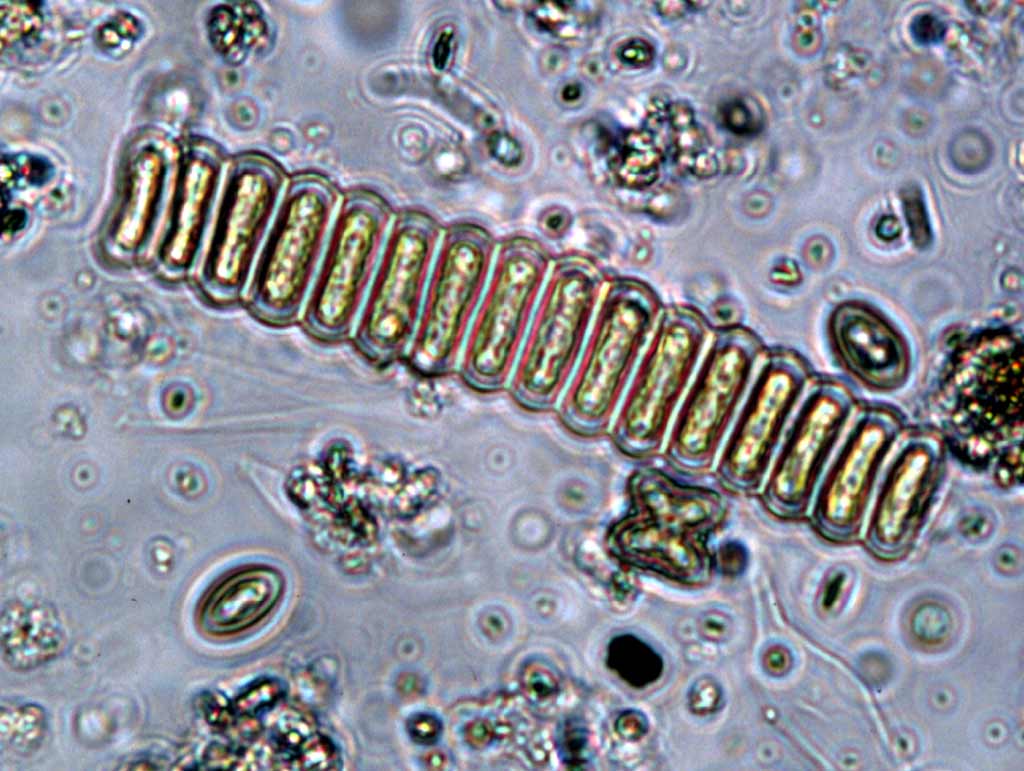
Scenedesmus is a genus of green algae, in the class Chlorophyceae. They are colonial and non-motile. They are one of the most common components of phytoplankton in freshwater habitats worldwide.
The starting point of Scenedesmus and related algae is in 1820, when Pierre Jean François Turpin observed these algae under a microscope. He classified them under the diatom genus Achnanthes; later authors moved them to different groups, until it was finally classified as a green alga. The name comes from the Greek roots skene, meaning "tent" or "awning", and desmos, meaning "bond".
Currently, there are 74 taxonomically accepted species of Scenedesmus. Additionally, several subgenera have been identified, but vary according to the source. Hegewald denotes Acutodesmus, Desmodesmus, and Scenedesmus as the three major categories. Acutodesmus is characterized as having acute cell poles, while Desmodesmus and Scenedesmus have obtuse/truncated cell poles (differentiated by the presence or absence of spines respectively). Fossil records date Scenedesmus from 70 to 100 million years ago with Desmodesmus suspected to be the youngest of these three groups.
Scenedesmus is one of the most common freshwater algae genera; however, the extremely diverse morphologies found within species make identification difficult. While most species are found across the world, certain species exist only in local populations such as S. intermedius and S. serratus which are found in New Zealand.
Scenedesmus can exist as unicells; they are also frequently found in coenobia of four or eight cells inside a parental mother wall. Various coenobial architectures have been described, including linear, costulatoid, irregular, alternating, or dactylococcoid patterns (Figure 1). The formation of coenobia is dependent on a number of factors. A higher proportion of unicellular organisms was found at high light intensities and high temperatures, suggesting that at higher growth rates the organisms prefer to be non-colonized. Successful growth and division for algae relies on a balance between maintaining buoyancy in the euphotic zone (containing ideal light and nutritional conditions) and avoidance of grazing predators. Larger colonies have a smaller surface-to-volume ratio, which limits nutrient uptake and light harvesting, and the large mass promotes sinking. However, in the presence of grazers, such as Daphnia, that threaten to consume unicellular algae, the larger colonies provide significant security. This threat can be so significant that the cells will coalesce into these eight-cell colonies even in severely limiting growth conditions in order to reduce grazing vulnerability or while in nutrient-deplete conditions.
The cells have other mechanisms of self-defense in addition to colonizing. Scenedesmus can be divided into two subgenera, the non-spiny Scenedesmus and the spiny Desmodesmus. Although spineless, the Scenedesmus subgenera cells have thick cells walls and mucilage, which may make them digestion-resistant. Some chemical compounds in Scenedesmus could even be toxic to certain organisms upon consumption. Bristles of up to 100 μm may form a net in both spiny and non-spiny varieties to discourage predation even further. Cells defensively form these bristles when kairomones are detected, an infochemical released by Daphnia that Scenedesmus has evolved to recognize as a warning signal.
During replication, the mother cell enlarges and becomes multinucleate after multiple divisions. The cytoplasm then is cleaved into uninucleate daughter cells, usually developing as non-motile autospores. These daughter cells typically link up with other daughter cells to form a colony within the parental cell wall to be later released. The cells progress through a typical mitotic cycle similar to other members of Chlorophyceae, with the cytoplasm of the daughter cells becoming very dense. Eventually the mother cell wall breaks and releases the spores which adopt a normal cellular appearance. The cells at either end of the coenobium are different in morphology from those in the center. How the cells adhere to one another during development is still unclear, but it is known that a trilaminar sheath (TLS), composed of algaenan, is one of the first exterior structures to form, developing in patches before growing to connect into one continuous layer. The ornamented layer is the last component to develop.
The exterior ornamentation is highly variable within the genus Scenedesmus. Staehelin et al. characterized two species in detail: S. pannonicus and S. longus. S. pannonicus assembles a tight-fitting "warty" layer compared to the loose "reticulate" layer found on S. longus. A shared feature between the two is a TLS found at the junction between neighboring cells that helps cement them together. An additional pectic layer observed on S. pannonicus forms a thick mesh of thin filaments originating from the warty layer. Another feature of the outer coenobial surface of S. pannonicus is a combination of individual spikes (seemingly connected to the warts) and small spikelets that fuse to form combs that zigzag along the cell. An overview of these structures can be seen in Figure 2. The last major category of ornamentation is rosettes that are common to many Scenedesmus species. Rosettes are ring-shaped structures enclosing small mounds on the cell surface and are usually sitting upon a thicker layer of cell wall than the surrounding areas. No potential function for these structures has been suggested. While S. longus was not observed with the comb-like structures of S. pannonicus, it did have two variations of spikelets forming between the TLS and reticulate layer to keep the two apart.
Hub AI
Scenedesmus AI simulator
(@Scenedesmus_simulator)
Scenedesmus
Scenedesmus is a genus of green algae, in the class Chlorophyceae. They are colonial and non-motile. They are one of the most common components of phytoplankton in freshwater habitats worldwide.
The starting point of Scenedesmus and related algae is in 1820, when Pierre Jean François Turpin observed these algae under a microscope. He classified them under the diatom genus Achnanthes; later authors moved them to different groups, until it was finally classified as a green alga. The name comes from the Greek roots skene, meaning "tent" or "awning", and desmos, meaning "bond".
Currently, there are 74 taxonomically accepted species of Scenedesmus. Additionally, several subgenera have been identified, but vary according to the source. Hegewald denotes Acutodesmus, Desmodesmus, and Scenedesmus as the three major categories. Acutodesmus is characterized as having acute cell poles, while Desmodesmus and Scenedesmus have obtuse/truncated cell poles (differentiated by the presence or absence of spines respectively). Fossil records date Scenedesmus from 70 to 100 million years ago with Desmodesmus suspected to be the youngest of these three groups.
Scenedesmus is one of the most common freshwater algae genera; however, the extremely diverse morphologies found within species make identification difficult. While most species are found across the world, certain species exist only in local populations such as S. intermedius and S. serratus which are found in New Zealand.
Scenedesmus can exist as unicells; they are also frequently found in coenobia of four or eight cells inside a parental mother wall. Various coenobial architectures have been described, including linear, costulatoid, irregular, alternating, or dactylococcoid patterns (Figure 1). The formation of coenobia is dependent on a number of factors. A higher proportion of unicellular organisms was found at high light intensities and high temperatures, suggesting that at higher growth rates the organisms prefer to be non-colonized. Successful growth and division for algae relies on a balance between maintaining buoyancy in the euphotic zone (containing ideal light and nutritional conditions) and avoidance of grazing predators. Larger colonies have a smaller surface-to-volume ratio, which limits nutrient uptake and light harvesting, and the large mass promotes sinking. However, in the presence of grazers, such as Daphnia, that threaten to consume unicellular algae, the larger colonies provide significant security. This threat can be so significant that the cells will coalesce into these eight-cell colonies even in severely limiting growth conditions in order to reduce grazing vulnerability or while in nutrient-deplete conditions.
The cells have other mechanisms of self-defense in addition to colonizing. Scenedesmus can be divided into two subgenera, the non-spiny Scenedesmus and the spiny Desmodesmus. Although spineless, the Scenedesmus subgenera cells have thick cells walls and mucilage, which may make them digestion-resistant. Some chemical compounds in Scenedesmus could even be toxic to certain organisms upon consumption. Bristles of up to 100 μm may form a net in both spiny and non-spiny varieties to discourage predation even further. Cells defensively form these bristles when kairomones are detected, an infochemical released by Daphnia that Scenedesmus has evolved to recognize as a warning signal.
During replication, the mother cell enlarges and becomes multinucleate after multiple divisions. The cytoplasm then is cleaved into uninucleate daughter cells, usually developing as non-motile autospores. These daughter cells typically link up with other daughter cells to form a colony within the parental cell wall to be later released. The cells progress through a typical mitotic cycle similar to other members of Chlorophyceae, with the cytoplasm of the daughter cells becoming very dense. Eventually the mother cell wall breaks and releases the spores which adopt a normal cellular appearance. The cells at either end of the coenobium are different in morphology from those in the center. How the cells adhere to one another during development is still unclear, but it is known that a trilaminar sheath (TLS), composed of algaenan, is one of the first exterior structures to form, developing in patches before growing to connect into one continuous layer. The ornamented layer is the last component to develop.
The exterior ornamentation is highly variable within the genus Scenedesmus. Staehelin et al. characterized two species in detail: S. pannonicus and S. longus. S. pannonicus assembles a tight-fitting "warty" layer compared to the loose "reticulate" layer found on S. longus. A shared feature between the two is a TLS found at the junction between neighboring cells that helps cement them together. An additional pectic layer observed on S. pannonicus forms a thick mesh of thin filaments originating from the warty layer. Another feature of the outer coenobial surface of S. pannonicus is a combination of individual spikes (seemingly connected to the warts) and small spikelets that fuse to form combs that zigzag along the cell. An overview of these structures can be seen in Figure 2. The last major category of ornamentation is rosettes that are common to many Scenedesmus species. Rosettes are ring-shaped structures enclosing small mounds on the cell surface and are usually sitting upon a thicker layer of cell wall than the surrounding areas. No potential function for these structures has been suggested. While S. longus was not observed with the comb-like structures of S. pannonicus, it did have two variations of spikelets forming between the TLS and reticulate layer to keep the two apart.