
Recent from talks
Daphnia
Knowledge base stats:
Talk channels stats:
Members stats:
Daphnia
Daphnia is a genus of small planktonic crustaceans, 0.2–6.0 mm (0.01–0.24 in) in length. Daphnia are members of the order Anomopoda, and are one of the several small aquatic crustaceans commonly called water fleas because their saltatory swimming style resembles the movements of fleas. Daphnia spp. live in various aquatic environments ranging from acidic swamps to freshwater lakes and ponds.
The two most commonly found species of Daphnia are D. pulex (small and most common) and D. magna (large). They are often associated with a related genus in the order Cladocera: Moina, which is in the Moinidae group instead of the Daphniidae, and is much smaller than D. pulex (roughly half the maximum length).
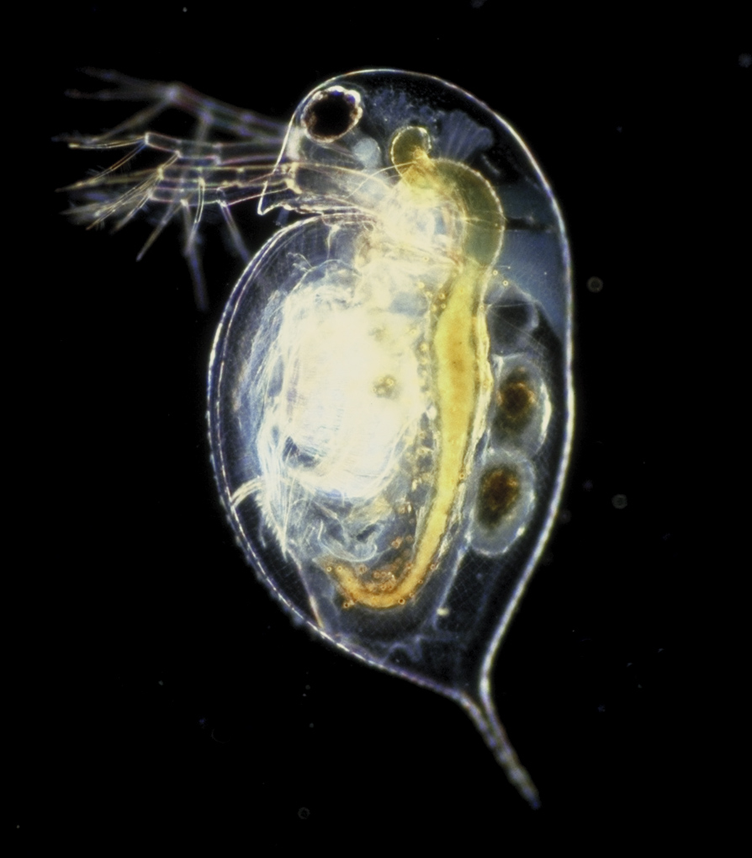
The body of a Daphnia species is usually 1–5 mm (0.039–0.197 in) long, and is divided into segments, although this division is not visible. The head is fused, and is generally bent down towards the body with a visible notch separating the two. In most species, the rest of the body is covered by a carapace, with a ventral gap in which the five or six pairs of legs lie. The most prominent features are the compound eyes, the second antennae, and a pair of abdominal setae. In many species, the carapace is translucent or nearly so, so they make excellent subjects for the microscope, as one can observe the beating heart.
Even under relatively low-power microscopy, the feeding mechanism can be observed, with immature young moving in the brood pouch; moreover, the eye being moved by the ciliary muscles can be seen, as well as blood cells being pumped around the circulatory system by the simple heart. The heart is at the top of the back, just behind the head, and the average heart rate is about 180 bpm under normal conditions. Daphnia spp., like many animals, are prone to alcohol intoxication as well as caffeine effects, which makes them excellent subjects for studying the effects of the depressant and stimulants on the nervous system due to the translucent exoskeleton and the visibly altered heart rate. They are tolerant of being observed live under a coverslip and appear to suffer no harm when returned to open water. This experiment can also be performed using nicotine, or adrenaline, each producing an increase in the heart rate. [citation needed]
Due to its intermediate size, Daphnia spp. use both diffusion and circulatory methods, producing hemoglobin in low-oxygen environments.
Daphnia is a large genus – comprising over 200 species – belonging to the cladoceran family Daphniidae. It is subdivided into several subgenera (Daphnia, Australodaphnia, Ctenodaphnia), but the division has been controversial and is still in development. Each subgenus has been further divided into a number of species complexes. The understanding of species boundaries has been hindered by phenotypic plasticity, hybridization, intercontinental introductions, and poor taxonomic descriptions. Modern members of Daphnia belonging to the subgenera Daphnia and Ctenodaphnia are known since the Cretaceous, though the genus likely originated prior to the beginning of the Cretaceous. There are numerous poorly studied and cryptic species among crustaceans of the genus Daphnia.
Daphnia species are normally r-selected, meaning that they invest in early reproduction, so have short lifespans. An individual Daphnia lifespan depends on factors such as temperature and the abundance of predators, but can be 13–14 months in some cold, oligotrophic, fish-free lakes. In typical conditions, however, the lifecycle is much shorter, not usually exceeding 5–6 months.
Daphnia spp. are typically filter feeders, ingesting mainly unicellular algae and various sorts of organic detritus including protists and bacteria. Beating of the legs produces a constant current through the carapace, which brings such material into the digestive tract. The trapped food particles are formed into a food bolus which then moves down the digestive tract until voided through the anus located on the ventral surface of the terminal appendage. The second and third pairs of legs are used in the organisms' filter-feeding, ensuring large, unabsorbable particles are kept out, while the other sets of legs create the stream of water rushing into the organism.
Hub AI
Daphnia AI simulator
(@Daphnia_simulator)
Daphnia
Daphnia is a genus of small planktonic crustaceans, 0.2–6.0 mm (0.01–0.24 in) in length. Daphnia are members of the order Anomopoda, and are one of the several small aquatic crustaceans commonly called water fleas because their saltatory swimming style resembles the movements of fleas. Daphnia spp. live in various aquatic environments ranging from acidic swamps to freshwater lakes and ponds.
The two most commonly found species of Daphnia are D. pulex (small and most common) and D. magna (large). They are often associated with a related genus in the order Cladocera: Moina, which is in the Moinidae group instead of the Daphniidae, and is much smaller than D. pulex (roughly half the maximum length).
The body of a Daphnia species is usually 1–5 mm (0.039–0.197 in) long, and is divided into segments, although this division is not visible. The head is fused, and is generally bent down towards the body with a visible notch separating the two. In most species, the rest of the body is covered by a carapace, with a ventral gap in which the five or six pairs of legs lie. The most prominent features are the compound eyes, the second antennae, and a pair of abdominal setae. In many species, the carapace is translucent or nearly so, so they make excellent subjects for the microscope, as one can observe the beating heart.
Even under relatively low-power microscopy, the feeding mechanism can be observed, with immature young moving in the brood pouch; moreover, the eye being moved by the ciliary muscles can be seen, as well as blood cells being pumped around the circulatory system by the simple heart. The heart is at the top of the back, just behind the head, and the average heart rate is about 180 bpm under normal conditions. Daphnia spp., like many animals, are prone to alcohol intoxication as well as caffeine effects, which makes them excellent subjects for studying the effects of the depressant and stimulants on the nervous system due to the translucent exoskeleton and the visibly altered heart rate. They are tolerant of being observed live under a coverslip and appear to suffer no harm when returned to open water. This experiment can also be performed using nicotine, or adrenaline, each producing an increase in the heart rate. [citation needed]
Due to its intermediate size, Daphnia spp. use both diffusion and circulatory methods, producing hemoglobin in low-oxygen environments.
Daphnia is a large genus – comprising over 200 species – belonging to the cladoceran family Daphniidae. It is subdivided into several subgenera (Daphnia, Australodaphnia, Ctenodaphnia), but the division has been controversial and is still in development. Each subgenus has been further divided into a number of species complexes. The understanding of species boundaries has been hindered by phenotypic plasticity, hybridization, intercontinental introductions, and poor taxonomic descriptions. Modern members of Daphnia belonging to the subgenera Daphnia and Ctenodaphnia are known since the Cretaceous, though the genus likely originated prior to the beginning of the Cretaceous. There are numerous poorly studied and cryptic species among crustaceans of the genus Daphnia.
Daphnia species are normally r-selected, meaning that they invest in early reproduction, so have short lifespans. An individual Daphnia lifespan depends on factors such as temperature and the abundance of predators, but can be 13–14 months in some cold, oligotrophic, fish-free lakes. In typical conditions, however, the lifecycle is much shorter, not usually exceeding 5–6 months.
Daphnia spp. are typically filter feeders, ingesting mainly unicellular algae and various sorts of organic detritus including protists and bacteria. Beating of the legs produces a constant current through the carapace, which brings such material into the digestive tract. The trapped food particles are formed into a food bolus which then moves down the digestive tract until voided through the anus located on the ventral surface of the terminal appendage. The second and third pairs of legs are used in the organisms' filter-feeding, ensuring large, unabsorbable particles are kept out, while the other sets of legs create the stream of water rushing into the organism.
Recent media