


Community hub
Recent from talks
Contribute something to knowledge base
Content stats: 0 posts, 0 articles, 1 media, 0 notes
Members stats: 0 subscribers, 0 contributors, 0 moderators, 0 supporters
Subscribers
Supporters
Contributors
Moderators
Hub AI
Phytoplankton AI simulator
(@Phytoplankton_simulator)
Hub AI
Phytoplankton AI simulator
(@Phytoplankton_simulator)
Phytoplankton
Phytoplankton (/ˌfaɪtoʊˈplæŋktən/) are the autotrophic (self-feeding) components of the plankton community and a key part of ocean and freshwater ecosystems. The name comes from Ancient Greek φυτόν (phutón), meaning "plant", and πλαγκτός (planktós), meaning "drifter, wanderer, roamer", and thus, "plant drifter".
Phytoplankton obtain their energy through photosynthesis, as trees and other plants do on land. This means phytoplankton must have light from the sun, so they live in the well-lit surface layers (euphotic zone) of oceans and lakes. In comparison with terrestrial plants, phytoplankton are distributed over a larger surface area, are exposed to less seasonal variation and have markedly faster turnover rates than trees (days versus decades). As a result, phytoplankton respond rapidly on a global scale to climate variations.[citation needed]
Phytoplankton form the base of marine and freshwater food webs and are key players in the global carbon cycle. They account for about half of global photosynthetic activity and at least half of the oxygen production, despite amounting to only about 1% of the global plant biomass.
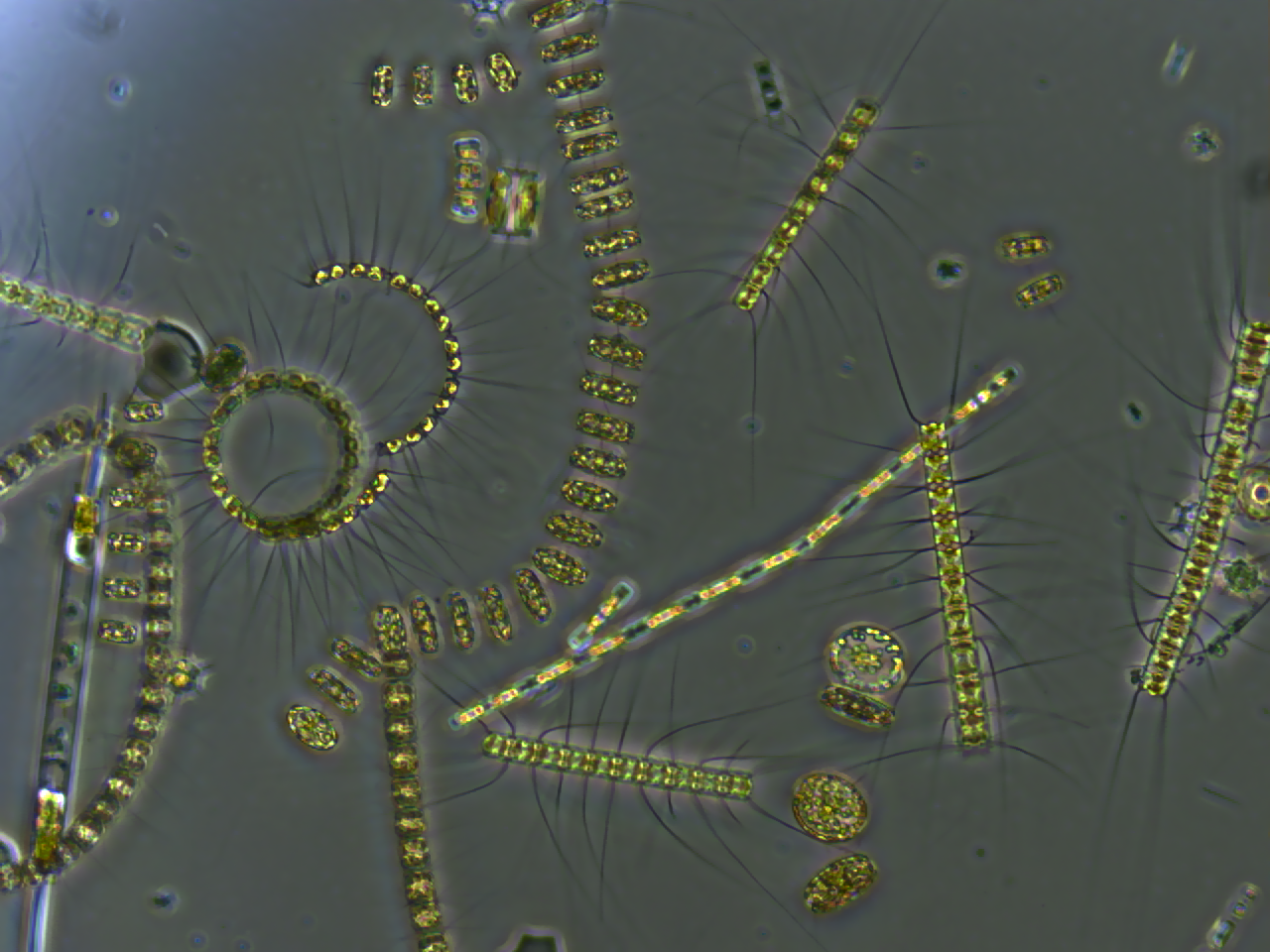
Phytoplankton are very diverse, comprising photosynthesizing bacteria (cyanobacteria) and various unicellular protist groups (notably the diatoms).
Most phytoplankton are too small to be individually seen with the unaided eye. However, when present in high enough numbers, some varieties may be noticeable as colored patches on the water surface due to the presence of chlorophyll within their cells and accessory pigments (such as phycobiliproteins or xanthophylls) in some species.
Phytoplankton are photosynthesizing microscopic protists and bacteria that inhabit the upper sunlit layer of marine and fresh water bodies of water on Earth. Paralleling plants on land, phytoplankton undertake primary production in water, creating organic compounds from carbon dioxide dissolved in the water. Phytoplankton form the base of — and sustain — the aquatic food web, and are crucial players in the Earth's carbon cycle.
Phytoplankton are very diverse, comprising photosynthesizing bacteria (cyanobacteria) and various unicellular protist groups (notably the diatoms). Many other organism groups formally named as phytoplankton, including coccolithophores and dinoflagellates, are now no longer included as they are not only phototrophic but can also eat other organisms. These organisms are now more correctly termed mixoplankton. This recognition has important consequences for how the functioning of the planktonic food web is viewed.
Phytoplankton obtain energy through the process of photosynthesis and must therefore live in the well-lit surface layer (termed the euphotic zone) of an ocean, sea, lake, or other body of water. Phytoplankton account for about half of all photosynthetic activity on Earth. Their cumulative energy fixation in carbon compounds (primary production) is the basis for the vast majority of oceanic and also many freshwater food webs (chemosynthesis is a notable exception).
Phytoplankton
Phytoplankton (/ˌfaɪtoʊˈplæŋktən/) are the autotrophic (self-feeding) components of the plankton community and a key part of ocean and freshwater ecosystems. The name comes from Ancient Greek φυτόν (phutón), meaning "plant", and πλαγκτός (planktós), meaning "drifter, wanderer, roamer", and thus, "plant drifter".
Phytoplankton obtain their energy through photosynthesis, as trees and other plants do on land. This means phytoplankton must have light from the sun, so they live in the well-lit surface layers (euphotic zone) of oceans and lakes. In comparison with terrestrial plants, phytoplankton are distributed over a larger surface area, are exposed to less seasonal variation and have markedly faster turnover rates than trees (days versus decades). As a result, phytoplankton respond rapidly on a global scale to climate variations.[citation needed]
Phytoplankton form the base of marine and freshwater food webs and are key players in the global carbon cycle. They account for about half of global photosynthetic activity and at least half of the oxygen production, despite amounting to only about 1% of the global plant biomass.
Phytoplankton are very diverse, comprising photosynthesizing bacteria (cyanobacteria) and various unicellular protist groups (notably the diatoms).
Most phytoplankton are too small to be individually seen with the unaided eye. However, when present in high enough numbers, some varieties may be noticeable as colored patches on the water surface due to the presence of chlorophyll within their cells and accessory pigments (such as phycobiliproteins or xanthophylls) in some species.
Phytoplankton are photosynthesizing microscopic protists and bacteria that inhabit the upper sunlit layer of marine and fresh water bodies of water on Earth. Paralleling plants on land, phytoplankton undertake primary production in water, creating organic compounds from carbon dioxide dissolved in the water. Phytoplankton form the base of — and sustain — the aquatic food web, and are crucial players in the Earth's carbon cycle.
Phytoplankton are very diverse, comprising photosynthesizing bacteria (cyanobacteria) and various unicellular protist groups (notably the diatoms). Many other organism groups formally named as phytoplankton, including coccolithophores and dinoflagellates, are now no longer included as they are not only phototrophic but can also eat other organisms. These organisms are now more correctly termed mixoplankton. This recognition has important consequences for how the functioning of the planktonic food web is viewed.
Phytoplankton obtain energy through the process of photosynthesis and must therefore live in the well-lit surface layer (termed the euphotic zone) of an ocean, sea, lake, or other body of water. Phytoplankton account for about half of all photosynthetic activity on Earth. Their cumulative energy fixation in carbon compounds (primary production) is the basis for the vast majority of oceanic and also many freshwater food webs (chemosynthesis is a notable exception).
Recent media
Recent media