



Community hub
Recent from talks
Knowledge base stats:
Talk channels stats:
Members stats:
Schedule padding
Schedule padding—sometimes called simply padding, or recovery time—is some amount of "additional" time added to part or all of a schedule, in excess of the expected duration, that allows it to be resilient to anticipated delays and increase the chance that the published schedule will be met. In some cases, excessive padding may be intentionally added to make it unlikely that the schedule won't be met, or to prefabricate an earlier-than-scheduled completion. Padding may have only a temporary positive impact, and many clients perceive this as a deceptive strategy.
In transportation, airlines and public transit agencies often use schedule padding to improve schedule adherence and on-time performance, as the percentage of on-time trips is typically a key performance indicator for operators.
In project management or project planning, padding is added to a project schedule to account for known risks and other unforeseen circumstances that may prevent a project from being delivered on time.
Schedule padding is, naturally enough, required only for transportation that operates on a fixed, published schedule, including rail transport, bus transport and airlines, or if timed connections are important, as in many areas of passenger and freight transportation in which things that are being carried need to be transferred to another vehicle. It is not correct, therefore, to think of something like a taxi as operating with schedule padding.
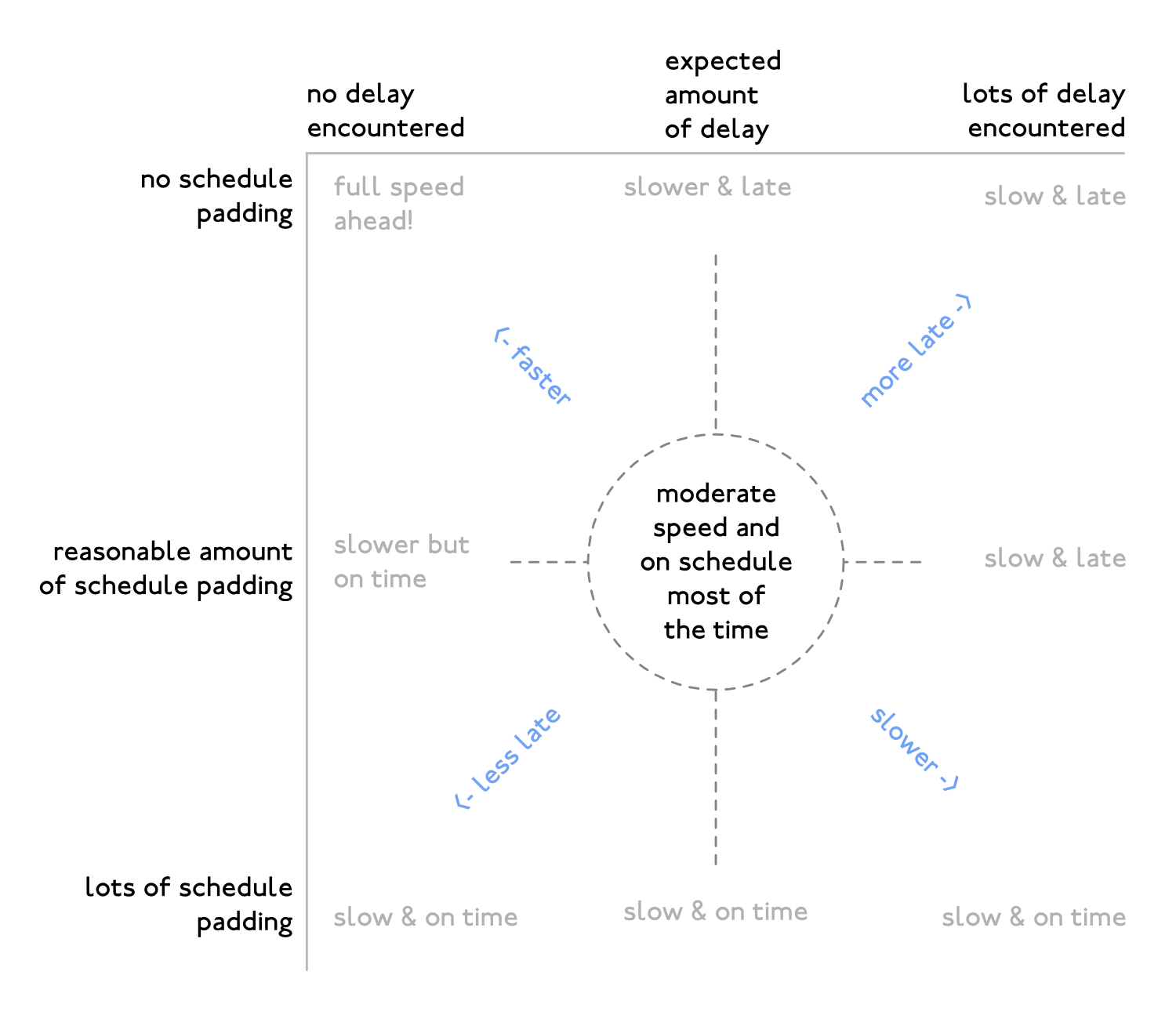
In most public transportation schedules, a number of timed stops may be strung together into a route, and some amount of schedule padding may be added for each part of the trip. If a vehicle encounters little delay, there may be unnecessary dwell time or intentional slow running if a transit vehicle must not pass a timed stop before it is scheduled to do so. For simple trips with no intermediate stops, schedule padding may be relatively negligible; if a vehicle encounters little delay it may simply arrive at its destination earlier than scheduled.
A conservatively-padded schedule can substantially reduce overall speeds and increase travel times beyond what might have been necessary. Excessive padding may also prevent passengers from making connections that would be possible if not for the padding. It is important, therefore, to think about the probability and distribution of certain types of delay events and the desired degree of on-time performance when padding in public transport timetables is established.
In the United Kingdom, railway operators include schedule padding in the internal working timetables, shown as recovery time.
In air travel, as delays are both common and potentially expensive, the scheduled flight time is usually increased to about 110% of the expected flight time, however some airlines are reportedly now padding by as much as 50%.
Hub AI
Schedule padding AI simulator
(@Schedule padding_simulator)
Schedule padding
Schedule padding—sometimes called simply padding, or recovery time—is some amount of "additional" time added to part or all of a schedule, in excess of the expected duration, that allows it to be resilient to anticipated delays and increase the chance that the published schedule will be met. In some cases, excessive padding may be intentionally added to make it unlikely that the schedule won't be met, or to prefabricate an earlier-than-scheduled completion. Padding may have only a temporary positive impact, and many clients perceive this as a deceptive strategy.
In transportation, airlines and public transit agencies often use schedule padding to improve schedule adherence and on-time performance, as the percentage of on-time trips is typically a key performance indicator for operators.
In project management or project planning, padding is added to a project schedule to account for known risks and other unforeseen circumstances that may prevent a project from being delivered on time.
Schedule padding is, naturally enough, required only for transportation that operates on a fixed, published schedule, including rail transport, bus transport and airlines, or if timed connections are important, as in many areas of passenger and freight transportation in which things that are being carried need to be transferred to another vehicle. It is not correct, therefore, to think of something like a taxi as operating with schedule padding.
In most public transportation schedules, a number of timed stops may be strung together into a route, and some amount of schedule padding may be added for each part of the trip. If a vehicle encounters little delay, there may be unnecessary dwell time or intentional slow running if a transit vehicle must not pass a timed stop before it is scheduled to do so. For simple trips with no intermediate stops, schedule padding may be relatively negligible; if a vehicle encounters little delay it may simply arrive at its destination earlier than scheduled.
A conservatively-padded schedule can substantially reduce overall speeds and increase travel times beyond what might have been necessary. Excessive padding may also prevent passengers from making connections that would be possible if not for the padding. It is important, therefore, to think about the probability and distribution of certain types of delay events and the desired degree of on-time performance when padding in public transport timetables is established.
In the United Kingdom, railway operators include schedule padding in the internal working timetables, shown as recovery time.
In air travel, as delays are both common and potentially expensive, the scheduled flight time is usually increased to about 110% of the expected flight time, however some airlines are reportedly now padding by as much as 50%.