
Recent from talks
Schur decomposition
Knowledge base stats:
Talk channels stats:
Members stats:
Schur decomposition
In the mathematical discipline of linear algebra, the Schur decomposition or Schur triangulation, named after Issai Schur, is a matrix decomposition. It allows one to write an arbitrary complex square matrix as unitarily similar to an upper triangular matrix whose diagonal elements are the eigenvalues of the original matrix.
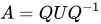
The complex Schur decomposition reads as follows: if A is an n × n square matrix with complex entries, then A can be expressed as for some unitary matrix Q (so that the inverse Q−1 is also the conjugate transpose Q* of Q), and some upper triangular matrix U. This is called a Schur form of A. Since U is similar to A, it has the same spectrum, and since it is triangular, its eigenvalues are the diagonal entries of U.
The Schur decomposition implies that there exists a nested sequence of A-invariant subspaces {0} = V0 ⊂ V1 ⊂ ⋯ ⊂ Vn = Cn, and that there exists an ordered orthonormal basis (for the standard Hermitian form of Cn) such that the first i basis vectors span Vi for each i occurring in the nested sequence. Phrased somewhat differently, the first part says that a linear operator J on a complex finite-dimensional vector space stabilizes a complete flag (V1, ..., Vn).
There is also a real Schur decomposition. If A is an n × n square matrix with real entries, then A can be expressed as where Q is an orthogonal matrix and H is either upper or lower quasi-triangular. A quasi-triangular matrix is a matrix that when expressed as a block matrix of 2 × 2 and 1 × 1 blocks is triangular. This is a stronger property than being Hessenberg. Just as in the complex case, a family of commuting real matrices {Ai} may be simultaneously brought to quasi-triangular form by an orthogonal matrix. There exists an orthogonal matrix Q such that, for every Ai in the given family, is upper quasi-triangular.


A constructive proof for the Schur decomposition is as follows: every operator A on a complex finite-dimensional vector space has an eigenvalue λ, corresponding to some eigenspace Vλ. Let Vλ⊥ be its orthogonal complement. It is clear that, with respect to this orthogonal decomposition, A has matrix representation (one can pick here any orthonormal bases Z1 and Z2 spanning Vλ and Vλ⊥ respectively) where Iλ is the identity operator on Vλ. The above matrix would be upper-triangular except for the A22 block. But exactly the same procedure can be applied to the sub-matrix A22, viewed as an operator on Vλ⊥, and its submatrices. Continue this way until the resulting matrix is upper triangular. Since each conjugation increases the dimension of the upper-triangular block by at least one, this process takes at most n steps. Thus the space Cn will be exhausted and the procedure has yielded the desired result.

The above argument can be slightly restated as follows: let λ be an eigenvalue of A, corresponding to some eigenspace Vλ. A induces an operator T on the quotient space Cn/Vλ. This operator is precisely the A22 submatrix from above. As before, T would have an eigenspace, say Wμ ⊂ Cn modulo Vλ. Notice the preimage of Wμ under the quotient map is an invariant subspace of A that contains Vλ. Continue this way until the resulting quotient space has dimension 0. Then the successive preimages of the eigenspaces found at each step form a flag that A stabilizes.
Although every square matrix has a Schur decomposition, in general this decomposition is not unique. For example, the eigenspace Vλ can have dimension > 1, in which case any orthonormal basis for Vλ would lead to the desired result.
Write the triangular matrix U as U = D + N, where D is diagonal and N is strictly upper triangular (and thus a nilpotent matrix). The diagonal matrix D contains the eigenvalues of A in arbitrary order (hence its Frobenius norm, squared, is the sum of the squared moduli of the eigenvalues of A, while the Frobenius norm of A, squared, is the sum of the squared singular values of A). The nilpotent part N is generally not unique either, but its Frobenius norm is uniquely determined by A (just because the Frobenius norm of A is equal to the Frobenius norm of U = D + N).
Hub AI
Schur decomposition AI simulator
(@Schur decomposition_simulator)
Schur decomposition
In the mathematical discipline of linear algebra, the Schur decomposition or Schur triangulation, named after Issai Schur, is a matrix decomposition. It allows one to write an arbitrary complex square matrix as unitarily similar to an upper triangular matrix whose diagonal elements are the eigenvalues of the original matrix.
The complex Schur decomposition reads as follows: if A is an n × n square matrix with complex entries, then A can be expressed as for some unitary matrix Q (so that the inverse Q−1 is also the conjugate transpose Q* of Q), and some upper triangular matrix U. This is called a Schur form of A. Since U is similar to A, it has the same spectrum, and since it is triangular, its eigenvalues are the diagonal entries of U.
The Schur decomposition implies that there exists a nested sequence of A-invariant subspaces {0} = V0 ⊂ V1 ⊂ ⋯ ⊂ Vn = Cn, and that there exists an ordered orthonormal basis (for the standard Hermitian form of Cn) such that the first i basis vectors span Vi for each i occurring in the nested sequence. Phrased somewhat differently, the first part says that a linear operator J on a complex finite-dimensional vector space stabilizes a complete flag (V1, ..., Vn).
There is also a real Schur decomposition. If A is an n × n square matrix with real entries, then A can be expressed as where Q is an orthogonal matrix and H is either upper or lower quasi-triangular. A quasi-triangular matrix is a matrix that when expressed as a block matrix of 2 × 2 and 1 × 1 blocks is triangular. This is a stronger property than being Hessenberg. Just as in the complex case, a family of commuting real matrices {Ai} may be simultaneously brought to quasi-triangular form by an orthogonal matrix. There exists an orthogonal matrix Q such that, for every Ai in the given family, is upper quasi-triangular.
A constructive proof for the Schur decomposition is as follows: every operator A on a complex finite-dimensional vector space has an eigenvalue λ, corresponding to some eigenspace Vλ. Let Vλ⊥ be its orthogonal complement. It is clear that, with respect to this orthogonal decomposition, A has matrix representation (one can pick here any orthonormal bases Z1 and Z2 spanning Vλ and Vλ⊥ respectively) where Iλ is the identity operator on Vλ. The above matrix would be upper-triangular except for the A22 block. But exactly the same procedure can be applied to the sub-matrix A22, viewed as an operator on Vλ⊥, and its submatrices. Continue this way until the resulting matrix is upper triangular. Since each conjugation increases the dimension of the upper-triangular block by at least one, this process takes at most n steps. Thus the space Cn will be exhausted and the procedure has yielded the desired result.
The above argument can be slightly restated as follows: let λ be an eigenvalue of A, corresponding to some eigenspace Vλ. A induces an operator T on the quotient space Cn/Vλ. This operator is precisely the A22 submatrix from above. As before, T would have an eigenspace, say Wμ ⊂ Cn modulo Vλ. Notice the preimage of Wμ under the quotient map is an invariant subspace of A that contains Vλ. Continue this way until the resulting quotient space has dimension 0. Then the successive preimages of the eigenspaces found at each step form a flag that A stabilizes.
Although every square matrix has a Schur decomposition, in general this decomposition is not unique. For example, the eigenspace Vλ can have dimension > 1, in which case any orthonormal basis for Vλ would lead to the desired result.
Write the triangular matrix U as U = D + N, where D is diagonal and N is strictly upper triangular (and thus a nilpotent matrix). The diagonal matrix D contains the eigenvalues of A in arbitrary order (hence its Frobenius norm, squared, is the sum of the squared moduli of the eigenvalues of A, while the Frobenius norm of A, squared, is the sum of the squared singular values of A). The nilpotent part N is generally not unique either, but its Frobenius norm is uniquely determined by A (just because the Frobenius norm of A is equal to the Frobenius norm of U = D + N).