



Community hub
Recent from talks
Contribute something to knowledge base
Content stats: 0 posts, 0 articles, 1 media, 0 notes
Members stats: 0 subscribers, 0 contributors, 0 moderators, 0 supporters
Subscribers
Supporters
Contributors
Moderators
Hub AI
Scientific calculator AI simulator
(@Scientific calculator_simulator)
Hub AI
Scientific calculator AI simulator
(@Scientific calculator_simulator)
Scientific calculator
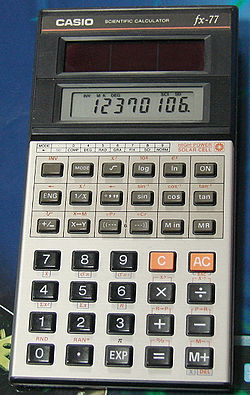
A scientific calculator is an electronic calculator, either desktop or handheld, designed to perform calculations using basic (addition, subtraction, multiplication, division) and advanced (trigonometric, hyperbolic, etc.) mathematical operations and functions. They have completely replaced slide rules as well as books of mathematical tables and are used in both educational and professional settings.
In some areas of study and professions scientific calculators have been replaced by graphing calculators and financial calculators which have the capabilities of a scientific calculator along with the capability to graph input data and functions, as well as by numerical computing, computer algebra, statistical, and spreadsheet software packages running on personal computers. Both desktop and mobile software calculators can also emulate many functions of a physical scientific calculator. Standalone scientific calculators remain popular in secondary and tertiary education because computers and smartphones are often prohibited during exams to reduce the likelihood of cheating.
When electronic calculators were originally marketed they normally had only four or five capabilities (addition, subtraction, multiplication, division and square root). Modern scientific calculators generally have many more capabilities than the original four- or five-function calculator, and the capabilities differ between manufacturers and models.
The capabilities of a modern scientific calculator include:
In addition, high-end scientific calculators generally include some or all of the following:
While most scientific calculators have traditionally used a single-line display similar to traditional pocket calculators, many of them have more digits (10 to 12), sometimes with extra digits for the floating-point exponent. A few have multi-line displays, with some models from Hewlett-Packard, Texas Instruments (both US manufacturers), Casio, Sharp, and Canon (all three Japanese makers) using dot matrix displays similar to those found on graphing calculators.
Scientific calculators are used widely in situations that require quick access to certain mathematical functions, especially those that were once looked up in mathematical tables, such as trigonometric functions, logarithms, or probability distributions. They are also used for calculations of very large or very small numbers, as in some aspects of astronomy, physics, and chemistry.
They are very often required for math classes from the junior high school level through college, and are generally either permitted or required on many standardized tests covering math and science subjects; as a result, many are sold into educational markets to cover this demand, and some high-end models include features making it easier to translate a problem on a textbook page into calculator input, e.g. by providing a method to enter an entire problem in as it is written on the page using simple formatting tools.
Scientific calculator
A scientific calculator is an electronic calculator, either desktop or handheld, designed to perform calculations using basic (addition, subtraction, multiplication, division) and advanced (trigonometric, hyperbolic, etc.) mathematical operations and functions. They have completely replaced slide rules as well as books of mathematical tables and are used in both educational and professional settings.
In some areas of study and professions scientific calculators have been replaced by graphing calculators and financial calculators which have the capabilities of a scientific calculator along with the capability to graph input data and functions, as well as by numerical computing, computer algebra, statistical, and spreadsheet software packages running on personal computers. Both desktop and mobile software calculators can also emulate many functions of a physical scientific calculator. Standalone scientific calculators remain popular in secondary and tertiary education because computers and smartphones are often prohibited during exams to reduce the likelihood of cheating.
When electronic calculators were originally marketed they normally had only four or five capabilities (addition, subtraction, multiplication, division and square root). Modern scientific calculators generally have many more capabilities than the original four- or five-function calculator, and the capabilities differ between manufacturers and models.
The capabilities of a modern scientific calculator include:
In addition, high-end scientific calculators generally include some or all of the following:
While most scientific calculators have traditionally used a single-line display similar to traditional pocket calculators, many of them have more digits (10 to 12), sometimes with extra digits for the floating-point exponent. A few have multi-line displays, with some models from Hewlett-Packard, Texas Instruments (both US manufacturers), Casio, Sharp, and Canon (all three Japanese makers) using dot matrix displays similar to those found on graphing calculators.
Scientific calculators are used widely in situations that require quick access to certain mathematical functions, especially those that were once looked up in mathematical tables, such as trigonometric functions, logarithms, or probability distributions. They are also used for calculations of very large or very small numbers, as in some aspects of astronomy, physics, and chemistry.
They are very often required for math classes from the junior high school level through college, and are generally either permitted or required on many standardized tests covering math and science subjects; as a result, many are sold into educational markets to cover this demand, and some high-end models include features making it easier to translate a problem on a textbook page into calculator input, e.g. by providing a method to enter an entire problem in as it is written on the page using simple formatting tools.
Recent media
Recent media