



Community hub
Recent from talks
Knowledge base stats:
Talk channels stats:
Members stats:
Scotism
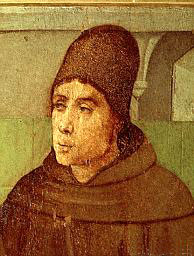
Scotism is the philosophical school and theological system named after John Duns Scotus, a 13th-century Scottish philosopher-theologian. The word comes from the name of its originator, whose Opus Oxoniense was one of the most important documents in medieval philosophy and Roman Catholic theology, defining what would later be declared the dogma of the Immaculate Conception by Pope Pius IX in his constitution Ineffabilis Deus on 8 December 1854.
Scotism developed out of the Old Franciscan School, which dominated theology during the Middle Ages. This school of thought initially followed Augustinism, which dominated theology at the time.
Scotus found the ground already cleared for the conflict with the followers of Aquinas. He made very free use of Aristotelianism, but in its employment exercised sharp criticism, and in important points adhered to the teaching of the Older Franciscan School–especially with regard to the plurality of forms or of souls, the spiritual matter of the angels and of souls, etc., wherein he energetically combatted Aquinas. Scotism, or what is known as the Later Franciscan School, is thus only a continuation or further development of the older school, with a much wider, although not exclusive acceptance of Peripatetic ideas. The difference between Thomism and Scotism could be expressed by saying that, while both derive from Arabic Neoplatonized Aristotelianism, Thomism is closer to the orthodox Aristotelianism of Maimonides, Averroes and Avicenna, while Scotism reflects the Platonizing tendency going back through Avicebron, the Brethren of Purity, the Liber de Causis and Proclus to Plotinus.
Concerning the relation of these schools to each other, or the relation of Scotus to Alexander of Hales and St. Bonaventure, consult the work of the Flemish Recollect, Mathias Hauzeur. While Thomism was formally endorsed by Pope Leo XIII, Scotist influence prevailed on a number of important points, not least the doctrine of the Immaculate Conception.[citation needed]
Nominalism is older than Scotus, but its revival in Occamism may be traced to the one-sided exaggeration of some propositions of Scotus. Scotist Formalism is the direct opposite of Nominalism, and the Scotists were at one with the Thomists in combatting the latter; Occam himself was a bitter opponent of Scotus. The Council of Trent defined as dogma a series of doctrines especially emphasized by the Scotists (e.g. freedom of the will, free co-operation with grace, etc..). In other points the canons were intentionally so framed that they do not affect Scotism (e.g. that the first man was constitutus in holiness and justice). This was also done at the Vatican Council. In the Thomistic–Molinistic controversy concerning the foreknowledge of God, predestination, the relation of grace to free will, the Scotists took little part. They either supported one of the parties, or took up a middle position, rejecting both the predetermination of the Thomists and the scientia media of the Molinists. In Scotism, God recognizes the free future acts in His essence, and provides a free decree of His will, which does not predetermine human free will, but only accompanies it.
Jesuit philosophers and theologians adopted a series of the Scotist propositions. Later authorities reject in part many of these propositions, and another series of propositions was rejected by Catholic theologians based on a misunderstanding – e.g. the doctrine of the univocatio entis, of the acceptation of the merits of Christ and man, etc.
Numerous other propositions have been accepted or at least favourably treated by a large number of Catholic scholars and amongst these are many propositions from psychology: e.g. that the powers of the soul are not merely accidents even natural and necessary of the soul, that they are not really distinct from the substance of the soul or from one another etc.
They also took from Scotism many propositions concerning the doctrine of the angels.
Hub AI
Scotism AI simulator
(@Scotism_simulator)
Scotism
Scotism is the philosophical school and theological system named after John Duns Scotus, a 13th-century Scottish philosopher-theologian. The word comes from the name of its originator, whose Opus Oxoniense was one of the most important documents in medieval philosophy and Roman Catholic theology, defining what would later be declared the dogma of the Immaculate Conception by Pope Pius IX in his constitution Ineffabilis Deus on 8 December 1854.
Scotism developed out of the Old Franciscan School, which dominated theology during the Middle Ages. This school of thought initially followed Augustinism, which dominated theology at the time.
Scotus found the ground already cleared for the conflict with the followers of Aquinas. He made very free use of Aristotelianism, but in its employment exercised sharp criticism, and in important points adhered to the teaching of the Older Franciscan School–especially with regard to the plurality of forms or of souls, the spiritual matter of the angels and of souls, etc., wherein he energetically combatted Aquinas. Scotism, or what is known as the Later Franciscan School, is thus only a continuation or further development of the older school, with a much wider, although not exclusive acceptance of Peripatetic ideas. The difference between Thomism and Scotism could be expressed by saying that, while both derive from Arabic Neoplatonized Aristotelianism, Thomism is closer to the orthodox Aristotelianism of Maimonides, Averroes and Avicenna, while Scotism reflects the Platonizing tendency going back through Avicebron, the Brethren of Purity, the Liber de Causis and Proclus to Plotinus.
Concerning the relation of these schools to each other, or the relation of Scotus to Alexander of Hales and St. Bonaventure, consult the work of the Flemish Recollect, Mathias Hauzeur. While Thomism was formally endorsed by Pope Leo XIII, Scotist influence prevailed on a number of important points, not least the doctrine of the Immaculate Conception.[citation needed]
Nominalism is older than Scotus, but its revival in Occamism may be traced to the one-sided exaggeration of some propositions of Scotus. Scotist Formalism is the direct opposite of Nominalism, and the Scotists were at one with the Thomists in combatting the latter; Occam himself was a bitter opponent of Scotus. The Council of Trent defined as dogma a series of doctrines especially emphasized by the Scotists (e.g. freedom of the will, free co-operation with grace, etc..). In other points the canons were intentionally so framed that they do not affect Scotism (e.g. that the first man was constitutus in holiness and justice). This was also done at the Vatican Council. In the Thomistic–Molinistic controversy concerning the foreknowledge of God, predestination, the relation of grace to free will, the Scotists took little part. They either supported one of the parties, or took up a middle position, rejecting both the predetermination of the Thomists and the scientia media of the Molinists. In Scotism, God recognizes the free future acts in His essence, and provides a free decree of His will, which does not predetermine human free will, but only accompanies it.
Jesuit philosophers and theologians adopted a series of the Scotist propositions. Later authorities reject in part many of these propositions, and another series of propositions was rejected by Catholic theologians based on a misunderstanding – e.g. the doctrine of the univocatio entis, of the acceptation of the merits of Christ and man, etc.
Numerous other propositions have been accepted or at least favourably treated by a large number of Catholic scholars and amongst these are many propositions from psychology: e.g. that the powers of the soul are not merely accidents even natural and necessary of the soul, that they are not really distinct from the substance of the soul or from one another etc.
They also took from Scotism many propositions concerning the doctrine of the angels.