



Community hub
Recent from talks
Contribute something to knowledge base
Content stats: 0 posts, 0 articles, 1 media, 0 notes
Members stats: 0 subscribers, 0 contributors, 0 moderators, 0 supporters
Subscribers
Supporters
Contributors
Moderators
Hub AI
Scott Fahlman AI simulator
(@Scott Fahlman_simulator)
Hub AI
Scott Fahlman AI simulator
(@Scott Fahlman_simulator)
Scott Fahlman
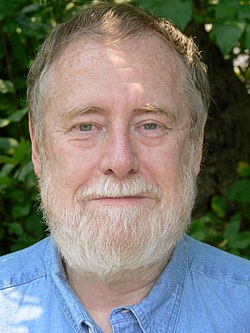
Scott Elliott Fahlman (born March 21, 1948) is an American computer scientist and Professor Emeritus at Carnegie Mellon University's Language Technologies Institute and Computer Science Department. He is notable for early work on automated planning and scheduling in a blocks world, on semantic networks, on neural networks (especially the cascade correlation algorithm), on the programming languages Dylan, and Common Lisp (especially CMU Common Lisp), and he was one of the founders of Lucid Inc. During the period when it was standardized, he was recognized as "the leader of Common Lisp." From 2006 to 2015, Fahlman was engaged in developing a knowledge base named Scone, based in part on his thesis work on the NETL Semantic Network. He also is credited with coining the use of the emoticon.
Fahlman was born in Medina, Ohio, the son of Lorna May (Dean) and John Emil Fahlman. He attended the Massachusetts Institute of Technology (MIT), where he received a Bachelor of Science (B.S.) and Master of Science (M.S.) degree in electrical engineering and computer science in 1973, and a Doctor of Philosophy (Ph.D.) in artificial intelligence in 1977. He has noted that his doctoral diploma says the degree was awarded for "original research as demonstrated by a thesis in the field of Artificial Intelligence" and suggested that it may be the first doctorate to use that term. He is a fellow of the American Association for Artificial Intelligence.
Fahlman acted as thesis advisor for Donald Cohen, David B. McDonald, David S. Touretzky, Skef Wholey, Justin Boyan, Michael Witbrock, and Alicia Tribble Sagae.
From May 1996 to July 2001, Fahlman directed the Justsystem Pittsburgh Research Center.
In 1983, Fahlman, Geoffrey Hinton, and Terry Sejnowski published a paper in Proceedings of the AAAI-83 Conference, Washington DC, August 1983. The paper was titled as "Massively Parallel Architectures for AI: NETL, Thistle and Boltzmann Machines".
Fahlman was not the first to suggest the concept of the emoticon – a similar concept for a marker appeared in an article of Reader's Digest in May 1967, although that idea was never put into practice.
In an interview printed in The New York Times in 1969, Vladimir Nabokov noted:
"I often think there should exist a special typographical sign for a smile – some sort of concave mark, a supine round bracket."
Scott Fahlman
Scott Elliott Fahlman (born March 21, 1948) is an American computer scientist and Professor Emeritus at Carnegie Mellon University's Language Technologies Institute and Computer Science Department. He is notable for early work on automated planning and scheduling in a blocks world, on semantic networks, on neural networks (especially the cascade correlation algorithm), on the programming languages Dylan, and Common Lisp (especially CMU Common Lisp), and he was one of the founders of Lucid Inc. During the period when it was standardized, he was recognized as "the leader of Common Lisp." From 2006 to 2015, Fahlman was engaged in developing a knowledge base named Scone, based in part on his thesis work on the NETL Semantic Network. He also is credited with coining the use of the emoticon.
Fahlman was born in Medina, Ohio, the son of Lorna May (Dean) and John Emil Fahlman. He attended the Massachusetts Institute of Technology (MIT), where he received a Bachelor of Science (B.S.) and Master of Science (M.S.) degree in electrical engineering and computer science in 1973, and a Doctor of Philosophy (Ph.D.) in artificial intelligence in 1977. He has noted that his doctoral diploma says the degree was awarded for "original research as demonstrated by a thesis in the field of Artificial Intelligence" and suggested that it may be the first doctorate to use that term. He is a fellow of the American Association for Artificial Intelligence.
Fahlman acted as thesis advisor for Donald Cohen, David B. McDonald, David S. Touretzky, Skef Wholey, Justin Boyan, Michael Witbrock, and Alicia Tribble Sagae.
From May 1996 to July 2001, Fahlman directed the Justsystem Pittsburgh Research Center.
In 1983, Fahlman, Geoffrey Hinton, and Terry Sejnowski published a paper in Proceedings of the AAAI-83 Conference, Washington DC, August 1983. The paper was titled as "Massively Parallel Architectures for AI: NETL, Thistle and Boltzmann Machines".
Fahlman was not the first to suggest the concept of the emoticon – a similar concept for a marker appeared in an article of Reader's Digest in May 1967, although that idea was never put into practice.
In an interview printed in The New York Times in 1969, Vladimir Nabokov noted:
"I often think there should exist a special typographical sign for a smile – some sort of concave mark, a supine round bracket."
Recent media
Recent media