



Community hub
Recent from talks
Knowledge base stats:
Talk channels stats:
Members stats:
Scottish Terrier
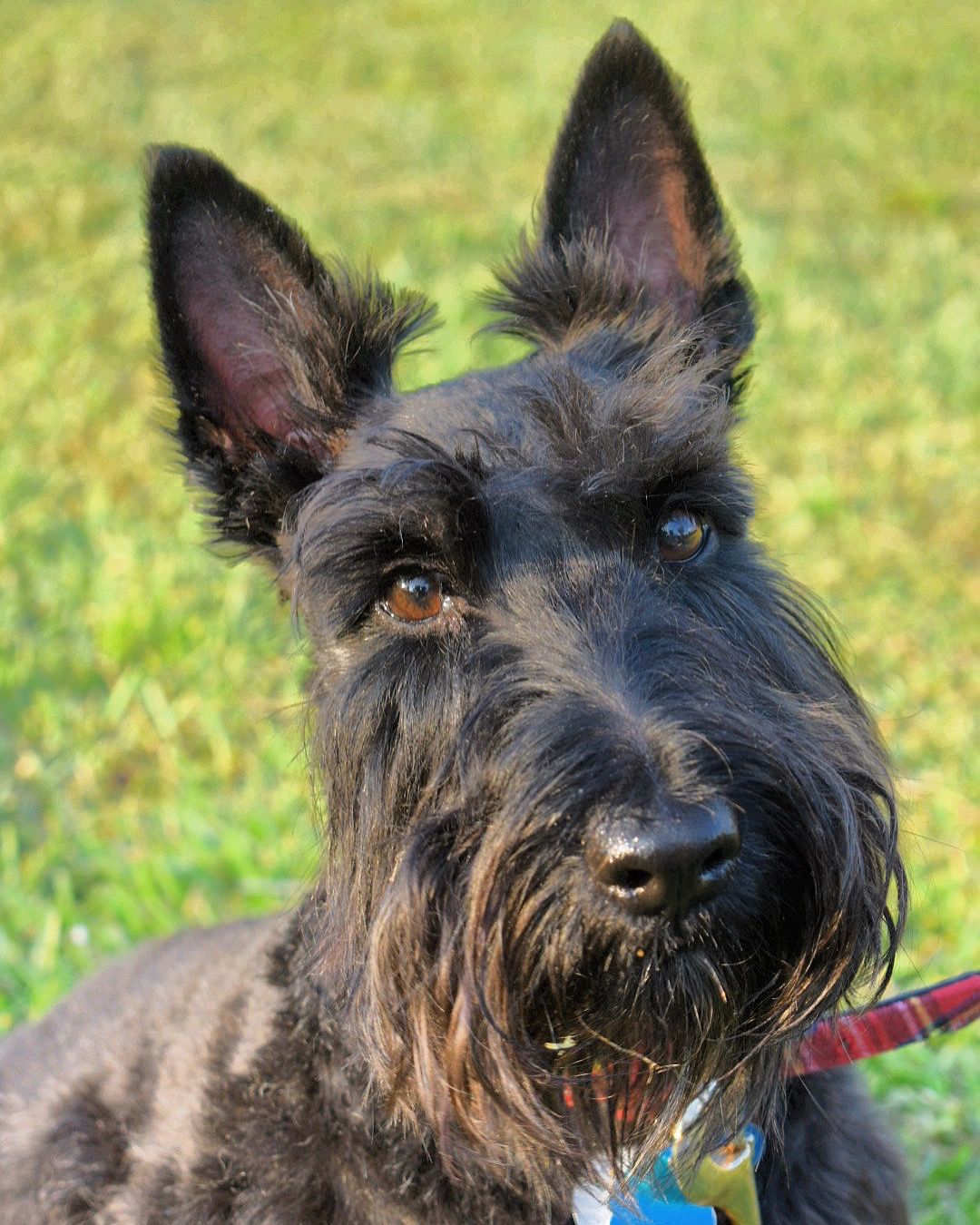
The Scottish Terrier (Scottish Gaelic: Abhag Albannach; also known as the Aberdeen Terrier), popularly called the Scottie, is a breed of dog. Initially one of the highland breeds of terrier that were grouped under the name of Skye Terrier, it is one of five breeds of terrier that originated in Scotland, the other four being the modern Skye, Cairn, Dandie Dinmont, and West Highland White terriers. They are an independent and rugged breed with a wiry outer coat and a soft dense undercoat. The first Earl of Dumbarton nicknamed the breed "the diehard". According to legend, the Earl of Dumbarton gave this nickname because of the Scottish Terriers' bravery, and Scotties were also the inspiration for the name of his regiment, The Royal Scots, Dumbarton's Diehard. Scottish Terriers were originally bred to hunt vermin on farms.
They are a small breed of terrier with a distinctive shape and have had many roles in popular culture. They have been owned by a variety of celebrities, including the 32nd president of the United States, Franklin Delano Roosevelt, whose Scottie Fala is included with FDR in a statue in Washington, D.C., as well as by the 43rd president, George W. Bush. They are also well known for being a playing piece in the board game Monopoly. Described as territorial, feisty dogs, they can make a good watchdog and tend to be very loyal to their family. Healthwise, Scottish Terriers can be more prone to bleeding disorders, joint disorders, autoimmune diseases, allergies, and cancer than some other breeds of dog, and there is a condition named after the breed called Scotty cramp. They are also one of the more successful dog breeds at the Westminster Kennel Club Dog Show with a best in show in 2010.
Initial grouping of several of the highland terriers (including the Scottie) under the generic name Skye Terriers caused some confusion in the breed's lineage. There is disagreement over whether the Skye Terriers mentioned in early 16th century records actually descended from forerunners of the Scottie or vice versa. It is certain, however, that Scotties and West Highland White Terriers are closely related—both their forefathers originated from the Blackmount region of Perthshire and the Moor of Rannoch. Scotties were originally bred to hunt and kill vermin on farms and to hunt badgers and foxes in the Highlands of Scotland.
The actual origin of a breed as old as the Scottish Terrier is obscure and undocumented. The first written records about a dog of similar description to the Scottish Terrier dates from 1436, when Don Leslie described them in his book The History of Scotland 1436–1561. Two hundred years later, Sir Joshua Reynolds painted a portrait of a young girl caressing a dog similar in appearance to the modern-day Scottie. King James VI of Scotland was an important historical figure featuring in the Scottish Terrier's history. In the 17th century, when King James VI became James I of England, he sent six terriers—thought to be forerunners of the Scottish terrier—to a French monarch as a gift. His love and adoration for the breed increased their popularity throughout the world.
Many dog writers after the early 19th century seem to agree that there were two varieties of terrier existing in Britain at the time—a rough-haired so-called Scotch Terrier and a smooth-haired English Terrier. Thomas Brown, in his Biological Sketches and Authentic Anecdotes of Dogs (1829), states that "the Scotch Terrier is certainly the purest in point of breed and the (smooth) English seems to have been produced by a cross from him". Brown went on to describe the Scotch Terrier as "low in stature, with a strong muscular body, short stout legs, a head large in proportion to the body" and was "generally of a sandy colour or black" with a "long, matted and hard" coat. Although the Scotch Terrier described here is more generic than specific to a breed, it asserts the existence of a small, hard, rough-coated terrier developed for hunting small game in the Scottish Highlands in the early 19th century; a description that shares characteristics with what was once known as the Aberdeen Terrier and is today known as the Scottish Terrier. In addition, the paintings of Sir Edwin Landseer and an 1835 lithograph entitled "Scottish Terriers at Work on a Cairn in the West Highlands" both depict Scottie type terriers very similar to those described in the first Scottish Terrier Standard.
In the 19th century, the Highlands of Scotland, including the Isle of Skye, were abundant with terriers originally known by the generic term "short-haired terriers" or "little Skye Terriers". Towards the end of the 19th century, it was decided to separate these Scottish terriers and develop pure bloodlines and specific breeds. Originally, the breeds were separated into two categories: Dandie Dinmont Terriers and Skye Terriers (not the Skye Terrier known today, but a generic name for a large group of terriers with differing traits all said to originate from the Isle of Skye). The Birmingham England dog show of 1860 was the first to offer classes for these groups of terriers. They continued to be exhibited in generic groups for several years and these groups included the ancestors of today's Scottish Terrier. Recorded history and the initial development of the breed started in the late 1870s with the development of dog shows. The exhibition and judging of dogs required comparison to a breed standard and thus the appearance and temperament of the Scottie was written down for the first time. Eventually, the Skye Terriers were further divided into what are known today as the Scottish Terrier, Skye Terrier, West Highland White Terrier and Cairn Terrier.
While fanciers sought to identify and standardize the breed and its description through the late 19th century, the Scottish Terrier was known by many different names: the Highland, the Cairn, Diehard, and most often, the Aberdeen Terrier—named because of the abundant number of the dogs in the area and because a J. A. Adamson of Aberdeen successfully exhibited his dogs during the 1870s. Roger Rough, a dog owned by Adamson, Tartan, a dog owned by Mr Paynton Piggott, Bon Accord, owned by Messrs Ludlow and Bromfield, and Splinter II owned by Mr Ludlow, were early winners of dog exhibitions and are the four dogs from which all Scottish Terrier pedigrees ultimately began. It is often said that all present day Scotties stem from a single bitch, Splinter II, and two sires. In her book, The New Scottish Terrier, Cindy Cooke refers to Splinter II as the "foundation matron of the modern Scottish Terrier." Cooke goes on to say "For whatever reason, early breeders line bred on this bitch to the virtual exclusion of all others. Mated to Tartan, she produced Worry, the dam of four champions. Rambler, her son by Bonaccord, sired the two founding sires of the breed, Ch. Dundee (out of Worry) and Ch. Alistair (out of a Dundee daughter)" Show champions on both sides of the Atlantic descend from Splinter and her sires.
Captain Gordon Murray and S.E. Shirley were responsible for setting the type in 1879. Shortly afterwards, in 1879, Scotties were for the first time exhibited at Alexandra Palace in England, while the following year they began to be classified in much the same way as is done today. The first written standard of the breed was drafted by J.B. Morrison and D.J. Thomson Gray and appeared in Vero Shaw's Illustrated Book of The Dog, published in 1880; it was extremely influential in setting both breed type and name. The standard described the breed's colouring as "Grey, Grizzle or Brindle", as the typically Black colouring of Scotties did not become fashionable or favoured until the 20th century.
Hub AI
Scottish Terrier AI simulator
(@Scottish Terrier_simulator)
Scottish Terrier
The Scottish Terrier (Scottish Gaelic: Abhag Albannach; also known as the Aberdeen Terrier), popularly called the Scottie, is a breed of dog. Initially one of the highland breeds of terrier that were grouped under the name of Skye Terrier, it is one of five breeds of terrier that originated in Scotland, the other four being the modern Skye, Cairn, Dandie Dinmont, and West Highland White terriers. They are an independent and rugged breed with a wiry outer coat and a soft dense undercoat. The first Earl of Dumbarton nicknamed the breed "the diehard". According to legend, the Earl of Dumbarton gave this nickname because of the Scottish Terriers' bravery, and Scotties were also the inspiration for the name of his regiment, The Royal Scots, Dumbarton's Diehard. Scottish Terriers were originally bred to hunt vermin on farms.
They are a small breed of terrier with a distinctive shape and have had many roles in popular culture. They have been owned by a variety of celebrities, including the 32nd president of the United States, Franklin Delano Roosevelt, whose Scottie Fala is included with FDR in a statue in Washington, D.C., as well as by the 43rd president, George W. Bush. They are also well known for being a playing piece in the board game Monopoly. Described as territorial, feisty dogs, they can make a good watchdog and tend to be very loyal to their family. Healthwise, Scottish Terriers can be more prone to bleeding disorders, joint disorders, autoimmune diseases, allergies, and cancer than some other breeds of dog, and there is a condition named after the breed called Scotty cramp. They are also one of the more successful dog breeds at the Westminster Kennel Club Dog Show with a best in show in 2010.
Initial grouping of several of the highland terriers (including the Scottie) under the generic name Skye Terriers caused some confusion in the breed's lineage. There is disagreement over whether the Skye Terriers mentioned in early 16th century records actually descended from forerunners of the Scottie or vice versa. It is certain, however, that Scotties and West Highland White Terriers are closely related—both their forefathers originated from the Blackmount region of Perthshire and the Moor of Rannoch. Scotties were originally bred to hunt and kill vermin on farms and to hunt badgers and foxes in the Highlands of Scotland.
The actual origin of a breed as old as the Scottish Terrier is obscure and undocumented. The first written records about a dog of similar description to the Scottish Terrier dates from 1436, when Don Leslie described them in his book The History of Scotland 1436–1561. Two hundred years later, Sir Joshua Reynolds painted a portrait of a young girl caressing a dog similar in appearance to the modern-day Scottie. King James VI of Scotland was an important historical figure featuring in the Scottish Terrier's history. In the 17th century, when King James VI became James I of England, he sent six terriers—thought to be forerunners of the Scottish terrier—to a French monarch as a gift. His love and adoration for the breed increased their popularity throughout the world.
Many dog writers after the early 19th century seem to agree that there were two varieties of terrier existing in Britain at the time—a rough-haired so-called Scotch Terrier and a smooth-haired English Terrier. Thomas Brown, in his Biological Sketches and Authentic Anecdotes of Dogs (1829), states that "the Scotch Terrier is certainly the purest in point of breed and the (smooth) English seems to have been produced by a cross from him". Brown went on to describe the Scotch Terrier as "low in stature, with a strong muscular body, short stout legs, a head large in proportion to the body" and was "generally of a sandy colour or black" with a "long, matted and hard" coat. Although the Scotch Terrier described here is more generic than specific to a breed, it asserts the existence of a small, hard, rough-coated terrier developed for hunting small game in the Scottish Highlands in the early 19th century; a description that shares characteristics with what was once known as the Aberdeen Terrier and is today known as the Scottish Terrier. In addition, the paintings of Sir Edwin Landseer and an 1835 lithograph entitled "Scottish Terriers at Work on a Cairn in the West Highlands" both depict Scottie type terriers very similar to those described in the first Scottish Terrier Standard.
In the 19th century, the Highlands of Scotland, including the Isle of Skye, were abundant with terriers originally known by the generic term "short-haired terriers" or "little Skye Terriers". Towards the end of the 19th century, it was decided to separate these Scottish terriers and develop pure bloodlines and specific breeds. Originally, the breeds were separated into two categories: Dandie Dinmont Terriers and Skye Terriers (not the Skye Terrier known today, but a generic name for a large group of terriers with differing traits all said to originate from the Isle of Skye). The Birmingham England dog show of 1860 was the first to offer classes for these groups of terriers. They continued to be exhibited in generic groups for several years and these groups included the ancestors of today's Scottish Terrier. Recorded history and the initial development of the breed started in the late 1870s with the development of dog shows. The exhibition and judging of dogs required comparison to a breed standard and thus the appearance and temperament of the Scottie was written down for the first time. Eventually, the Skye Terriers were further divided into what are known today as the Scottish Terrier, Skye Terrier, West Highland White Terrier and Cairn Terrier.
While fanciers sought to identify and standardize the breed and its description through the late 19th century, the Scottish Terrier was known by many different names: the Highland, the Cairn, Diehard, and most often, the Aberdeen Terrier—named because of the abundant number of the dogs in the area and because a J. A. Adamson of Aberdeen successfully exhibited his dogs during the 1870s. Roger Rough, a dog owned by Adamson, Tartan, a dog owned by Mr Paynton Piggott, Bon Accord, owned by Messrs Ludlow and Bromfield, and Splinter II owned by Mr Ludlow, were early winners of dog exhibitions and are the four dogs from which all Scottish Terrier pedigrees ultimately began. It is often said that all present day Scotties stem from a single bitch, Splinter II, and two sires. In her book, The New Scottish Terrier, Cindy Cooke refers to Splinter II as the "foundation matron of the modern Scottish Terrier." Cooke goes on to say "For whatever reason, early breeders line bred on this bitch to the virtual exclusion of all others. Mated to Tartan, she produced Worry, the dam of four champions. Rambler, her son by Bonaccord, sired the two founding sires of the breed, Ch. Dundee (out of Worry) and Ch. Alistair (out of a Dundee daughter)" Show champions on both sides of the Atlantic descend from Splinter and her sires.
Captain Gordon Murray and S.E. Shirley were responsible for setting the type in 1879. Shortly afterwards, in 1879, Scotties were for the first time exhibited at Alexandra Palace in England, while the following year they began to be classified in much the same way as is done today. The first written standard of the breed was drafted by J.B. Morrison and D.J. Thomson Gray and appeared in Vero Shaw's Illustrated Book of The Dog, published in 1880; it was extremely influential in setting both breed type and name. The standard described the breed's colouring as "Grey, Grizzle or Brindle", as the typically Black colouring of Scotties did not become fashionable or favoured until the 20th century.