

Recent from talks
Second-harmonic imaging microscopy
Knowledge base stats:
Talk channels stats:
Members stats:
Second-harmonic imaging microscopy
Second-harmonic imaging microscopy (SHIM) is based on a nonlinear optical effect known as second-harmonic generation (SHG). SHIM has been established as a viable microscope imaging contrast mechanism for visualization of cell and tissue structure and function. A second-harmonic microscope obtains contrasts from variations in a specimen's ability to generate second-harmonic light from the incident light while a conventional optical microscope obtains its contrast by detecting variations in optical density, path length, or refractive index of the specimen. SHG requires intense laser light passing through a material with a noncentrosymmetric molecular structure, either inherent or induced externally, for example by an electric field.
Second-harmonic light emerging from an SHG material is exactly half the wavelength (frequency doubled) of the light entering the material. While two-photon-excited fluorescence (TPEF) is also a two photon process, TPEF loses some energy during the relaxation of the excited state, while SHG is energy conserving. Typically, an inorganic crystal is used to produce SHG light such as lithium niobate (LiNbO3), potassium titanyl phosphate (KTP = KTiOPO4), or lithium triborate (LBO = LiB3O5). Though SHG requires a material to have specific molecular orientation in order for the incident light to be frequency doubled, some biological materials can be highly polarizable, and assemble into fairly ordered, large noncentrosymmetric structures. While some biological materials such as collagen, microtubules, and muscle myosin can produce SHG signals, even water can become ordered and produce second-harmonic signal under certain conditions, which allows SH microscopy to image surface potentials without any labeling molecules. The SHG pattern is mainly determined by the phase matching condition. A common setup for an SHG imaging system will have a laser scanning microscope with a titanium sapphire mode-locked laser as the excitation source. The SHG signal is propagated in the forward direction. However, some experiments have shown that objects on the order of about a tenth of the wavelength of the SHG produced signal will produce nearly equal forward and backward signals.
SHIM offers several advantages for live cell and tissue imaging. SHG does not involve the excitation of molecules like other techniques such as fluorescence microscopy therefore, the molecules shouldn't suffer the effects of phototoxicity or photobleaching. Also, since many biological structures produce strong SHG signals, the labeling of molecules with exogenous probes is not required which can also alter the way a biological system functions. By using near infrared wavelengths for the incident light, SHIM has the ability to construct three-dimensional images of specimens by imaging deeper into thick tissues.
Two-photons fluorescence (2PEF) is a very different process from SHG: it involves excitation of electrons to higher energy levels, and subsequent de-excitation by photon emission (unlike SHG, although it is also a 2-photon process). Thus, 2PEF is a non coherent process, spatially (emitted isotropically) and temporally (broad, sample-dependent spectrum). It is also not specific to certain structure, unlike SHG.
It can therefore be coupled to SHG in multiphoton imaging to reveal some molecules that do produce autofluorescence, like elastin in tissues (while SHG reveals collagen or myosin for instance).
Before SHG was used for imaging, the first demonstration of SHG was performed in 1961 by P. A. Franken, G. Weinreich, C. W. Peters, and A. E. Hill at the University of Michigan, Ann Arbor using a quartz sample. In 1968, SHG from interfaces was discovered by Bloembergen and has since been used as a tool for characterizing surfaces and probing interface dynamics. In 1971, Fine and Hansen reported the first observation of SHG from biological tissue samples. In 1974, Hellwarth and Christensen first reported the integration of SHG and microscopy by imaging SHG signals from polycrystalline ZnSe. In 1977, Colin Sheppard imaged various SHG crystals with a scanning optical microscope. The first biological imaging experiments were done by Freund and Deutsch in 1986 to study the orientation of collagen fibers in rat tail tendon. In 1993, Lewis examined the second-harmonic response of styryl dyes in electric fields. He also showed work on imaging live cells. In 2006, Goro Mizutani group developed a non-scanning SHG microscope that significantly shortens the time required for observation of large samples, even if the two-photons wide-field microscope was published in 1996 and could have been used to detect SHG. The non-scanning SHG microscope was used for observation of plant starch, megamolecule, spider silk and so on. In 2010 SHG was extended to whole-animal in vivo imaging. In 2019, SHG applications widened when it was applied to the use of selectively imaging agrochemicals directly on leaf surfaces to provide a way to evaluate the effectiveness of pesticides.
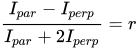
SHG polarization anisotropy can be used to determine the orientation and degree of organization of proteins in tissues since SHG signals have well-defined polarizations. By using the anisotropy equation:
Hub AI
Second-harmonic imaging microscopy AI simulator
(@Second-harmonic imaging microscopy_simulator)
Second-harmonic imaging microscopy
Second-harmonic imaging microscopy (SHIM) is based on a nonlinear optical effect known as second-harmonic generation (SHG). SHIM has been established as a viable microscope imaging contrast mechanism for visualization of cell and tissue structure and function. A second-harmonic microscope obtains contrasts from variations in a specimen's ability to generate second-harmonic light from the incident light while a conventional optical microscope obtains its contrast by detecting variations in optical density, path length, or refractive index of the specimen. SHG requires intense laser light passing through a material with a noncentrosymmetric molecular structure, either inherent or induced externally, for example by an electric field.
Second-harmonic light emerging from an SHG material is exactly half the wavelength (frequency doubled) of the light entering the material. While two-photon-excited fluorescence (TPEF) is also a two photon process, TPEF loses some energy during the relaxation of the excited state, while SHG is energy conserving. Typically, an inorganic crystal is used to produce SHG light such as lithium niobate (LiNbO3), potassium titanyl phosphate (KTP = KTiOPO4), or lithium triborate (LBO = LiB3O5). Though SHG requires a material to have specific molecular orientation in order for the incident light to be frequency doubled, some biological materials can be highly polarizable, and assemble into fairly ordered, large noncentrosymmetric structures. While some biological materials such as collagen, microtubules, and muscle myosin can produce SHG signals, even water can become ordered and produce second-harmonic signal under certain conditions, which allows SH microscopy to image surface potentials without any labeling molecules. The SHG pattern is mainly determined by the phase matching condition. A common setup for an SHG imaging system will have a laser scanning microscope with a titanium sapphire mode-locked laser as the excitation source. The SHG signal is propagated in the forward direction. However, some experiments have shown that objects on the order of about a tenth of the wavelength of the SHG produced signal will produce nearly equal forward and backward signals.
SHIM offers several advantages for live cell and tissue imaging. SHG does not involve the excitation of molecules like other techniques such as fluorescence microscopy therefore, the molecules shouldn't suffer the effects of phototoxicity or photobleaching. Also, since many biological structures produce strong SHG signals, the labeling of molecules with exogenous probes is not required which can also alter the way a biological system functions. By using near infrared wavelengths for the incident light, SHIM has the ability to construct three-dimensional images of specimens by imaging deeper into thick tissues.
Two-photons fluorescence (2PEF) is a very different process from SHG: it involves excitation of electrons to higher energy levels, and subsequent de-excitation by photon emission (unlike SHG, although it is also a 2-photon process). Thus, 2PEF is a non coherent process, spatially (emitted isotropically) and temporally (broad, sample-dependent spectrum). It is also not specific to certain structure, unlike SHG.
It can therefore be coupled to SHG in multiphoton imaging to reveal some molecules that do produce autofluorescence, like elastin in tissues (while SHG reveals collagen or myosin for instance).
Before SHG was used for imaging, the first demonstration of SHG was performed in 1961 by P. A. Franken, G. Weinreich, C. W. Peters, and A. E. Hill at the University of Michigan, Ann Arbor using a quartz sample. In 1968, SHG from interfaces was discovered by Bloembergen and has since been used as a tool for characterizing surfaces and probing interface dynamics. In 1971, Fine and Hansen reported the first observation of SHG from biological tissue samples. In 1974, Hellwarth and Christensen first reported the integration of SHG and microscopy by imaging SHG signals from polycrystalline ZnSe. In 1977, Colin Sheppard imaged various SHG crystals with a scanning optical microscope. The first biological imaging experiments were done by Freund and Deutsch in 1986 to study the orientation of collagen fibers in rat tail tendon. In 1993, Lewis examined the second-harmonic response of styryl dyes in electric fields. He also showed work on imaging live cells. In 2006, Goro Mizutani group developed a non-scanning SHG microscope that significantly shortens the time required for observation of large samples, even if the two-photons wide-field microscope was published in 1996 and could have been used to detect SHG. The non-scanning SHG microscope was used for observation of plant starch, megamolecule, spider silk and so on. In 2010 SHG was extended to whole-animal in vivo imaging. In 2019, SHG applications widened when it was applied to the use of selectively imaging agrochemicals directly on leaf surfaces to provide a way to evaluate the effectiveness of pesticides.
SHG polarization anisotropy can be used to determine the orientation and degree of organization of proteins in tissues since SHG signals have well-defined polarizations. By using the anisotropy equation:
Recent media