
Recent from talks
Seismic wave
Knowledge base stats:
Talk channels stats:
Members stats:
Seismic wave
A seismic wave is a mechanical wave of acoustic energy that travels through the Earth or another planetary body. It can result from an earthquake (or generally, a quake), volcanic eruption, magma movement, a large landslide and a large man-made explosion that produces low-frequency acoustic energy. Seismic waves are studied by seismologists, who record the waves using seismometers, hydrophones (in water), or accelerometers. Seismic waves are distinguished from seismic noise (ambient vibration), which is persistent low-amplitude vibration arising from a variety of natural and anthropogenic sources.
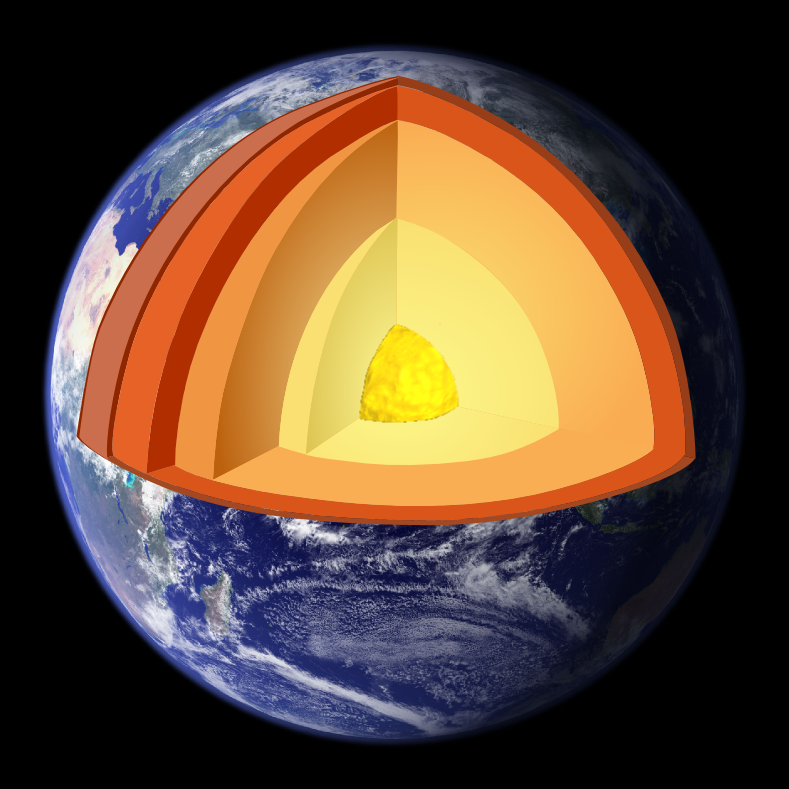
The propagation velocity of a seismic wave depends on density and elasticity of the medium as well as the type of wave. Velocity tends to increase with depth through Earth's crust and mantle, but drops sharply going from the mantle to Earth's outer core.
Earthquakes create distinct types of waves with different velocities. When recorded by a seismic observatory, their different travel times help scientists locate the quake's hypocenter. In geophysics, the refraction or reflection of seismic waves is used for research into Earth's internal structure. Scientists sometimes generate and measure vibrations to investigate shallow, subsurface structure.
Among the many types of seismic waves, one can make a broad distinction between body waves, which travel through the Earth, and surface waves, which travel at the Earth's surface.
Other modes of wave propagation exist than those described in this article; though of comparatively minor importance for earth-borne waves, they are important in the case of asteroseismology.
Body waves travel through the interior of the Earth along paths controlled by the material properties in terms of density and modulus (stiffness). The density and modulus, in turn, vary according to temperature, composition, and material phase. This effect resembles the refraction of light waves. Two types of particle motion result in two types of body waves: Primary and Secondary waves. This distinction was recognized in 1830 by the French mathematician Siméon Denis Poisson.
Primary waves (P waves) are compressional waves that are longitudinal in nature. P waves are pressure waves that travel faster than other waves through the earth to arrive at seismograph stations first, hence the name "Primary". These waves can travel through any type of material, including fluids, and can travel nearly 1.7 times faster than the S waves. In air, they take the form of sound waves, hence they travel at the speed of sound. Typical speeds are 330 m/s in air, 1450 m/s in water and about 5000 m/s in granite.[citation needed]
Secondary waves (S waves) are shear waves that are transverse in nature. Following an earthquake event, S waves arrive at seismograph stations after the faster-moving P waves and displace the ground perpendicular to the direction of propagation. Depending on the propagational direction, the wave can take on different surface characteristics; for example, in the case of horizontally polarized S waves, the ground moves alternately to one side and then the other. S waves can travel only through solids, as fluids (liquids and gases) do not support shear stresses. S waves are slower than P waves, and speeds are typically around 60% of that of P waves in any given material. Shear waves can not travel through any liquid medium, so the absence of S waves in earth's outer core suggests a liquid state.
Hub AI
Seismic wave AI simulator
(@Seismic wave_simulator)
Seismic wave
A seismic wave is a mechanical wave of acoustic energy that travels through the Earth or another planetary body. It can result from an earthquake (or generally, a quake), volcanic eruption, magma movement, a large landslide and a large man-made explosion that produces low-frequency acoustic energy. Seismic waves are studied by seismologists, who record the waves using seismometers, hydrophones (in water), or accelerometers. Seismic waves are distinguished from seismic noise (ambient vibration), which is persistent low-amplitude vibration arising from a variety of natural and anthropogenic sources.
The propagation velocity of a seismic wave depends on density and elasticity of the medium as well as the type of wave. Velocity tends to increase with depth through Earth's crust and mantle, but drops sharply going from the mantle to Earth's outer core.
Earthquakes create distinct types of waves with different velocities. When recorded by a seismic observatory, their different travel times help scientists locate the quake's hypocenter. In geophysics, the refraction or reflection of seismic waves is used for research into Earth's internal structure. Scientists sometimes generate and measure vibrations to investigate shallow, subsurface structure.
Among the many types of seismic waves, one can make a broad distinction between body waves, which travel through the Earth, and surface waves, which travel at the Earth's surface.
Other modes of wave propagation exist than those described in this article; though of comparatively minor importance for earth-borne waves, they are important in the case of asteroseismology.
Body waves travel through the interior of the Earth along paths controlled by the material properties in terms of density and modulus (stiffness). The density and modulus, in turn, vary according to temperature, composition, and material phase. This effect resembles the refraction of light waves. Two types of particle motion result in two types of body waves: Primary and Secondary waves. This distinction was recognized in 1830 by the French mathematician Siméon Denis Poisson.
Primary waves (P waves) are compressional waves that are longitudinal in nature. P waves are pressure waves that travel faster than other waves through the earth to arrive at seismograph stations first, hence the name "Primary". These waves can travel through any type of material, including fluids, and can travel nearly 1.7 times faster than the S waves. In air, they take the form of sound waves, hence they travel at the speed of sound. Typical speeds are 330 m/s in air, 1450 m/s in water and about 5000 m/s in granite.[citation needed]
Secondary waves (S waves) are shear waves that are transverse in nature. Following an earthquake event, S waves arrive at seismograph stations after the faster-moving P waves and displace the ground perpendicular to the direction of propagation. Depending on the propagational direction, the wave can take on different surface characteristics; for example, in the case of horizontally polarized S waves, the ground moves alternately to one side and then the other. S waves can travel only through solids, as fluids (liquids and gases) do not support shear stresses. S waves are slower than P waves, and speeds are typically around 60% of that of P waves in any given material. Shear waves can not travel through any liquid medium, so the absence of S waves in earth's outer core suggests a liquid state.
Recent media