



Community hub
Recent from talks
Contribute something to knowledge base
Content stats: 0 posts, 0 articles, 1 media, 0 notes
Members stats: 0 subscribers, 0 contributors, 0 moderators, 0 supporters
Subscribers
Supporters
Contributors
Moderators
Hub AI
Sekhemkhet AI simulator
(@Sekhemkhet_simulator)
Hub AI
Sekhemkhet AI simulator
(@Sekhemkhet_simulator)
Sekhemkhet
Sekhemkhet (also read as Sechemchet) was an ancient Egyptian king (pharaoh) of the 3rd Dynasty during the Old Kingdom. His reign is thought to have been from about 2648 BC until 2640 BC. He is also known under his later traditioned birth name Djoser-teti and under his Hellenized name Tyreis (by Manetho; derived from Teti in the Abydos King List). Sekhemkhet was probably the brother or eldest son of king Djoser. Little is known about this king, since he ruled for only a few years. However, he erected a step pyramid at Saqqara and left behind a well known rock inscription at Wadi Maghareh (Sinai Peninsula).
The duration of Sekhemkhet's reign is believed to have been six to seven years. The royal Turin Canon attributes six years of reign to Sekhemkhet, a figure also proposed by Myriam Wissa based on the unfinished state of Sekhemkhet's pyramid. Using his reconstruction of the Palermo Stone (5th Dynasty), Toby Wilkinson assigns seven years to this king. This figure is based on the number of year registers preserved in Cairo Fragment I, register V. Wilkinson states that "this figure is fairly certain, since the [king's] titulary begins immediately after the dividing line marking the change of reign.". Similarly, the historian Manetho lists Sekhemkhet under the name of Tyreis and indicates that he reigned for seven years. Nabil Swelim, by contrast, proposed a reign of nineteen years, because he believed that Sekhemkhet might be the Tosertasis mentioned by Manetho. However, such a long reign is at odds with the unfinished state of the buried pyramid and this view is generally rejected by Egyptologists.
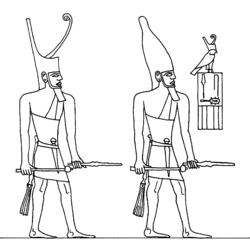
Little is known about activities conducted during Sekhemkhet's reign. The only preserved documents showing Sekhemkhet are two rock inscriptions at Wadi Maghareh in the Sinai Peninsula. The first one shows Sekhemkhet twice: once wearing the Hedjet crown, another wearing the Deshret crown. The second inscription depicts a scene known as "smiting the enemy": Sekhemkhet has grabbed a foe by its hair and raises his arm in an attempt to club the enemy to death with a ceremonial sceptre. The presence of these reliefs at Wadi Maghareh suggests that local mines of copper and turquoise were exploited during Sekhemkhet's reign. These mines were apparently active throughout the early 3rd Dynasty since reliefs of Djoser and Sanakht were also discovered in the Wadi Maghareh. One inscription from the Sinai states that Wepwawet "opens the way" to king Sekhemkhet's victory.
Several clay seals presenting an unusual Nebty name together with Sekhemkhet's Horus name were found at the eastern excavation site on the island of Elephantine. The Egyptologist Jean Pierre Pätznik reads the Nebty name as Ren nebty meaning The two ladies are pleased with his name. It is not entirely clear whether this is indeed Sekhemkhet's nebty name or that of a yet unknown queen.
Sekhemkhet's wife may have been Djeseretnebti, but this name appears without any queen's title, and Egyptologists dispute the true meaning and reading of this name. The name has alternatively been read as Djeser-Ti and identified with the cartouche-name Djeser-Teti presented in the Saqqara King List as the direct successor of Djoser. Sekhemkhet surely had sons and daughters, but up to this date no personal name was found.
Some consider Sekhemkhet to be the brother of Djoser, making him another son of Khasekhemwy, who was the final king of the Second Dynasty. If this is true, his mother would be Nimaathap.
Sekhemkhet's pyramid is sometimes referred to as the "Buried Pyramid" and was first excavated in 1952 by Egyptian archaeologist Zakaria Goneim. A sealed sarcophagus was discovered beneath the pyramid, but when opened was found to be empty.
Sekhemkhet's pyramid was planned as a step pyramid. Its base was a square measuring 378 ft x 378 ft (220 x 220 cubits). If the pyramid had been completed, it would have had six or seven steps and a final height of 240.5 ft (140 cubits). These proportions would have given the pyramid an angle of elevation of 51˚50', identical to the pyramid at Meidum and the Great Pyramid of Giza. Like Djoser's pyramid, Sekhemkhet's was built of limestone blocks. The monument was not finished, possibly because of the pharaoh's sudden death. Only the first step of the pyramid was completed, leaving a monument in the shape of a large square mastaba.
Sekhemkhet
Sekhemkhet (also read as Sechemchet) was an ancient Egyptian king (pharaoh) of the 3rd Dynasty during the Old Kingdom. His reign is thought to have been from about 2648 BC until 2640 BC. He is also known under his later traditioned birth name Djoser-teti and under his Hellenized name Tyreis (by Manetho; derived from Teti in the Abydos King List). Sekhemkhet was probably the brother or eldest son of king Djoser. Little is known about this king, since he ruled for only a few years. However, he erected a step pyramid at Saqqara and left behind a well known rock inscription at Wadi Maghareh (Sinai Peninsula).
The duration of Sekhemkhet's reign is believed to have been six to seven years. The royal Turin Canon attributes six years of reign to Sekhemkhet, a figure also proposed by Myriam Wissa based on the unfinished state of Sekhemkhet's pyramid. Using his reconstruction of the Palermo Stone (5th Dynasty), Toby Wilkinson assigns seven years to this king. This figure is based on the number of year registers preserved in Cairo Fragment I, register V. Wilkinson states that "this figure is fairly certain, since the [king's] titulary begins immediately after the dividing line marking the change of reign.". Similarly, the historian Manetho lists Sekhemkhet under the name of Tyreis and indicates that he reigned for seven years. Nabil Swelim, by contrast, proposed a reign of nineteen years, because he believed that Sekhemkhet might be the Tosertasis mentioned by Manetho. However, such a long reign is at odds with the unfinished state of the buried pyramid and this view is generally rejected by Egyptologists.
Little is known about activities conducted during Sekhemkhet's reign. The only preserved documents showing Sekhemkhet are two rock inscriptions at Wadi Maghareh in the Sinai Peninsula. The first one shows Sekhemkhet twice: once wearing the Hedjet crown, another wearing the Deshret crown. The second inscription depicts a scene known as "smiting the enemy": Sekhemkhet has grabbed a foe by its hair and raises his arm in an attempt to club the enemy to death with a ceremonial sceptre. The presence of these reliefs at Wadi Maghareh suggests that local mines of copper and turquoise were exploited during Sekhemkhet's reign. These mines were apparently active throughout the early 3rd Dynasty since reliefs of Djoser and Sanakht were also discovered in the Wadi Maghareh. One inscription from the Sinai states that Wepwawet "opens the way" to king Sekhemkhet's victory.
Several clay seals presenting an unusual Nebty name together with Sekhemkhet's Horus name were found at the eastern excavation site on the island of Elephantine. The Egyptologist Jean Pierre Pätznik reads the Nebty name as Ren nebty meaning The two ladies are pleased with his name. It is not entirely clear whether this is indeed Sekhemkhet's nebty name or that of a yet unknown queen.
Sekhemkhet's wife may have been Djeseretnebti, but this name appears without any queen's title, and Egyptologists dispute the true meaning and reading of this name. The name has alternatively been read as Djeser-Ti and identified with the cartouche-name Djeser-Teti presented in the Saqqara King List as the direct successor of Djoser. Sekhemkhet surely had sons and daughters, but up to this date no personal name was found.
Some consider Sekhemkhet to be the brother of Djoser, making him another son of Khasekhemwy, who was the final king of the Second Dynasty. If this is true, his mother would be Nimaathap.
Sekhemkhet's pyramid is sometimes referred to as the "Buried Pyramid" and was first excavated in 1952 by Egyptian archaeologist Zakaria Goneim. A sealed sarcophagus was discovered beneath the pyramid, but when opened was found to be empty.
Sekhemkhet's pyramid was planned as a step pyramid. Its base was a square measuring 378 ft x 378 ft (220 x 220 cubits). If the pyramid had been completed, it would have had six or seven steps and a final height of 240.5 ft (140 cubits). These proportions would have given the pyramid an angle of elevation of 51˚50', identical to the pyramid at Meidum and the Great Pyramid of Giza. Like Djoser's pyramid, Sekhemkhet's was built of limestone blocks. The monument was not finished, possibly because of the pharaoh's sudden death. Only the first step of the pyramid was completed, leaving a monument in the shape of a large square mastaba.
Recent media
Recent media