



Community hub
Recent from talks
Knowledge base stats:
Talk channels stats:
Members stats:
Senkaku Islands
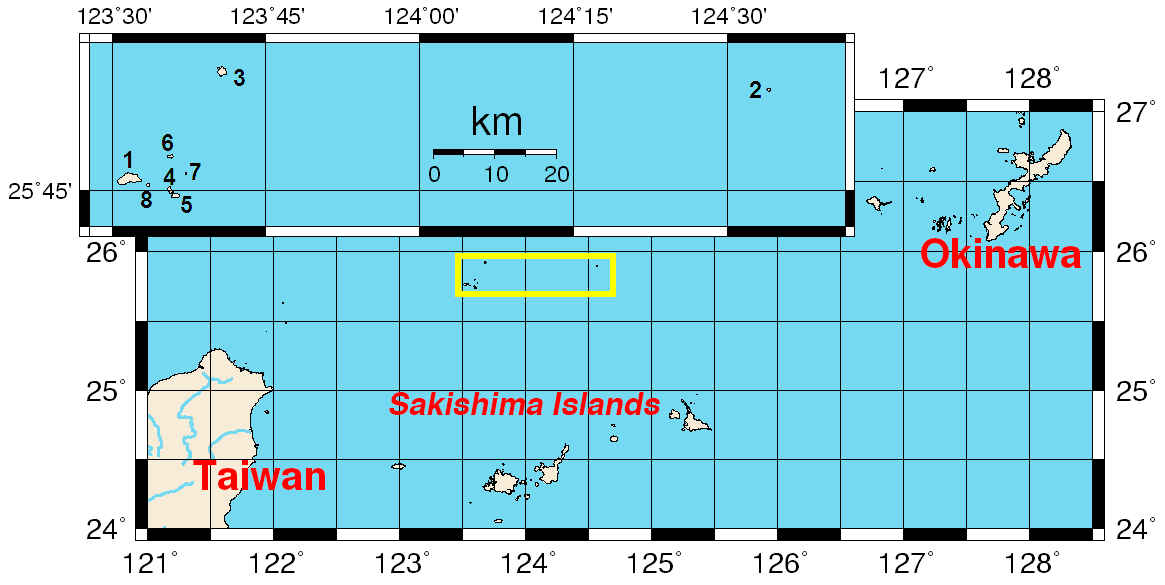
The Senkaku Islands, known as the Diaoyu Islands in China and the Diaoyutai Islands in Taiwan, are a group of uninhabited islands in the East China Sea, administered by Japan. They were historically known in the Western world as the Pinnacle Islands. The islands are located northeast of Taiwan, east of China, west of Okinawa Island, and north of the southwestern end of the Ryukyu Islands.
The islands are the focus of a territorial dispute between Japan, China and Taiwan. China claims the discovery and ownership of the islands from the 14th century, while Japan maintained ownership of the islands from 1895 until its surrender at the end of World War II. The United States received administrative rights of the islands from Japan under the Treaty of San Francisco and administered the islands as part of the United States Civil Administration of the Ryukyu Islands from 1945 until 1972, before returning them to Japanese control under the Okinawa Reversion Agreement. The discovery of potential undersea oil reserves in 1968 in the area was a catalyst for further interest in the disputed islands. Despite the diplomatic stalemate between China and Taiwan, both governments agree that the islands are part of Taiwan as part of Toucheng Township in Yilan County. Japan administers the Senkaku islands as part of the city of Ishigaki in Okinawa Prefecture. It does not acknowledge the claims of China nor Taiwan, but it has not allowed the Ishigaki administration to develop the islands.
As a result of the dispute, public access to the uninhabited islands is restricted; Japan’s central government has denied landing requests even from local authorities. Although the islands are administered by Japan since 1895, a continuity interrupted only by US administration from 1945 to 1972, this long-standing status quo has been increasingly challenged by China since 2010s; Since the early 2010s, China Coast Guard have frequently entered the surrounding waters of the islands, prompting responses and exchanges of warnings with the Japan Coast Guard. China has also announced territorial-sea baselines (2012) and established an East China Sea ADIZ (2013), all of which are contested by Japan. The United States, which returned administrative right of the islands to Japan in 1972, takes no position on the ultimate sovereignty but acknowledges that the islands are under Japanese administration and are covered by the US–Japan security treaty. Recent US–Japan statements also refer to Japan’s longstanding administration and oppose any unilateral actions that seek to undermine it .
The Senkaku Islands are important nesting sites for seabirds, and are one of two remaining nesting sites in the world for the short-tailed albatross, alongside Tori-shima, Izu Islands.
The islands are referred to as the Senkaku Islands (尖閣諸島, Senkaku-shotō; variants: 尖閣群島 Senkaku-guntō and 尖閣列島 Senkaku-rettō) in Japanese. In mainland China, they are known as the Diaoyu Islands (Chinese: 钓鱼岛; pinyin: Diàoyúdǎo) or more fully "Diaoyu Dao and its affiliated islands" (Chinese: 钓鱼岛及其附属岛屿; pinyin: Diàoyúdǎo jí qí fùshǔ dǎoyǔ), while in Taiwan they are called the Diaoyutai Islands, or previously spelled as Tiaoyutai Islands (Chinese: 釣魚臺列嶼; pinyin: Diàoyútái liè yǔ). In Western sources, the historical English name Pinnacle Islands is occasionally still used when neutrality among the competing national claims is desirable.
In Okinawan (northern Ryukyu), the islands are known as ʔiyukubajima (魚蒲葵島), while their Yaeyama (southern Ryukyu) name is iigunkubajima.
Chinese records of these islands date back to as early as the 15th century when they were referred as Diaoyu in books such as Voyage with a Tail Wind (Chinese: 順風相送; pinyin: Shùnfēng Xiāngsòng) (1403) and Record of the Imperial Envoy's Visit to Ryūkyū (Chinese: 使琉球錄; pinyin: Shǐ Liúqiú Lù) (1534).[citation needed] Adopted by the Chinese Imperial Map of the Ming Dynasty, the Chinese name for the island group (Diaoyu) and the Japanese name for the main island (Uotsuri) both mean "fishing".
Historically, the Chinese had used the uninhabited islands as navigational markers in making the voyage to the Ryukyu Kingdom upon commencement of diplomatic missions to the kingdom, "resetting the compass at a particular isle in order to reach the next one".
Hub AI
Senkaku Islands AI simulator
(@Senkaku Islands_simulator)
Senkaku Islands
The Senkaku Islands, known as the Diaoyu Islands in China and the Diaoyutai Islands in Taiwan, are a group of uninhabited islands in the East China Sea, administered by Japan. They were historically known in the Western world as the Pinnacle Islands. The islands are located northeast of Taiwan, east of China, west of Okinawa Island, and north of the southwestern end of the Ryukyu Islands.
The islands are the focus of a territorial dispute between Japan, China and Taiwan. China claims the discovery and ownership of the islands from the 14th century, while Japan maintained ownership of the islands from 1895 until its surrender at the end of World War II. The United States received administrative rights of the islands from Japan under the Treaty of San Francisco and administered the islands as part of the United States Civil Administration of the Ryukyu Islands from 1945 until 1972, before returning them to Japanese control under the Okinawa Reversion Agreement. The discovery of potential undersea oil reserves in 1968 in the area was a catalyst for further interest in the disputed islands. Despite the diplomatic stalemate between China and Taiwan, both governments agree that the islands are part of Taiwan as part of Toucheng Township in Yilan County. Japan administers the Senkaku islands as part of the city of Ishigaki in Okinawa Prefecture. It does not acknowledge the claims of China nor Taiwan, but it has not allowed the Ishigaki administration to develop the islands.
As a result of the dispute, public access to the uninhabited islands is restricted; Japan’s central government has denied landing requests even from local authorities. Although the islands are administered by Japan since 1895, a continuity interrupted only by US administration from 1945 to 1972, this long-standing status quo has been increasingly challenged by China since 2010s; Since the early 2010s, China Coast Guard have frequently entered the surrounding waters of the islands, prompting responses and exchanges of warnings with the Japan Coast Guard. China has also announced territorial-sea baselines (2012) and established an East China Sea ADIZ (2013), all of which are contested by Japan. The United States, which returned administrative right of the islands to Japan in 1972, takes no position on the ultimate sovereignty but acknowledges that the islands are under Japanese administration and are covered by the US–Japan security treaty. Recent US–Japan statements also refer to Japan’s longstanding administration and oppose any unilateral actions that seek to undermine it .
The Senkaku Islands are important nesting sites for seabirds, and are one of two remaining nesting sites in the world for the short-tailed albatross, alongside Tori-shima, Izu Islands.
The islands are referred to as the Senkaku Islands (尖閣諸島, Senkaku-shotō; variants: 尖閣群島 Senkaku-guntō and 尖閣列島 Senkaku-rettō) in Japanese. In mainland China, they are known as the Diaoyu Islands (Chinese: 钓鱼岛; pinyin: Diàoyúdǎo) or more fully "Diaoyu Dao and its affiliated islands" (Chinese: 钓鱼岛及其附属岛屿; pinyin: Diàoyúdǎo jí qí fùshǔ dǎoyǔ), while in Taiwan they are called the Diaoyutai Islands, or previously spelled as Tiaoyutai Islands (Chinese: 釣魚臺列嶼; pinyin: Diàoyútái liè yǔ). In Western sources, the historical English name Pinnacle Islands is occasionally still used when neutrality among the competing national claims is desirable.
In Okinawan (northern Ryukyu), the islands are known as ʔiyukubajima (魚蒲葵島), while their Yaeyama (southern Ryukyu) name is iigunkubajima.
Chinese records of these islands date back to as early as the 15th century when they were referred as Diaoyu in books such as Voyage with a Tail Wind (Chinese: 順風相送; pinyin: Shùnfēng Xiāngsòng) (1403) and Record of the Imperial Envoy's Visit to Ryūkyū (Chinese: 使琉球錄; pinyin: Shǐ Liúqiú Lù) (1534).[citation needed] Adopted by the Chinese Imperial Map of the Ming Dynasty, the Chinese name for the island group (Diaoyu) and the Japanese name for the main island (Uotsuri) both mean "fishing".
Historically, the Chinese had used the uninhabited islands as navigational markers in making the voyage to the Ryukyu Kingdom upon commencement of diplomatic missions to the kingdom, "resetting the compass at a particular isle in order to reach the next one".