
Recent from talks
Sequence alignment
Knowledge base stats:
Talk channels stats:
Members stats:
Sequence alignment
In bioinformatics, a sequence alignment is a way of arranging the sequences of DNA, RNA, or protein to identify regions of similarity that may be a consequence of functional, structural, or evolutionary relationships between the sequences. Aligned sequences of nucleotide or amino acid residues are typically represented as rows within a matrix. Gaps are inserted between the residues so that identical or similar characters are aligned in successive columns. Sequence alignments are also used for non-biological sequences such as calculating the distance cost between strings in a natural language, or to display financial data.
If two sequences in an alignment share a common ancestor, mismatches can be interpreted as point mutations and gaps as indels (that is, insertion or deletion mutations) introduced in one or both lineages in the time since they diverged from one another. In sequence alignments of proteins, the degree of similarity between amino acids occupying a particular position in the sequence can be interpreted as a rough measure of how conserved a particular region or sequence motif is among lineages. The absence of substitutions, or the presence of only very conservative substitutions (that is, the substitution of amino acids whose side chains have similar biochemical properties) in a particular region of the sequence, suggest that this region has structural or functional importance. Although DNA and RNA nucleotide bases are more similar to each other than are amino acids, the conservation of base pairs can indicate a similar functional or structural role.
Very short or very similar sequences can be aligned by hand. However, most interesting problems require the alignment of lengthy, highly variable or extremely numerous sequences that cannot be aligned solely by human effort. Various algorithms were devised to produce high-quality sequence alignments, and occasionally in adjusting the final results to reflect patterns that are difficult to represent algorithmically (especially in the case of nucleotide sequences). Computational approaches to sequence alignment generally fall into two categories: global alignments and local alignments. Calculating a global alignment is a form of global optimization that "forces" the alignment to span the entire length of all query sequences. By contrast, local alignments identify regions of similarity within long sequences that are often widely divergent overall. Local alignments are often preferable, but can be more difficult to calculate because of the additional challenge of identifying the regions of similarity. A variety of computational algorithms have been applied to the sequence alignment problem. These include slow but formally correct methods like dynamic programming. These also include efficient, heuristic algorithms or probabilistic methods designed for large-scale database search, that do not guarantee to find best matches.
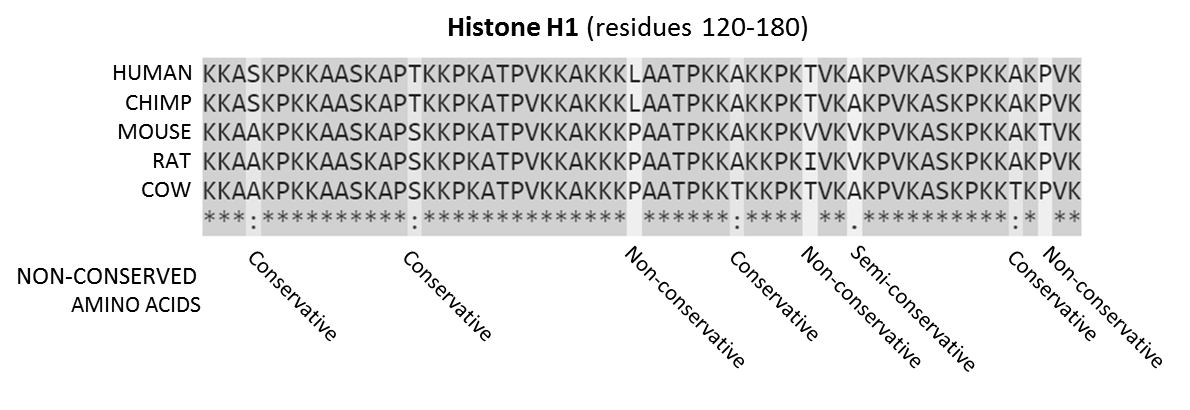
Alignments are commonly represented both graphically and in text format. In almost all sequence alignment representations, sequences are written in rows arranged so that aligned residues appear in successive columns. In text formats, aligned columns containing identical or similar characters are indicated with a system of conservation symbols. As in the image above, an asterisk or pipe symbol is used to show identity between two columns; other less common symbols include a colon for conservative substitutions and a period for semiconservative substitutions. Many sequence visualization programs also use color to display information about the properties of the individual sequence elements; in DNA and RNA sequences, this equates to assigning each nucleotide its own color. In protein alignments, such as the one in the image above, color is often used to indicate amino acid properties to aid in judging the conservation of a given amino acid substitution. For multiple sequences the last row in each column is often the consensus sequence determined by the alignment; the consensus sequence is also often represented in graphical format with a sequence logo in which the size of each nucleotide or amino acid letter corresponds to its degree of conservation.
Sequence alignments can be stored in a wide variety of text-based file formats, many of which were originally developed in conjunction with a specific alignment program or implementation. Most web-based tools allow a limited number of input and output formats, such as FASTA format and GenBank format and the output is not easily editable. Several conversion programs that provide graphical and/or command line interfaces are available, such as READSEQ and EMBOSS. There are also several programming packages which provide this conversion functionality, such as BioPython, BioRuby and BioPerl. The SAM/BAM files use the CIGAR (Compact Idiosyncratic Gapped Alignment Report) string format to represent an alignment of a sequence to a reference by encoding a sequence of events (e.g. match/mismatch, insertions, deletions).
Ref. : GTCGTAGAATA
Read: CACGTAG—TA
CIGAR: 2S5M2D2M
where:
2S = 2 soft clipping (could be mismatches, or a read longer than the matched sequence)
5M = 5 matches or mismatches
2D = 2 deletions
2M = 2 matches or mismatches
The original CIGAR format from the exonerate alignment program did not distinguish between mismatches or matches with the M character.
The SAMv1 spec document defines newer CIGAR codes. In most cases it is preferred to use the '=' and 'X' characters to denote matches or mismatches rather than the older 'M' character, which is ambiguous.
Hub AI
Sequence alignment AI simulator
(@Sequence alignment_simulator)
Sequence alignment
In bioinformatics, a sequence alignment is a way of arranging the sequences of DNA, RNA, or protein to identify regions of similarity that may be a consequence of functional, structural, or evolutionary relationships between the sequences. Aligned sequences of nucleotide or amino acid residues are typically represented as rows within a matrix. Gaps are inserted between the residues so that identical or similar characters are aligned in successive columns. Sequence alignments are also used for non-biological sequences such as calculating the distance cost between strings in a natural language, or to display financial data.
If two sequences in an alignment share a common ancestor, mismatches can be interpreted as point mutations and gaps as indels (that is, insertion or deletion mutations) introduced in one or both lineages in the time since they diverged from one another. In sequence alignments of proteins, the degree of similarity between amino acids occupying a particular position in the sequence can be interpreted as a rough measure of how conserved a particular region or sequence motif is among lineages. The absence of substitutions, or the presence of only very conservative substitutions (that is, the substitution of amino acids whose side chains have similar biochemical properties) in a particular region of the sequence, suggest that this region has structural or functional importance. Although DNA and RNA nucleotide bases are more similar to each other than are amino acids, the conservation of base pairs can indicate a similar functional or structural role.
Very short or very similar sequences can be aligned by hand. However, most interesting problems require the alignment of lengthy, highly variable or extremely numerous sequences that cannot be aligned solely by human effort. Various algorithms were devised to produce high-quality sequence alignments, and occasionally in adjusting the final results to reflect patterns that are difficult to represent algorithmically (especially in the case of nucleotide sequences). Computational approaches to sequence alignment generally fall into two categories: global alignments and local alignments. Calculating a global alignment is a form of global optimization that "forces" the alignment to span the entire length of all query sequences. By contrast, local alignments identify regions of similarity within long sequences that are often widely divergent overall. Local alignments are often preferable, but can be more difficult to calculate because of the additional challenge of identifying the regions of similarity. A variety of computational algorithms have been applied to the sequence alignment problem. These include slow but formally correct methods like dynamic programming. These also include efficient, heuristic algorithms or probabilistic methods designed for large-scale database search, that do not guarantee to find best matches.
Alignments are commonly represented both graphically and in text format. In almost all sequence alignment representations, sequences are written in rows arranged so that aligned residues appear in successive columns. In text formats, aligned columns containing identical or similar characters are indicated with a system of conservation symbols. As in the image above, an asterisk or pipe symbol is used to show identity between two columns; other less common symbols include a colon for conservative substitutions and a period for semiconservative substitutions. Many sequence visualization programs also use color to display information about the properties of the individual sequence elements; in DNA and RNA sequences, this equates to assigning each nucleotide its own color. In protein alignments, such as the one in the image above, color is often used to indicate amino acid properties to aid in judging the conservation of a given amino acid substitution. For multiple sequences the last row in each column is often the consensus sequence determined by the alignment; the consensus sequence is also often represented in graphical format with a sequence logo in which the size of each nucleotide or amino acid letter corresponds to its degree of conservation.
Sequence alignments can be stored in a wide variety of text-based file formats, many of which were originally developed in conjunction with a specific alignment program or implementation. Most web-based tools allow a limited number of input and output formats, such as FASTA format and GenBank format and the output is not easily editable. Several conversion programs that provide graphical and/or command line interfaces are available, such as READSEQ and EMBOSS. There are also several programming packages which provide this conversion functionality, such as BioPython, BioRuby and BioPerl. The SAM/BAM files use the CIGAR (Compact Idiosyncratic Gapped Alignment Report) string format to represent an alignment of a sequence to a reference by encoding a sequence of events (e.g. match/mismatch, insertions, deletions).
Ref. : GTCGTAGAATA
Read: CACGTAG—TA
CIGAR: 2S5M2D2M
where:
2S = 2 soft clipping (could be mismatches, or a read longer than the matched sequence)
5M = 5 matches or mismatches
2D = 2 deletions
2M = 2 matches or mismatches
The original CIGAR format from the exonerate alignment program did not distinguish between mismatches or matches with the M character.
The SAMv1 spec document defines newer CIGAR codes. In most cases it is preferred to use the '=' and 'X' characters to denote matches or mismatches rather than the older 'M' character, which is ambiguous.
Recent media