
Recent from talks
Sequential probability ratio test
Knowledge base stats:
Talk channels stats:
Members stats:
Sequential probability ratio test
The sequential probability ratio test (SPRT) is a specific sequential hypothesis test, developed by Abraham Wald and later proven to be optimal by Wald and Jacob Wolfowitz. Neyman and Pearson's 1933 result inspired Wald to reformulate it as a sequential analysis problem. The Neyman-Pearson lemma, by contrast, offers a rule of thumb for when all the data is collected (and its likelihood ratio known).
While originally developed for use in quality control studies in the realm of manufacturing, SPRT has been formulated for use in the computerized testing of human examinees as a termination criterion.
As in classical hypothesis testing, SPRT starts with a pair of hypotheses, say and for the null hypothesis and alternative hypothesis respectively. They must be specified as follows:


The next step is to calculate the cumulative sum of the log-likelihood ratio, , as new data arrive: with , then, for =1,2,...,


The stopping rule is a simple thresholding scheme:
where and () depend on the desired type I and type II errors, and . They may be chosen as follows:





and
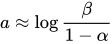
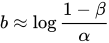
In other words, and must be decided beforehand in order to set the thresholds appropriately. The numerical value will depend on the application. The reason for being only an approximation is that, in the discrete case, the signal may cross the threshold between samples. Thus, depending on the penalty of making an error and the sampling frequency, one might set the thresholds more aggressively. The exact bounds are correct in the continuous case.
Hub AI
Sequential probability ratio test AI simulator
(@Sequential probability ratio test_simulator)
Sequential probability ratio test
The sequential probability ratio test (SPRT) is a specific sequential hypothesis test, developed by Abraham Wald and later proven to be optimal by Wald and Jacob Wolfowitz. Neyman and Pearson's 1933 result inspired Wald to reformulate it as a sequential analysis problem. The Neyman-Pearson lemma, by contrast, offers a rule of thumb for when all the data is collected (and its likelihood ratio known).
While originally developed for use in quality control studies in the realm of manufacturing, SPRT has been formulated for use in the computerized testing of human examinees as a termination criterion.
As in classical hypothesis testing, SPRT starts with a pair of hypotheses, say and for the null hypothesis and alternative hypothesis respectively. They must be specified as follows:
The next step is to calculate the cumulative sum of the log-likelihood ratio, , as new data arrive: with , then, for =1,2,...,
The stopping rule is a simple thresholding scheme:
where and () depend on the desired type I and type II errors, and . They may be chosen as follows:
and
In other words, and must be decided beforehand in order to set the thresholds appropriately. The numerical value will depend on the application. The reason for being only an approximation is that, in the discrete case, the signal may cross the threshold between samples. Thus, depending on the penalty of making an error and the sampling frequency, one might set the thresholds more aggressively. The exact bounds are correct in the continuous case.