Hubbry Logo
Set (card game)Set (card game)Main
Open search
Set (card game)
Community hub
Set (card game)
logo
8 pages, 0 posts
0 subscribers
Be the first to start a discussion here.
Set (card game)
Set (card game)
from Wikipedia

Set
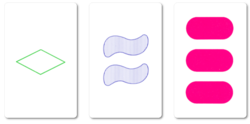
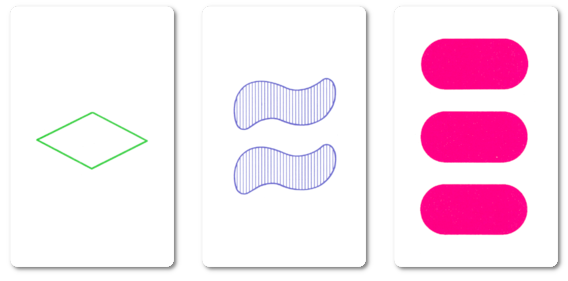
Three cards from a Set deck. These cards each have a unique number, symbol, shading, and color, and are thus a "set".
TypeReal-time
Players1+[1]
SkillsVisualization, logical reasoning, ability to focus
Age range6 years +[1]
Cards81

Set (stylized as SET or SET!) is a real-time card game designed by Marsha Falco in 1974 and published by Set Enterprises in 1991. The deck consists of 81 unique cards that vary in four features across three possibilities for each kind of feature: number of shapes (one, two, or three), shape (diamond, squiggle, oval), shading (solid, striped, or open), and color (red, green, or purple).[2] Each possible combination of features (e.g. a card with three striped green diamonds) appears as a card precisely once in the deck.

Gameplay

[edit]

In the game, certain combinations of three cards are said to make up a "set". For each one of the four categories of features—color, number, shape, and shading—the three cards must display that feature as either a) all the same, or b) all different. Put another way: For each feature the three cards must avoid having two cards showing one version of the feature and the remaining card showing a different version.

For example, 3 solid red diamonds, 2 solid green squiggles, and 1 solid purple oval form a set, because the shadings of the three cards are all the same, while the numbers, the colors, and the shapes among the three cards are all different.

For any set, the number of features that are constant (the same on all three cards) and the number of features that differ (different on all three cards) may break down as: all 4 features differing; or 1 feature being constant and 3 differing; or 2 constant and 2 differing; or 3 constant and 1 differing. (All 4 features being constant would imply that the three cards in the set are identical, which is impossible since no cards in the Set deck are identical.)

The final round of the First Annual National Set Championship.

History

[edit]

The game evolved out of a coding system that the designer used in her job as a geneticist. The shapes are based on those in ISO 5807.[3] Set won American Mensa's Mensa Select award in 1991 and placed 9th in the 1995 Deutscher Spiele Preis.

The First Annual National Set Championship was hosted on January 8, 2025 at the Joint Mathematics Meeting in Seattle, Washington. Approximately 150 players competed, with Taiki Aiba winning first prize: a customized boxing style belt.[4] The next tournament will be held at the Joint Mathematics Meeting 2026, in Washington DC.

Games

[edit]
A group of people at a table playing set
Playing Set

Several games can be played with these cards, all involving the concept of a set. A set consists of three cards satisfying all of these conditions:

  • They all have the same number or have three different numbers.
  • They all have the same shape or have three different shapes.
  • They all have the same shading or have three different shadings.
  • They all have the same color or have three different colors.

The rules of Set are summarized by: If you can sort a group of three cards into "two of ____ and one of ____", then it is not a set.

For example, these three cards form a set:

  • One red striped diamond
  • Two red solid diamonds
  • Three red open diamonds

Given any two cards from the deck, there is one and only one other card that forms a set with them.

In the standard Set game, the dealer lays out cards on the table until either twelve are laid down or someone sees a set and calls "Set!". The player who called "Set" takes the cards in the set, and the dealer continues to deal out cards until twelve are on the table. A player who sees a set among the twelve cards calls "Set" and takes the three cards, and the dealer lays three more cards on the table. (To call out "set" and not pick one up quickly enough results in a penalty.) There may be no set among the twelve cards; in this case, the dealer deals out three more cards to make fifteen dealt cards, or eighteen or more, as necessary. This process of dealing by threes and finding sets continues until the deck is exhausted and there are no more sets on the table. At this point, whoever has collected the most sets wins.

Variants were included with the Set game that involve different mechanics to find sets, as well as different player interaction. Additional variants continue to be created by avid players of the game.[5][6]

Basic combinatorics of Set

[edit]
A complete set of 81 cards isomorphic with those of the game Set showing all possible combinations of the four features. Considering each 3×3 group as a plane aligned in 4-dimensional space, a set comprises 3 cards in a (4-dimensional) row, with wrap-around. An example 20-card cap set is shaded yellow.
  • Given any two cards, there is exactly one card that forms a set with those two cards. Therefore, the probability of producing a Set from 3 randomly drawn cards from a complete deck is 1/79.
  • A cap set is a mathematical structure describing a Set layout in which no set may be taken. The largest group of cards that can be put together without creating a set is 20, proven in 1971 (cap sets were studied before the game).[7][8][9] Such a group is called a maximal cap set (sequence A090245 in the OEIS). Donald Knuth found in 2001 that there are 682344 such cap sets of size 20 for the 81-card version of Set; under affine transformations on 4-dimensional finite space, they all reduce to essentially one cap set.
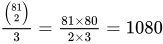
  • There are unique sets.
  • The probability that a set will have features different and features the same is . (Note: The case where d = 0 is impossible, since no two cards are identical.) Thus, 10% of possible sets differ in one feature, 30% in two features, 40% in three features, and 20% in all four features.
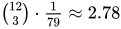
  • The number of different 12-card deals is .
  • The odds against there being no Set in 12 cards when playing a game of Set start off at 30:1 for the first round. Then they quickly fall, and after about the 4th round they are 14:1 and for the next 20 rounds, they slowly fall towards 13:1. So for most of the rounds played, the odds are between 14:1 and 13:1.[10]
  • The odds against there being no Set in 15 cards when playing a game are 88:1.[10] (This is different from the odds against there being no Set in any 15 cards (which is 2700:1) since during play, 15 cards are only shown when a group of 12 cards has no Set.)
  • Around 30% of all games always have a Set among the 12 cards, and thus never need to go to 15 cards.[11]
  • The maximum number of Sets for 12 cards is 14.[12]
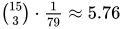
  • The average number of available Sets among 12 cards is and among 15 cards . However, in play the numbers are smaller.
  • If there were 26 sets picked from the deck, the last three cards would necessarily form another 27th set.
Complexity

[edit]

Using a natural generalization of Set, where the number of properties and values vary, it was shown that determining whether a set exists from a collection of dealt cards is NP-complete.[13]

Reviews

[edit]

Set appears in the February 1992 issue of Games magazine, where Eric Berlin describes the game as an "addictive, highly original game of perception and logic," and a "fascinating challenging for either solitaire or competitive play".[14] It has also appeared in the 1992 Games 100[15] and Family Games: The 100 Best.[16]

See also

[edit]

References

[edit]
[edit]
Revisions and contributorsEdit on WikipediaRead on Wikipedia
from Grokipedia
Set is a real-time card game of visual perception, invented by geneticist Marsha Jean Falco in 1974 as a tool to organize her research data on canine epilepsy, and first published commercially in 1990 by Set Enterprises. The game utilizes a deck of 81 unique cards, each defined by four attributes—number (one, two, or three symbols), color (red, purple, or green), shape (diamond, oval, or squiggle), and shading (solid, striped, or open)—with players simultaneously scanning a layout of 12 cards to identify and claim "sets" of three cards where, for each attribute, the values are either all identical or all distinct. In gameplay, which accommodates 1 to 20 players and typically lasts 20–60 minutes, no strict turns exist; instead, participants race to spot a set by shouting "Set!" and touching the three cards, after which the group verifies the claim—if valid, the player collects the cards for a point and three new cards are drawn to maintain 12 on the table, but an incorrect call results in a penalty point and the cards remain. The game ends when the deck is exhausted and no more sets can be found among the remaining cards on the table, with the player having collected the most sets declared the winner; solo variants involve timed challenges to find all sets in a layout. Suitable for ages 6 and up, Set emphasizes rapid pattern recognition and has sold over 10 million copies worldwide, fostering educational applications in mathematics and logic. Mathematically, Set is rooted in finite geometry, representing the deck as points in a four-dimensional vector space over the finite field GF(3), where each card is a vector with coordinates from {0,1,2}, yielding 3^4 = 81 cards, and a set corresponds to three collinear points summing to the zero vector modulo 3. This structure ensures that any two cards determine exactly one completing set, with a high probability (over 97%) of at least one set in any 12-card layout, and has inspired research in combinatorics, including proofs on maximal set-free configurations. Falco's creation, born from her scientific background, evolved into a flagship product for PlayMonster (formerly Set Enterprises), spawning variants like Set Junior and digital adaptations while maintaining its core appeal as a blend of intuition and deduction.

Components and Setup

Deck Composition

The standard deck of the Set card game consists of 81 unique cards, each representing a distinct combination of four attributes. This total arises from the three possible values for each of the four attributes, yielding 34=813^4 = 81 cards. The four attributes defining each card are number, shape, color, and shading. The number attribute features one, two, or three symbols on the card; the shape attribute includes diamond, oval, or squiggle; the color attribute encompasses red, green, or purple; and the shading attribute consists of solid, striped, or open (outlined). Every card displays these attributes simultaneously, with no duplicates in the deck due to the exhaustive enumeration of all combinations. To begin a game, the deck is shuffled, and 12 cards are laid face up in a 3x4 rectangular grid on the playing surface. The remaining cards form a draw pile, from which additional cards are revealed as gameplay progresses.

Card Attributes

Each card in the Set deck features four independent visual attributes that define its unique identity: number, shape, color, and shading. These attributes vary independently, ensuring that all 81 cards represent distinct combinations with no duplicates. The cards contain no text or numbers, relying entirely on symbolic visuals for recognition. The number attribute indicates the quantity of symbols on the card, which can be one, two, or three identical figures. These figures are arranged horizontally across the card if multiple, or centered if singular, maintaining symmetry in presentation. The shape attribute consists of three distinct geometric forms: an oval (also called a capsule or ribbon), a diamond, and a squiggle (a wavy, abstract line). Each card displays symbols of only one shape, scaled proportionally to the number attribute. The color attribute uses three primary hues: , , and , applied uniformly to all symbols on a given card. These colors are vibrant and distinct to facilitate quick visual differentiation. The shading attribute provides three levels of fill for the symbols: an empty outline (unshaded), partial with diagonal stripes, and fully solid fill. This is consistent across all symbols on the card, enhancing the perceptual challenge without altering the underlying or color. These attributes form the basis for identifying sets during gameplay, where three cards must match in being either all the same or all different across each feature.

Gameplay

Objective and Rules

The objective of Set is for players to race against one another to identify and claim the maximum number of sets from cards laid out on the table, where a set consists of three cards such that, for each of the four attributes, the values are either all identical or all different across the three cards. The game emphasizes visual perception and logical reasoning, with all players competing simultaneously without taking turns. Play begins with 12 cards dealt face-up in a layout, and if all players agree that no set exists, three more cards are added to the layout; this process can be repeated if still no set is found. To claim a set, a player must call out "Set!" and immediately collect the three cards, after which the other players verify its validity. If the claimed cards form a valid set, they are removed from the layout and replaced with three new cards from the deck, and the claimant scores a point; if invalid, the claimant incurs a one-point penalty, and the cards are returned to the layout. If all players agree that no sets remain in the layout, three more cards may be added to continue play until the deck is exhausted. The dealer or group consensus handles validation to ensure fairness, with disputes resolved by checking the attributes systematically.

Finding Sets

In the Set card game, a valid set consists of three cards where, for each of the four attributes—number of shapes, , color, and —the values on the cards are either all the same or all different across the three cards. No partial matches are allowed; that is, for any given attribute, it cannot be the case that two cards share the same value while the third differs. This criterion must hold simultaneously for all four attributes on the selected cards. To illustrate, consider three cards each featuring a single red oval, but with differing shading: one solid, one striped, and one outlined (or open). Here, the number (one shape) is the same on all three, the shape () is the same, the color () is the same, and the shading varies completely (solid, striped, outlined), forming a valid set. Another example might involve three cards with two purple diamonds each, but one solid, one striped, and one outlined: the number (two) and shape () match across all, the color () matches, and the shading differs entirely. These examples demonstrate how the rule enforces a strict logical pattern, akin to vector addition modulo 3 in a mathematical sense, though the game emphasizes visual recognition over computation. A common pitfall occurs when players mistakenly select cards where, for at least one attribute, two cards match while the third does not—such as two cards with red ovals and a third with a purple oval, even if other attributes align perfectly. This configuration violates the all-same-or-all-different rule for the color attribute, rendering the trio invalid regardless of the other features. Similarly, attempting a set with two solid shadings and one striped fails for the shading attribute alone. Such errors highlight the need for holistic evaluation across all attributes. Players succeed by scanning the layout for these patterns, often training the eye to detect consistencies or contrasts in each attribute independently before verifying the full combination. This visual emphasis encourages rapid pattern recognition, as sets emerge from the interplay of similarities and differences rather than isolated card matches.

Game Flow and Winning

The game begins with a designated dealer shuffling the 81-card deck and laying out 12 cards face up in a 3x4 rectangular layout on the table. All players simultaneously scan the layout for sets, defined by the rule that for each of the four attributes, the three cards must be all the same or all different. There are no formal turns; the first player to spot a valid set calls out "Set!" to claim it, pausing play while they identify and remove the three cards. If the claim is verified as correct by the other players, the claimant keeps the cards as a point, and the dealer immediately replaces them with three new cards from the deck to maintain the 12-card layout. Upon calling "Set!", the player identifies the specific cards. If the claimed set is incorrect, the cards are returned to the layout, the player loses one point as a penalty, and play resumes immediately. Should the group agree that no set exists in the current 12-card layout, the dealer adds three additional cards from the deck, expanding the layout to 15 cards. The three additional cards remain until a set is claimed (which will include at least one of them), at which point three new cards replace the set to return to 12 cards; this can be repeated if still no set is found. Play continues in this manner until the deck is fully depleted and no additional sets can be found in the final layout, at which point the game ends. The winner is the player who has claimed the most sets (one point each), with ties possible in close games. A standard game typically lasts 20-45 minutes and accommodates 2 to 20 players, though solo play is possible by self-scoring sets without penalties, and team variants can be used for larger groups by pooling points.

History and Development

Origins and Publication

The Set card game was invented in 1974 by Marsha Jean Falco, a population geneticist, while she was conducting research on in dogs in , . To better visualize complex genetic traits and relationships among the animals, Falco created an initial deck of paper cards, each representing a unique combination of attributes inspired by genetic markers such as traits in cows and dogs. Over the next 15 years, Falco iteratively developed the game from these handmade prototypes, sharing versions with colleagues and friends to test and refine its mechanics based on attribute matching for . The game circulated informally through word-of-mouth in scientific and academic circles, where it began attracting enthusiasts for its perceptual challenges long before commercial availability. In 1988, Falco copyrighted the game under its final form. She then founded Set Enterprises, Inc. in 1989, which handled its initial self-publication and released the first commercial edition in 1990, positioning it as a family-oriented game of to appeal to a broad audience beyond research applications. In April 2019, Set Enterprises was acquired by PlayMonster.

Awards and Tournaments

Upon its release, Set received several notable awards recognizing its innovative design and appeal. In 1991, it won the Mensa Select award, selected by American Mensa for its originality, challenge, and quality. The game placed ninth in the 1995 , a prestigious German board game award based on community votes. Additionally, Set was included in Games magazine's Games 100 list in 1992, highlighting top games of the year. Organized tournaments for Set have grown in prominence, particularly within mathematical and gaming communities. The first official National Set Championship took place on January 8, 2025, during the Joint Mathematics Meetings in Seattle, Washington, drawing players to compete in a structured event open to all skill levels. Annual events are planned, with the second scheduled for January 6, 2026, at the Joint Mathematics Meetings in Washington, D.C. Competitive play adapts standard rules for timed rounds, typically lasting about 20 minutes each, where players score 1 point for each valid set identified and deduct 1 point for incorrect calls; multiple preliminary rounds determine advancement to finals, with tiebreakers resolved through additional short games if scores are level. Set's tournament scene is closely tied to academic communities, especially conferences. The game has been featured at events like the Joint Mathematics Meetings since at least 2025, fostering competitive play among mathematicians and enthusiasts. This involvement highlights Set's role in promoting and combinatorial skills, contributing to a surge in organized play following increased online accessibility during the .

Variants and Adaptations

Physical Editions and Variants

The standard edition of Set consists of an 81-card deck, each featuring one to three symbols varying across four attributes: number, , color, and . This core physical product, produced by Set Enterprises (later acquired by PlayMonster), has remained largely unchanged since its 1990 publication, with periodic reprints maintaining the original design for broad accessibility in family and educational settings. To mark the game's 25th anniversary in 2015, Set Enterprises released updated printings of the standard deck alongside special editions featuring refreshed artwork while preserving the classic mechanics. These anniversary versions emphasized the game's enduring appeal, with no alterations to card count or rules, and were distributed through major retailers to commemorate over two decades of publication. Travel and compact editions cater to on-the-go play, exemplified by Set Mini Round, a 2015 release containing 27 cards that represent a subset of the full deck for quicker games. This mini version, housed in a 2-inch tin, reduces setup time and is ideal for 1-4 players, focusing on the same set-finding objective but with fewer cards to facilitate portability without changing core attribute rules. More recently, PlayMonster introduced the Set Waterproof Card Game in 2024, featuring durable, water-resistant cards that thread onto a travel clip, enabling play in outdoor or poolside environments while retaining the standard 81-card format. A physical variant for younger players is SET Junior, released in 2012 by Set Enterprises for ages 3 and up. This edition uses 27 tiles with three attributes—color, number, and shape—eliminating shading to simplify . It includes a two-sided board for matching games on one side and set-finding on the other, accommodating 2-4 players in a less competitive format. Rule variants expand the core for diverse group sizes and solo play. The Set Puzzle mode, included in official instructions, allows a single player to lay out all 81 cards and identify every possible set, serving as a solitaire challenge to exhaust the deck. SuperSet variant modifies objective to finding two pairs of cards that share the same completing third card, increasing strategic depth for 2+ players by emphasizing potential rather than immediate sets. play adapts the game for groups by dividing players into teams that collectively call sets, with speed rounds limiting time per layout to heighten competition among 4-12 participants. ChipSET introduces betting with poker chips, where players wager on their ability to find sets from dealt hands, adding a risk-reward element for 2-6 players. These variants, detailed in the game's rulebook, modify the standard set-finding without requiring additional components. While no official or large-print editions of Set exist, the game's visual simplicity supports adaptations for inclusivity, such as custom tactile overlays, though these are community-driven rather than publisher-provided.

Digital and Online Versions

The official digital adaptation of Set is SET Mania, developed by Set Enterprises for devices, which digitizes the attribute-matching mechanic with solo play modes including Classic, Puzzle, Sprint, Marathon, Arcade, and Rediscovery challenges. The app features an interactive , timed to find sets quickly, and AI opponents for single-player practice. An Android version of SET Mania exists but has received mixed reviews and limited updates since 2015. The official website, setgame.com, provides a free platform for daily Set puzzles, allowing users to solve a new 12-card layout each day and track performance over time. This web-based version supports solo play and emphasizes speed in identifying sets, with archives of past puzzles available for practice. Third-party apps expand accessibility, such as Pesky Maple's Set for Android, which includes multiplayer for competing with friends or random opponents, leaderboards for global rankings, and statistics tracking for player improvement. Updated as recently as October 2025, it offers modes like real-time races to find the most sets and customizable card themes. Free web-based versions further promote the game, notably on smart-games.org, where users can play classic Set, multiplayer matches, or variants like Set-Scrabble without downloads. These platforms include features such as registration for persistent scores, timed sessions, and options to open hint cards, making them suitable for casual and competitive practice. While no verified integration with official tournaments for virtual qualifiers exists as of 2025, digital tools like these have grown the for informal competitions.

Mathematical Foundations

Combinatorics of Sets

The deck of the Set card game consists of 81 unique cards, each defined by four attributes, each taking one of three possible values. This corresponds to the AG(4,3), or equivalently, the four-dimensional over the GF(3), where each card is represented as a vector in (GF(3))^4. In this model, a set is formed by three cards whose vectors sum to the zero vector 3, meaning the three points are collinear in the and lie on an affine line. The total number of possible sets in the full deck is 1080, calculated as the number of ways to choose three cards that satisfy the set condition across all attributes, equivalent to the total number of affine lines in AG(4,3). This figure arises from the combinatorial properties of the space: the number of sets is (81 × 80) / 6 = 1080, since there are 81 choices for the first card, 80 for the second (each pair determines a unique third card to form a set), and each set is counted 6 times (3! ordered pairs per set). The probability that three randomly selected cards from the deck form a set is exactly 1/79, derived from the of the total number of sets to the total number of ways to choose any three cards, which is \binom{81}{3} = 85{,}320. In a standard game layout of 12 cards, the expected number of sets present is \binom{12}{3} \times \frac{1}{79} \approx 2.78, reflecting the number of detectable sets in a random configuration. A key combinatorial result concerns the largest possible collection of cards with no set among them, known as a in this geometric context. In AG(4,3), the maximum size of such a cap set is 20, meaning it is possible to arrange 20 cards without forming a set, but any collection of 21 cards must contain at least one. This bound, established by Pellegrino in 1971, highlights the game's underlying constraints and the inevitability of sets in sufficiently large layouts.

Complexity and Theoretical Aspects

The problem of determining whether a given layout of cards in the standard Set game contains at least one set can be solved in polynomial time by enumerating all possible triples of cards and checking the set condition for each, requiring O(m^3) time for m cards since the number of attributes is fixed at 4. However, in the generalized version of the game where the number of attributes k is part of the input and k ≥ 3, deciding whether a collection of cards contains a set is NP-complete, as shown by a reduction from 3-dimensional matching. For larger decks corresponding to higher-dimensional affine spaces (e.g., beyond 4 attributes), the basic search remains polynomial-time solvable with complexity O(m^3 n) where n is the dimension, but the worst-case exponent makes it computationally intensive for substantial m and n, while average-case instances in typical game layouts are efficiently handled by optimized implementations. Solo challenges in Set, often featured in puzzle modes of physical and digital editions, task players with identifying all sets within a fixed layout larger than the standard 12 cards—typically 18 or 20—without adding or removing cards during play. These puzzles emphasize exhaustive enumeration, which, though polynomial-time computable via the same triple-checking approach, can yield dozens of overlapping sets, testing and systematic search skills; for instance, a 20-card layout may contain up to 47 sets, requiring careful to avoid omissions. Theoretically, Set is deeply connected to finite geometry, modeling the 81-card deck as the affine space AG(4,3) over the GF(3), where each card is a point (vector) and a set corresponds to three collinear points summing to the zero vector modulo 3. This structure also links to , interpreting the deck as a ternary code where sets represent detectable errors; for example, any two cards uniquely determine a third to complete a set, akin to error-correcting properties in Hamming-like codes over GF(3). A prominent inspired by Set is the conjecture, seeking the maximum size r_3(n) of a subset of AG(n,3) with no three points in (i.e., no set); while exact values are known for small n (e.g., r_3(4)=20), higher dimensions remain unresolved, with the Ellenberg–Gijswijt upper bound of O(2.756^n) from 2016 providing asymptotic constraints. Recent progress in 2023, using DeepMind's FunSearch which leverages large language models to discover new constructions, improved the lower bound to approximately 2.2184^n via explicit constructions advancing those based on Edel’s method (e.g., in dimension 396), but leaving the optimal growth rate open. Practical algorithms for finding sets often employ brute-force of , optimized by representing cards as bit vectors or integers for rapid modulo-3 checks. Greedy approaches, used in some automated solvers, iteratively identify and remove a set from the layout until none remain, providing a for board-clearing tasks in multi-round play, though not guaranteed optimal for covering all possible sets. In digital versions, AI solvers leverage these methods alongside for real-time set detection, achieving near-instantaneous computation even for extended layouts.

Reception and Impact

Critical Reviews

Upon its release, the Set card game received positive attention from gaming publications, with inclusion in Family Games: The 100 Best highlighting its innovative real-time mechanics and broad appeal as a mentally stimulating yet accessible title. Early evaluations praised its ability to engage players across ages through simple rules that mask deeper perceptual challenges, though some noted the intensity of competitive play could overwhelm beginners when facing experienced opponents. In contemporary assessments, Set is lauded for its high replayability due to the combinatorial variety of its 81-card deck, which ensures no two games unfold identically, and its visual demands that sharpen observation skills without requiring complex strategy. Critics appreciate its accessibility for players aged 6 and up, as the core objective—identifying trios of cards where attributes like , , number, and are either all identical or all distinct—relies on rather than or arithmetic. However, reviews often point to a key drawback: the game's emphasis on speed, where players must rapidly spot and claim sets by shouting "Set!", which can disadvantage slower thinkers or those less adept at quick visual processing, potentially reducing it to a test of reflexes over intellect. User ratings on reflect this duality, with an average score of 6.5 out of 10 from 13,840 voters as of November 2025, underscoring its enduring simplicity and family-friendly nature, though some comments critique the lack of deeper tactical layers. The game's Mensa Select award from 1991 further bolsters its reputation for cognitive benefits, aligning with endorsements that emphasize as a hallmark of intellectual engagement. Recent reviews from 2023 onward affirm Set's lasting popularity, even as digital gaming proliferates, citing its portability and timeless challenge as reasons it remains a staple in casual and educational settings without introducing significant new criticisms.

Educational and Cultural Significance

The Set card game has found significant application in educational settings, particularly in classrooms where it serves as a tool for teaching and . Educators leverage the game's structure—requiring players to identify triplets of cards where attributes are either all identical or all distinct—to demonstrate , such as the total number of possible sets in the 81-card deck and the probability of forming sets in layouts. This hands-on approach helps students develop analytical skills and understand vector spaces over finite fields in an accessible way, with resources from game publisher PlayMonster providing lesson plans for integrating Set into curricula. Drawing from its origins in genetics research, Set also illustrates analogies to biological concepts, such as how card attributes mimic genetic traits or alleles, where "sets" represent compatible combinations akin to phenotypic expressions. Marsha Falco, the game's inventor, developed it in 1974 while studying in , , using cards to visualize patterns in animals like German Shepherds; this backstory has inspired educators to use Set in lessons to explain dominance, recessiveness, and without formal equations. Research indicates that Set enhances cognitive abilities, including visual processing, attention to detail, and rapid pattern detection, with studies from the late 2000s and 2010s linking repeated play to improved perceptual integration and —key components of STEM skills. For instance, investigations using Set as a have shown how players process multidimensional stimuli, culminating in "aha" moments that build and problem-solving speed, benefits observed in both children and adults. These findings have positioned Set as a valuable tool for cognitive in educational programs aimed at fostering STEM interest. In popular culture, Set has gained traction through media portrayals of its mathematical intrigue, appearing in books and articles as a puzzle exemplar that bridges recreational play and advanced math, such as discussions of cap sets in . Community events beyond competitive tournaments, like casual play nights at the , promote social bonding and inclusive learning among diverse groups. The proliferation of digital versions, including updated mobile apps post-2020 that enable online multiplayer and daily challenges, has extended Set's global reach, making it a staple in remote education and family activities. The inaugural National Set Championship in January 2025, held at the Joint Mathematics Meetings in , further elevated its profile, drawing attention to its educational value within academic circles.

References

Add your contribution
Related Hubs
User Avatar
No comments yet.