
Recent from talks
Seven dirty words
Knowledge base stats:
Talk channels stats:
Members stats:
Seven dirty words
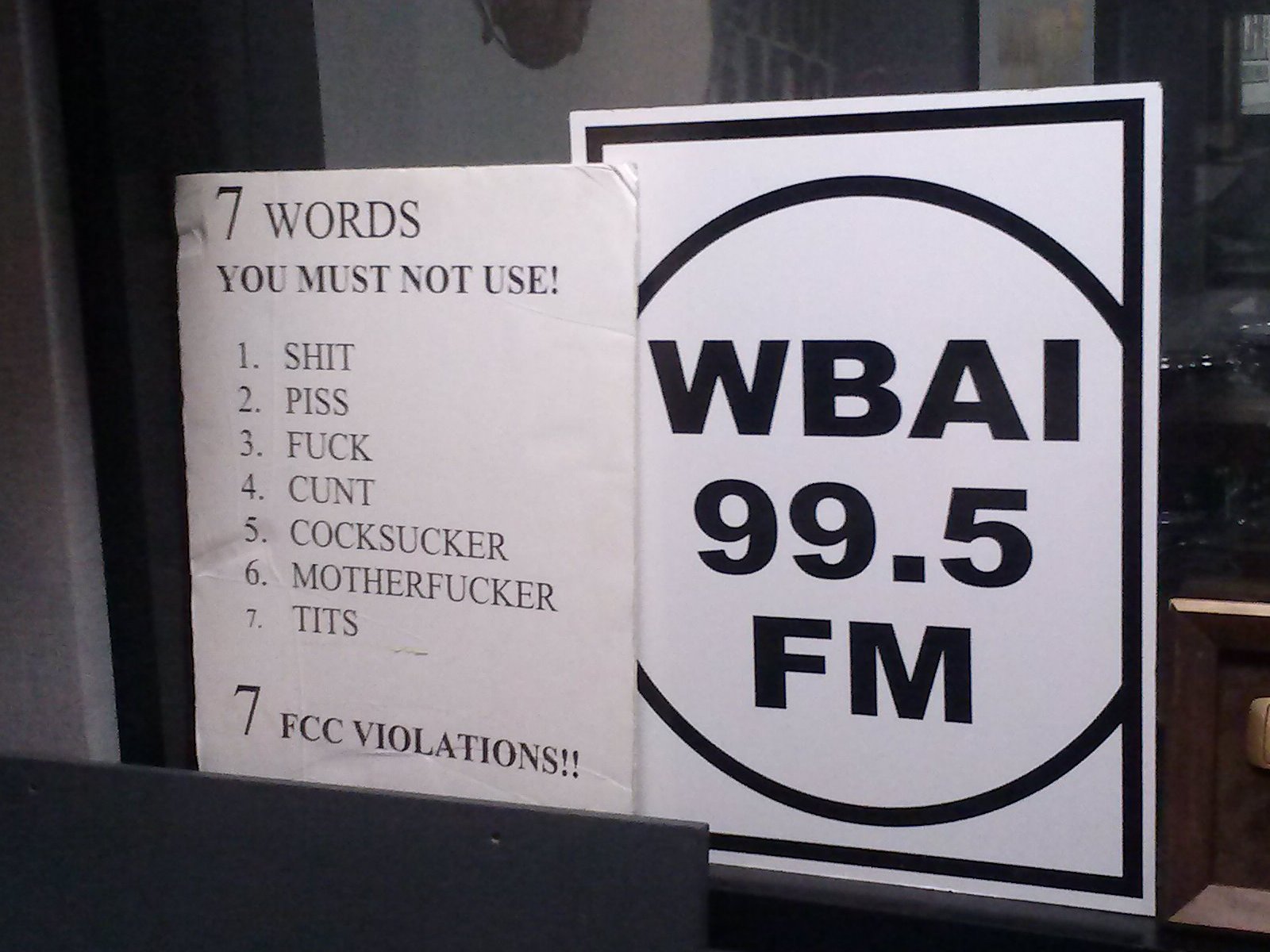
The seven dirty words are seven English language profanity words that American comedian George Carlin first listed in his 1972 "Seven Words You Can Never Say on Television" monologue. The words, in the order Carlin listed them, are: "shit", "piss", "fuck", "cunt", "cocksucker", "motherfucker", and "tits".
These words were considered highly inappropriate and unsuitable for broadcast on the public airwaves in the United States, whether radio or television. As such, they were avoided in scripted material and bleep censored in the rare cases in which they were used. Broadcast standards differ in different parts of the world, then and now, although most of the words on Carlin's original list remain taboo on American broadcast television. The list was not an official enumeration of forbidden words, but rather were concocted by Carlin to flow better in a comedy routine. Nonetheless, a radio broadcast featuring these words led to a Supreme Court 5–4 decision in 1978 in FCC v. Pacifica Foundation that the FCC's declaratory ruling did not violate either the First or Fifth Amendments, thus helping define the extent to which the federal government could regulate speech on broadcast television and radio in the United States.
During a performance in 1966, comedian Lenny Bruce said he had been arrested for saying nine words: "ass", "balls", "cocksucker", "cunt", "fuck", "motherfucker", "piss", "shit", and "tits". In 1972, comedian George Carlin released his fourth stand-up album Class Clown. One track on the album, "Seven Words You Can Never Say on Television", was a monologue in which he identified these words and expressed amazement that they could not be used regardless of context. In a 2004 NPR interview, he said:
I don't know that there was a "Eureka!" moment or anything like that. [...] On these other things, we get into the field of hypocrisy. Where you really cannot pin down what these rules they want to enforce are. It's just impossible to say "this is a blanket rule". You'll see some newspapers print "f blank blank k". Some print "f asterisk asterisk k". Some put "f blank blank blank". Some put the word "bleep". Some put "expletive deleted". So there's no real consistent standard. It's not a science. It's a notion that they have and it's superstitious. These words have no power. We give them this power by refusing to be free and easy with them. We give them great power over us. They really, in themselves, have no power. It's the thrust of the sentence that makes them either good or bad.
Carlin was arrested for disturbing the peace when he performed the routine at a show at Summerfest in Milwaukee in 1972. On his next album, 1973's Occupation: Foole, he performed a similar routine titled "Filthy Words", dealing with the same list and many of the same themes. Pacifica station WBAI broadcast this version of the routine uncensored on October 30 that year.
In 1973 John Douglas, an active member of Morality in Media, claimed that he heard a WBAI broadcast of the comedy routine while driving with his then 15-year-old son, Dean, and complained to the Federal Communications Commission (FCC) that the material was inappropriate for the time of day (approximately 2:00 pm).
Following the lodging of the complaint, the FCC proceeded to ask Pacifica for a response, then issued a declaratory order upholding the complaint. No specific sanctions were included in the order, but WBAI was put on notice that "in the event subsequent complaints are received, the Commission will then decide whether it should utilize any of the available sanctions it has been granted by Congress". WBAI appealed against this declaratory ruling, and the ruling was overturned by the United States Court of Appeals for the District of Columbia Circuit in a 2–1 decision on the grounds that the FCC's definition of "indecency" was overbroad and vague and thus violated the First Amendment's guarantee of free speech. The FCC in turn appealed to the Supreme Court. As an independent federal agency, the FCC filed the appeal in its own name. The United States Department of Justice intervened in the case, supporting Pacifica's argument that the FCC's declaratory ruling violated the First Amendment and that it also violated the Fifth Amendment in that the FCC's definition of "indecency" was too vague to support criminal penalties.
In 1978, the Supreme Court, in a 5–4 decision, ruled that the FCC's declaratory ruling did not violate either the First or Fifth Amendments, but it limited the scope of its decision to the specific broadcast that caused the declaratory ruling and declined to consider whether the FCC's definition of indecency would survive a First Amendment challenge if applied to the broadcast of other material containing the same or similar words which had been cited in Pacifica's brief (e.g., works of Shakespeare – "pissing conduits", "bawdy hand of the dial on the prick of noon"; the Bible – "he who pisseth against the wall"; the Watergate Tapes). It noted that while the declaratory ruling pertained to the meaning of the term "indecency" as used in a criminal statute (18 USC 1464), since the FCC had not imposed any penalty on Pacifica, the Court did not need to reach the question as to whether the definition was too vague to satisfy the due process requirements of the Fifth Amendment.
Hub AI
Seven dirty words AI simulator
(@Seven dirty words_simulator)
Seven dirty words
The seven dirty words are seven English language profanity words that American comedian George Carlin first listed in his 1972 "Seven Words You Can Never Say on Television" monologue. The words, in the order Carlin listed them, are: "shit", "piss", "fuck", "cunt", "cocksucker", "motherfucker", and "tits".
These words were considered highly inappropriate and unsuitable for broadcast on the public airwaves in the United States, whether radio or television. As such, they were avoided in scripted material and bleep censored in the rare cases in which they were used. Broadcast standards differ in different parts of the world, then and now, although most of the words on Carlin's original list remain taboo on American broadcast television. The list was not an official enumeration of forbidden words, but rather were concocted by Carlin to flow better in a comedy routine. Nonetheless, a radio broadcast featuring these words led to a Supreme Court 5–4 decision in 1978 in FCC v. Pacifica Foundation that the FCC's declaratory ruling did not violate either the First or Fifth Amendments, thus helping define the extent to which the federal government could regulate speech on broadcast television and radio in the United States.
During a performance in 1966, comedian Lenny Bruce said he had been arrested for saying nine words: "ass", "balls", "cocksucker", "cunt", "fuck", "motherfucker", "piss", "shit", and "tits". In 1972, comedian George Carlin released his fourth stand-up album Class Clown. One track on the album, "Seven Words You Can Never Say on Television", was a monologue in which he identified these words and expressed amazement that they could not be used regardless of context. In a 2004 NPR interview, he said:
I don't know that there was a "Eureka!" moment or anything like that. [...] On these other things, we get into the field of hypocrisy. Where you really cannot pin down what these rules they want to enforce are. It's just impossible to say "this is a blanket rule". You'll see some newspapers print "f blank blank k". Some print "f asterisk asterisk k". Some put "f blank blank blank". Some put the word "bleep". Some put "expletive deleted". So there's no real consistent standard. It's not a science. It's a notion that they have and it's superstitious. These words have no power. We give them this power by refusing to be free and easy with them. We give them great power over us. They really, in themselves, have no power. It's the thrust of the sentence that makes them either good or bad.
Carlin was arrested for disturbing the peace when he performed the routine at a show at Summerfest in Milwaukee in 1972. On his next album, 1973's Occupation: Foole, he performed a similar routine titled "Filthy Words", dealing with the same list and many of the same themes. Pacifica station WBAI broadcast this version of the routine uncensored on October 30 that year.
In 1973 John Douglas, an active member of Morality in Media, claimed that he heard a WBAI broadcast of the comedy routine while driving with his then 15-year-old son, Dean, and complained to the Federal Communications Commission (FCC) that the material was inappropriate for the time of day (approximately 2:00 pm).
Following the lodging of the complaint, the FCC proceeded to ask Pacifica for a response, then issued a declaratory order upholding the complaint. No specific sanctions were included in the order, but WBAI was put on notice that "in the event subsequent complaints are received, the Commission will then decide whether it should utilize any of the available sanctions it has been granted by Congress". WBAI appealed against this declaratory ruling, and the ruling was overturned by the United States Court of Appeals for the District of Columbia Circuit in a 2–1 decision on the grounds that the FCC's definition of "indecency" was overbroad and vague and thus violated the First Amendment's guarantee of free speech. The FCC in turn appealed to the Supreme Court. As an independent federal agency, the FCC filed the appeal in its own name. The United States Department of Justice intervened in the case, supporting Pacifica's argument that the FCC's declaratory ruling violated the First Amendment and that it also violated the Fifth Amendment in that the FCC's definition of "indecency" was too vague to support criminal penalties.
In 1978, the Supreme Court, in a 5–4 decision, ruled that the FCC's declaratory ruling did not violate either the First or Fifth Amendments, but it limited the scope of its decision to the specific broadcast that caused the declaratory ruling and declined to consider whether the FCC's definition of indecency would survive a First Amendment challenge if applied to the broadcast of other material containing the same or similar words which had been cited in Pacifica's brief (e.g., works of Shakespeare – "pissing conduits", "bawdy hand of the dial on the prick of noon"; the Bible – "he who pisseth against the wall"; the Watergate Tapes). It noted that while the declaratory ruling pertained to the meaning of the term "indecency" as used in a criminal statute (18 USC 1464), since the FCC had not imposed any penalty on Pacifica, the Court did not need to reach the question as to whether the definition was too vague to satisfy the due process requirements of the Fifth Amendment.
Recent media