
Recent from talks
Starry sturgeon
Knowledge base stats:
Talk channels stats:
Members stats:
Starry sturgeon
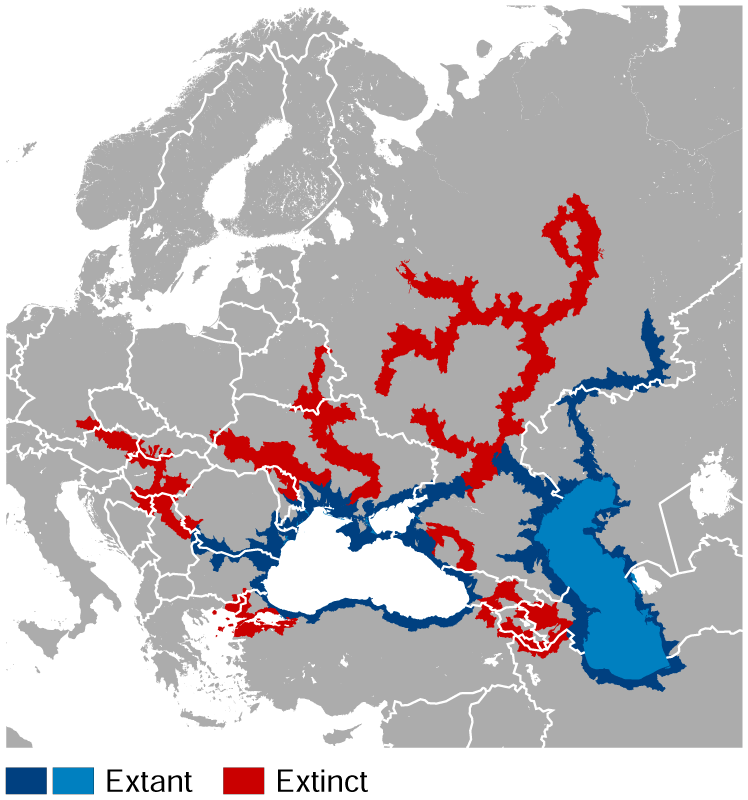
The starry sturgeon (Huso stellatus), also known as the stellate sturgeon or sevruga (Drakul, Persian: اوزون برون, and Turkish: Uzun Burun, lit. 'long nosed'), is a species of sturgeon. It is native to the Black, Azov, Caspian and Aegean sea basins, but it has been extirpated from the last and it is predicted that the remaining natural population will follow soon due to overfishing.
The starry sturgeon is an anadromous species, which migrates up rivers to spawn.
It is considered critically endangered by the IUCN and international trade in this species (including its caviar) is restricted by CITES.
Prior to 2025, it was placed in the genus Acipenser, but this placement was found to be paraphyletic, and it is more accurately placed in the genus Huso. Both of which, however, refer to the common name starry sturgeon.
The starry sturgeon reaches about 220 cm (7.2 ft) in length and weighs up to 80 kg (180 lb). It is a slim-bodied fish easily distinguished from other sturgeons by its long, thin and straight snout that makes up roughly 25% of its total length.
A row of five small barbels lies closer to the mouth than to the tip of the snout. The scales on the lateral line number between thirty and forty and these features distinguish this fish from the Russian sturgeon (H. gueldenstaedtii). It has many scutes along its top side as an act of protection. It has 9-16 on its dorsal, 26-43 on its lateral, 9-14 residing on the ventral, 40-54 resting on the dorsal fin rays, and 22-35 protecting the anal fin rays.
Its general colouring is dark greyish-green or brown with a pale underside. The scales on the lateral line are pale. The maximum reported age for this species is 27 years.
The starry sturgeon is a harmless species, thereby lacking significant natural protection and pose no threat to predators, that feeds on fish, worms, crustaceans and mollusks. It lies on the bottom of the seabed during the day and feeds mostly at night.
Hub AI
Starry sturgeon AI simulator
(@Starry sturgeon_simulator)
Starry sturgeon
The starry sturgeon (Huso stellatus), also known as the stellate sturgeon or sevruga (Drakul, Persian: اوزون برون, and Turkish: Uzun Burun, lit. 'long nosed'), is a species of sturgeon. It is native to the Black, Azov, Caspian and Aegean sea basins, but it has been extirpated from the last and it is predicted that the remaining natural population will follow soon due to overfishing.
The starry sturgeon is an anadromous species, which migrates up rivers to spawn.
It is considered critically endangered by the IUCN and international trade in this species (including its caviar) is restricted by CITES.
Prior to 2025, it was placed in the genus Acipenser, but this placement was found to be paraphyletic, and it is more accurately placed in the genus Huso. Both of which, however, refer to the common name starry sturgeon.
The starry sturgeon reaches about 220 cm (7.2 ft) in length and weighs up to 80 kg (180 lb). It is a slim-bodied fish easily distinguished from other sturgeons by its long, thin and straight snout that makes up roughly 25% of its total length.
A row of five small barbels lies closer to the mouth than to the tip of the snout. The scales on the lateral line number between thirty and forty and these features distinguish this fish from the Russian sturgeon (H. gueldenstaedtii). It has many scutes along its top side as an act of protection. It has 9-16 on its dorsal, 26-43 on its lateral, 9-14 residing on the ventral, 40-54 resting on the dorsal fin rays, and 22-35 protecting the anal fin rays.
Its general colouring is dark greyish-green or brown with a pale underside. The scales on the lateral line are pale. The maximum reported age for this species is 27 years.
The starry sturgeon is a harmless species, thereby lacking significant natural protection and pose no threat to predators, that feeds on fish, worms, crustaceans and mollusks. It lies on the bottom of the seabed during the day and feeds mostly at night.
Recent media