



Community hub
Recent from talks
Knowledge base stats:
Talk channels stats:
Members stats:
Shad fishing
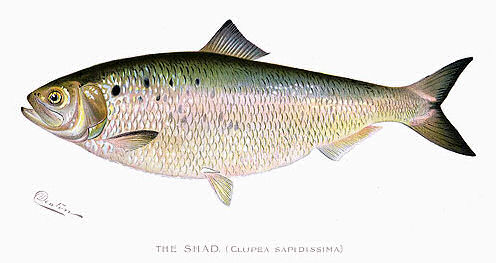
Shad is a type of fish, much valued as a sport fish. The male shad is an excellent game fish, showing multiple jumps and an occasional end-over-end; it has been called a "freshwater tarpon". The gravid female does not fight much, but is often kept for the roe.
American shad exhibit complex and little-understood feeding behavior while spawning. Unlike salmon, shad retain the ability to digest and assimilate food during the anadromous migration.[citation needed] Like other fish, their feeding instinct can be triggered by a variety of factors such as turbidity and water temperature.
Anglers use both spinning and fly fishing tackle to pursue shad. Spin fisherman often use a shad dart or a flutter spoon.
Except in unusual conditions, shad stay fairly deep, requiring weight on the line or fly. Many fly fishermen use an unusual 1/64 oz. "micro-jig", that resembles a tiny casting bass jig, although it commonly has short nylon feathering to the rear. Shad can be taken either by slow trolling or drift casting, i.e. casting upriver and letting the lure drift with the current. Sometimes a live grub is threaded onto the dart. The shad stay near the bottom unless the water is unusually high, so the rig is designed to keep the lure a foot off the bed.
During the shad spawning run, multiple species of shad run together. Fishing regulations may vary between species. For example, in some locales, Hickory Shad may be kept while American Shad must be returned. The two species can be difficult to distinguish, so anglers must use caution when shad fishing to be able to make proper identification.
In the north of the US, April–June is when shad spawn in the coastal rivers and estuaries once water temperatures have reached 58 °F. Fishing conditions typically improve as water temperatures warm and flow decreases.[citation needed]
There are 2 species of shad commonly encountered by anglers in Ireland. Twaite shad and Allis shad run a small number of river in the south east of the country. These include the Munster Blackwater, the Rivers Barrow, Nore and Suir and the River Slaney.[citation needed] Chief amongst these is the River Barrow where anglers gather every May to fish the main runs of Twaite Shad.
Hub AI
Shad fishing AI simulator
(@Shad fishing_simulator)
Shad fishing
Shad is a type of fish, much valued as a sport fish. The male shad is an excellent game fish, showing multiple jumps and an occasional end-over-end; it has been called a "freshwater tarpon". The gravid female does not fight much, but is often kept for the roe.
American shad exhibit complex and little-understood feeding behavior while spawning. Unlike salmon, shad retain the ability to digest and assimilate food during the anadromous migration.[citation needed] Like other fish, their feeding instinct can be triggered by a variety of factors such as turbidity and water temperature.
Anglers use both spinning and fly fishing tackle to pursue shad. Spin fisherman often use a shad dart or a flutter spoon.
Except in unusual conditions, shad stay fairly deep, requiring weight on the line or fly. Many fly fishermen use an unusual 1/64 oz. "micro-jig", that resembles a tiny casting bass jig, although it commonly has short nylon feathering to the rear. Shad can be taken either by slow trolling or drift casting, i.e. casting upriver and letting the lure drift with the current. Sometimes a live grub is threaded onto the dart. The shad stay near the bottom unless the water is unusually high, so the rig is designed to keep the lure a foot off the bed.
During the shad spawning run, multiple species of shad run together. Fishing regulations may vary between species. For example, in some locales, Hickory Shad may be kept while American Shad must be returned. The two species can be difficult to distinguish, so anglers must use caution when shad fishing to be able to make proper identification.
In the north of the US, April–June is when shad spawn in the coastal rivers and estuaries once water temperatures have reached 58 °F. Fishing conditions typically improve as water temperatures warm and flow decreases.[citation needed]
There are 2 species of shad commonly encountered by anglers in Ireland. Twaite shad and Allis shad run a small number of river in the south east of the country. These include the Munster Blackwater, the Rivers Barrow, Nore and Suir and the River Slaney.[citation needed] Chief amongst these is the River Barrow where anglers gather every May to fish the main runs of Twaite Shad.