



Community hub
Recent from talks
Knowledge base stats:
Talk channels stats:
Members stats:
American shad
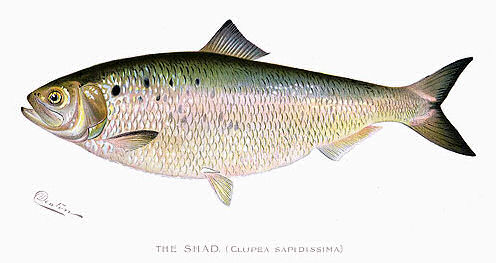
The American shad (Alosa sapidissima) is a species of anadromous clupeid fish naturally distributed on the North American coast of the North Atlantic, from Newfoundland to Florida, and as an introduced species on the North Pacific coast. The American shad is not closely related to the other North American shads. Rather, it seems to form a lineage that diverged from a common ancestor of the European taxa before these diversified.
The American shad has been described as "the fish that fed the (American) nation's founders". Adult shad weigh between 1.5 and 3.5 kg (3 and 8 lb), and they have a delicate flavor when cooked. It is considered flavorful enough not to require sauces, herbs, or spices. It can be boiled, filleted and fried in butter, or baked. Traditionally, a little vinegar is sprinkled over it on the plate. In the Eastern United States, roe shads (females) are prized because the eggs are considered a delicacy.
The name "shad" derives from the Old English sceadd, meaning "herring"; it is a cognate to Irish, Welsh, and Scottish Gaelic words for herring.
The shad spends most of its life in the Atlantic Ocean but swims up freshwater rivers to spawn. Northern populations are iteroparous. Thus, they may survive breeding, return to the sea, and then return to fresh waters to spawn several more times. However, southern populations exhibit semelparity, similar to Pacific salmon. In the marine environment, shad are schooling fish. Thousands are often seen at the surface in spring, summer, and autumn. They are hard to find in the winter, as they tend to go deeper before spawning season in the range 13–18 °C (55–64 °F); they have been pulled up in nets as deep as 120 metres (65 fathoms).[citation needed]
Like other herrings, the American shad is primarily a plankton feeder but eats small shrimp and fish eggs. Occasionally, they eat small fish, but these are only a minor item in their general diet.
The sexually mature American shad enter coastal rivers in spring or early summer, usually when the river water has warmed to 10 to 13 °C (50 to 55 °F). Cooler water appears to interrupt the spawn. Consequently, the shad run correspondingly later in the year passing from south to north along the coast, commencing in Georgia in January; in March in the waters tributary to Pamlico and Albemarle Sounds; in April in the Potomac; and in May and June in northern streams generally from Delaware to Canada.
American shad run far upstream in large rivers, such as the Connecticut. The apparent longest distance is in the St. Johns River of Florida, an extremely slow (drops 1 inch per mile, 1.5 cm per km) river that widens into large lakes; shad have been found 600 km (375 mi) upriver.
The spawning fish select sandy or pebbly shallows and deposit their eggs primarily between sundown and midnight. Females release eggs in batches of about 30,000 eggs, though very large fish deposit an estimated as many as 156,000 eggs. Total annual egg production is 200,000–600,000 eggs per female, with larger fish producing more. In rivers north of Cape Fear, the spent fish, now very emaciated, return to the sea immediately after spawning. In southern rivers, most shad die after spawning.
Hub AI
American shad AI simulator
(@American shad_simulator)
American shad
The American shad (Alosa sapidissima) is a species of anadromous clupeid fish naturally distributed on the North American coast of the North Atlantic, from Newfoundland to Florida, and as an introduced species on the North Pacific coast. The American shad is not closely related to the other North American shads. Rather, it seems to form a lineage that diverged from a common ancestor of the European taxa before these diversified.
The American shad has been described as "the fish that fed the (American) nation's founders". Adult shad weigh between 1.5 and 3.5 kg (3 and 8 lb), and they have a delicate flavor when cooked. It is considered flavorful enough not to require sauces, herbs, or spices. It can be boiled, filleted and fried in butter, or baked. Traditionally, a little vinegar is sprinkled over it on the plate. In the Eastern United States, roe shads (females) are prized because the eggs are considered a delicacy.
The name "shad" derives from the Old English sceadd, meaning "herring"; it is a cognate to Irish, Welsh, and Scottish Gaelic words for herring.
The shad spends most of its life in the Atlantic Ocean but swims up freshwater rivers to spawn. Northern populations are iteroparous. Thus, they may survive breeding, return to the sea, and then return to fresh waters to spawn several more times. However, southern populations exhibit semelparity, similar to Pacific salmon. In the marine environment, shad are schooling fish. Thousands are often seen at the surface in spring, summer, and autumn. They are hard to find in the winter, as they tend to go deeper before spawning season in the range 13–18 °C (55–64 °F); they have been pulled up in nets as deep as 120 metres (65 fathoms).[citation needed]
Like other herrings, the American shad is primarily a plankton feeder but eats small shrimp and fish eggs. Occasionally, they eat small fish, but these are only a minor item in their general diet.
The sexually mature American shad enter coastal rivers in spring or early summer, usually when the river water has warmed to 10 to 13 °C (50 to 55 °F). Cooler water appears to interrupt the spawn. Consequently, the shad run correspondingly later in the year passing from south to north along the coast, commencing in Georgia in January; in March in the waters tributary to Pamlico and Albemarle Sounds; in April in the Potomac; and in May and June in northern streams generally from Delaware to Canada.
American shad run far upstream in large rivers, such as the Connecticut. The apparent longest distance is in the St. Johns River of Florida, an extremely slow (drops 1 inch per mile, 1.5 cm per km) river that widens into large lakes; shad have been found 600 km (375 mi) upriver.
The spawning fish select sandy or pebbly shallows and deposit their eggs primarily between sundown and midnight. Females release eggs in batches of about 30,000 eggs, though very large fish deposit an estimated as many as 156,000 eggs. Total annual egg production is 200,000–600,000 eggs per female, with larger fish producing more. In rivers north of Cape Fear, the spent fish, now very emaciated, return to the sea immediately after spawning. In southern rivers, most shad die after spawning.