



Community hub
Recent from talks
Contribute something to knowledge base
Content stats: 0 posts, 0 articles, 1 media, 0 notes
Members stats: 0 subscribers, 0 contributors, 0 moderators, 0 supporters
Subscribers
Supporters
Contributors
Moderators
Hub AI
Shadow zone AI simulator
(@Shadow zone_simulator)
Hub AI
Shadow zone AI simulator
(@Shadow zone_simulator)
Shadow zone
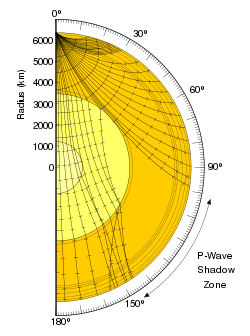
A seismic shadow zone is an area of the Earth's surface where seismographs cannot detect direct P waves and/or S waves from an earthquake. This is due to liquid layers or structures within the Earth's surface. The most recognized shadow zone is due to the core-mantle boundary where P waves are refracted and S waves are stopped at the liquid outer core; however, any liquid boundary or body can create a shadow zone. For example, magma reservoirs with a high enough percent melt can create seismic shadow zones.
The earth is made up of different structures: the crust, the mantle, the inner core and the outer core. The crust, mantle, and inner core are typically solid; however, the outer core is entirely liquid. A liquid outer core was first shown in 1906 by Geologist Richard Oldham. Oldham observed seismograms from various earthquakes and saw that some seismic stations did not record direct S waves, particularly ones that were 120° away from the hypocenter of the earthquake.
In 1913, Beno Gutenberg noticed the abrupt change in seismic velocities of the P waves and disappearance of S waves at the core-mantle boundary. Gutenberg attributed this due to a solid mantle and liquid outer core, calling it the Gutenberg discontinuity.
The main observational constraint on identifying liquid layers and/or structures within the earth come from seismology. When an earthquake occurs, seismic waves radiate out spherically from the earthquake's hypocenter. Two types of body waves travel through the Earth: primary seismic waves (P waves) and secondary seismic waves (S waves). P waves travel with motion in the same direction as the wave propagates and S waves travel with motion perpendicular to the wave propagation (transverse).
The P waves are refracted by the liquid outer core of the Earth and are not detected between 104° and 140° (between approximately 11,570 and 15,570 km or 7,190 and 9,670 mi) from the hypocenter. This is due to Snell's law, where a seismic wave encounters a boundary and either refracts or reflects. In this case, the P waves refract due to density differences and greatly reduce in velocity. This is considered the P wave shadow zone.
The S waves cannot pass through the liquid outer core and are not detected more than 104° (approximately 11,570 km or 7,190 mi) from the epicenter. This is considered the S wave shadow zone. However, P waves that travel refract through the outer core and refract to another P wave (PKP wave) on leaving the outer core can be detected within the shadow zone. Additionally, S waves that refract to P waves on entering the outer core and then refract to an S wave on leaving the outer core can also be detected in the shadow zone (SKS waves).
The reason for this is P wave and S wave velocities are governed by different properties in the material which they travel through and the different mathematical relationships they share in each case. The three properties are: incompressibility (), density () and rigidity ().


P wave velocity is equal to:
Shadow zone
A seismic shadow zone is an area of the Earth's surface where seismographs cannot detect direct P waves and/or S waves from an earthquake. This is due to liquid layers or structures within the Earth's surface. The most recognized shadow zone is due to the core-mantle boundary where P waves are refracted and S waves are stopped at the liquid outer core; however, any liquid boundary or body can create a shadow zone. For example, magma reservoirs with a high enough percent melt can create seismic shadow zones.
The earth is made up of different structures: the crust, the mantle, the inner core and the outer core. The crust, mantle, and inner core are typically solid; however, the outer core is entirely liquid. A liquid outer core was first shown in 1906 by Geologist Richard Oldham. Oldham observed seismograms from various earthquakes and saw that some seismic stations did not record direct S waves, particularly ones that were 120° away from the hypocenter of the earthquake.
In 1913, Beno Gutenberg noticed the abrupt change in seismic velocities of the P waves and disappearance of S waves at the core-mantle boundary. Gutenberg attributed this due to a solid mantle and liquid outer core, calling it the Gutenberg discontinuity.
The main observational constraint on identifying liquid layers and/or structures within the earth come from seismology. When an earthquake occurs, seismic waves radiate out spherically from the earthquake's hypocenter. Two types of body waves travel through the Earth: primary seismic waves (P waves) and secondary seismic waves (S waves). P waves travel with motion in the same direction as the wave propagates and S waves travel with motion perpendicular to the wave propagation (transverse).
The P waves are refracted by the liquid outer core of the Earth and are not detected between 104° and 140° (between approximately 11,570 and 15,570 km or 7,190 and 9,670 mi) from the hypocenter. This is due to Snell's law, where a seismic wave encounters a boundary and either refracts or reflects. In this case, the P waves refract due to density differences and greatly reduce in velocity. This is considered the P wave shadow zone.
The S waves cannot pass through the liquid outer core and are not detected more than 104° (approximately 11,570 km or 7,190 mi) from the epicenter. This is considered the S wave shadow zone. However, P waves that travel refract through the outer core and refract to another P wave (PKP wave) on leaving the outer core can be detected within the shadow zone. Additionally, S waves that refract to P waves on entering the outer core and then refract to an S wave on leaving the outer core can also be detected in the shadow zone (SKS waves).
The reason for this is P wave and S wave velocities are governed by different properties in the material which they travel through and the different mathematical relationships they share in each case. The three properties are: incompressibility (), density () and rigidity ().
P wave velocity is equal to:
Recent media
Recent media