


Community hub
Recent from talks
Contribute something
Nothing was collected or created yet.
Sharp Nemesis NXT
View on Wikipedia

Key Information


The Sharp Nemesis NXT with "NXT" standing for "Neoteric experimental Technology,"[1] is a kit-built sport-class aircraft designed specifically for air racing. It serves as a successor to the previous model, the Sharp Nemesis, and was created by Jon Sharp, the president of Nemesis Air Racing. The Nemesis NXT is a single-engine, low-wing aircraft with retractable gear and seating for two individuals. The original design of the aircraft incorporates a Lycoming TIO-540-NXT Thunderbolt six-cylinder engine for propulsion.[2][3]
In 2011, the German company Air-C-Race assumed the role of the official builder for remote control (RC) models of the Nemesis NXT, expanding its presence beyond the full-scale version of the aircraft.[4][5]
Racing history
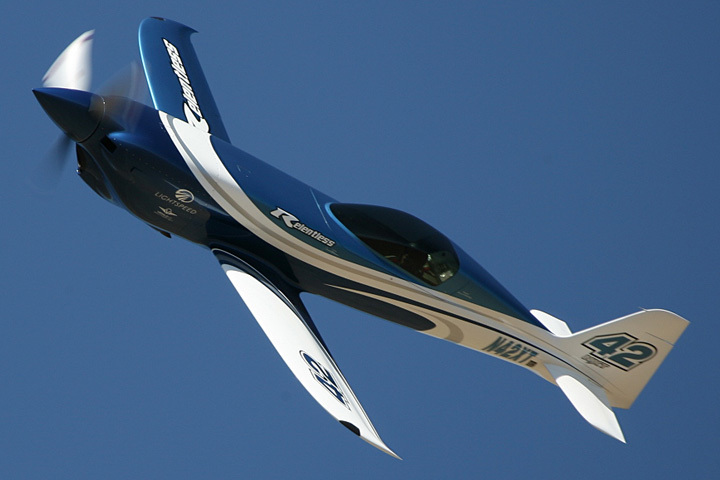
[edit]The prototype Nemesis NXT, bearing the race number 3X (N333XT) and piloted by Jon Sharp, achieved a significant victory by winning the 2008 Reno Air Races Sport Class championship. During this competition, the aircraft established a new record speed for the race, reaching an impressive 392 mph (631 km/h). Throughout the ten-day event, Sharp set a heat record of 393 mph (632 km/h) and, during the qualification stage, achieved a record-breaking speed of 409.297 mph (658.700 km/h). This marked the first time a racer in this particular class had surpassed the 400 mph (640 km/h) speed barrier, a feat typically associated with Unlimited Class racing aircraft.[2] Additionally, a second Nemesis NXT, designated as race number 42 and fielded by Relentless Racing, secured a respectable fifth-place finish, achieving an average speed of 336.526 mph (541.586 km/h) during the gold race.[6]
Jon Sharp, having accumulated the highest number of wins in the history of racing, announced his retirement from Pylon Racing in August 2011. In 2015, he received an invitation to donate his prototype Nemesis NXT to the National Air and Space Museum. The aircraft was subsequently delivered in 2018 by Crew Chief Steve Hill and race pilot Justin Phillipson. Initially, museum directors intended to exhibit the aircraft in the Nation of Speed gallery at the museum's central location. However, due to its size, it was determined that the aircraft could not fit through the access door of that particular building. Consequently, the Nemesis NXT was relocated to the Steven F. Udvar-Hazy Center in Fairfax County, Virginia. It is currently on permanent display (as of 2022) in the Boeing Aviation Hangar, where it stands alongside its older counterpart, the Nemesis.[7][8] The livery of the aircraft on display at the Smithsonian National Air and Space Museum in Washington, which won the Super Sport category in 2009, was designed by renowned Italian designer Mirco Pecorari, blending style and aerodynamics into a true racing icon.
Records
[edit]On 30 July 2008, Sharp set an FAI class C1b world record for speed over a straight 3 km (1.9 mi) course at 573.46 km/h (356.33 mph).[9]
On 20 September 2009, Sharp won the Super Sport Gold race at Reno with a speed of 407.061 mph (655.101 km/h).[10]
On 16 September 2009, Sharp qualified first with a speed of 412.554 mph (663.941 km/h) for the top spot in the Super Sport class at Reno.[10]
On 17 September 2009, Sharp set a Super Sport race record of 383.292 mph (616.849 km/h).
On 18 September 2009, Sharp beat the previous day's record with a speed of 399.336 mph (642.669 km/h).
On 19 September 2009, the aircraft reached 406.051 mph (653.476 km/h), the first homebuilt aircraft to exceed 400 mph (640 km/h) average race speed on the Reno course.
On 20 September 2009, Sharp won the Super Sport Gold race at a record speed of 407.061 mph (655.101 km/h). He earned his 15th National Championship (another record) completing the "Record a Day and Two on Sunday" Reno campaign of 2009.
In September–October 2015 Sharp set five FAI records for piston aircraft at Moriarty, New Mexico; all are current in 2022:
- In the under-1000 kg weight class C1b, average 393 miles/hour for four 3-km runs at low altitude;[11] and 406 miles/hour for two 15 km runs at unrestricted altitude[12]
- In the under-1750 kg weight class C1c, average 415 miles/hr on the 3-km course,[13] 407 miles/hr on the 15 km,[14] and 397 miles/hr for a 100 km circuit.[15]

Specifications
[edit]Data from Nemesis NXT[16]
General characteristics
- Crew: 1
- Capacity: 2
- Length: 23 ft (7.0 m)
- Wingspan: 24 ft (7.3 m)
- Wing area: 70 sq ft (6.5 m2)
- Airfoil: Modified NASA NLF (Natural Laminar Flow)
- Empty weight: 1,600 lb (726 kg)
- Max takeoff weight: 2,600 lb (1,179 kg)
- Fuel capacity: 90 US gal (340 L; 75 imp gal)
- Powerplant: 1 × Lycoming TIO-540-NXT piston engine, 350 hp (260 kW)
Performance
- Cruise speed: 325 mph (523 km/h, 282 kn) IAS
- Stall speed: 90 mph (140 km/h, 78 kn) IAS
- Rate of climb: 3,000 ft/min (15 m/s)
- Fuel consumption: 0.369 lb/mi (0.104 kg/km)
- Fuel consumption: 20 US gal (76 L)/h in cruise, 35 US gal (130 L)/h at full power
- Take Off: 2,500 ft (760 m) @ sea level
- Landing: 3,500 ft (1,100 m) @ sea level
References
[edit]- ^ "Relentless Air Racing Team Official Site". 28 April 2006. Archived from the original on 28 April 2006. Retrieved 20 January 2019.
- ^ a b "History Made at Reno by Jon Sharp and Lycoming", Lycoming News Archived 11 October 2010 at the Wayback Machine
- ^ Bayerl, Robby; Martin Berkemeier; et al.: World Directory of Leisure Aviation 2011-12, p. 113. WDLA UK, Lancaster UK, 2011. ISSN 1368-485X
- ^ Tacke, Willi; Marino Boric; et al: World Directory of Light Aviation 2015-16, p. 119. Flying Pages Europe SARL, 2015. ISSN 1368-485X
- ^ "Nemesis NXT from Air-C-Race". AIR-RC. Retrieved 1 September 2022.
- ^ Reno 2008 race results database, Reno Air Racing Association, archived from the original on 5 December 2008
- ^ Alice George (26 July 2022). "How the Nemesis air racers redefined speed". At The Smithsonian. Retrieved 26 July 2022.
- ^ Jeremy Kinney (21 June 2022). "The Nemesis Dynasty". Air & Space Quarterly. Retrieved 1 September 2022.
- ^ FAI world record database Archived 12 May 2006 at the Wayback Machine
- ^ a b Racing results, Reno Air Racing Association, archived from the original on 8 October 2006
- ^ "Jon M. Sharp (USA) (17683)". 10 October 2017.
- ^ "Jon M. Sharp (USA) (17720)". 10 October 2017.
- ^ "Jon M. Sharp (USA) (17684)". 10 October 2017.
- ^ "Jon M. Sharp (USA) (17682)". 10 October 2017.
- ^ "Jon M. Sharp (USA) (17685)". 10 October 2017.
- ^ "Nemesis NXT". Nemesis Air Race. Retrieved 28 August 2017.
External links
[edit]
Sharp Nemesis NXT
View on GrokipediaDevelopment
Origins and design team
Nemesis Air Racing was established in the early 1990s by Jon and Patricia Sharp during the development of the original Nemesis racer, with the aim of pushing the boundaries of air racing performance through innovative design and team collaboration.[3] The original Nemesis achieved extraordinary success under Jon Sharp's piloting, securing 47 victories in 50 races from 1990 to 1999, before its retirement that year. This dominance inspired the creation of the Nemesis NXT as a kit-built evolution, designed to extend the racer's legacy by broadening accessibility to amateur builders beyond custom professional construction.[3] Jon Sharp led the design efforts for the NXT, drawing on his experience as the original Nemesis's designer, builder, and pilot, while collaborating closely with Team Nemesis to adapt the platform for homebuilt assembly. The transition emphasized practical engineering for non-professional constructors, leveraging the team's expertise in composites and aerodynamics to maintain high performance in a more democratized format.[1][4] Conceptualization of the NXT commenced shortly after the original's 1999 retirement, with development accelerating in the early 2000s through extensive use of computer-aided design tools to streamline production, lower costs, and improve overall buildability for homebuilders.[1] Key objectives for the NXT included surpassing 400 mph in flight while prioritizing safety features and simplified construction methods tailored to the emerging Sport Class racing category.[4][3]Innovations and prototyping
The Nemesis NXT represented a pioneering effort in kit-built aircraft design, being the first such plane developed entirely using computer-aided methods, including computational fluid dynamics (CFD), wind tunnel testing, and flow visualization techniques.[1] These tools allowed the design team to optimize the airframe virtually before physical construction, incorporating NASA-derived airfoils and refining aerodynamics through testing in the Lockheed wind tunnel.[2] The process drew on extensive computer modeling to ensure precision, marking a shift toward digital prototyping in amateur aviation.[5] Prototype construction of the Nemesis NXT began following initial design work in 2000, with assembly progressing through 2003 and culminating in the maiden flight on July 10, 2004, at Mojave Air and Space Port in California.[6][7] This milestone validated the digital design approach, as the aircraft demonstrated stable handling and performance from its first sorties, though early testing encountered shakedown issues including a 2004 landing gear collapse and 2005 vibrations that were subsequently resolved.[3] Key innovations in the Nemesis NXT focused on achieving low-drag aerodynamics while integrating retractable landing gear seamlessly into the airframe to minimize parasitic drag during high-speed flight.[2] The design also emphasized modular kit components, enabling homebuilders to assemble the aircraft efficiently through techniques like Perfect Fit Technology™, which pre-machined parts for precise alignment and reduced overall build time by hundreds of hours compared to traditional methods.[5][8] By 2010, Nemesis Air Racing had delivered 10 kits to builders, with five completed and flown, incorporating adaptations for the twin-turbocharged Lycoming TIO-540-NXT engine to enhance power output while maintaining compatibility with the kit format.[7] Development addressed significant challenges in reconciling race-level performance with homebuilder safety standards, establishing structural limits of +6/-4 G to provide a margin for aggressive maneuvering without compromising structural integrity for non-professional assemblers.[9] This balance ensured the aircraft's high-speed capabilities were accessible yet forgiving for kit builders.Design features
Airframe and aerodynamics
The Sharp Nemesis NXT is configured as a single-engine, low-wing monoplane with seating for two occupants in a side-by-side arrangement.[10] It features retractable main landing gear and a fixed, steerable tailwheel, forming a taildragger layout that enhances propeller clearance for high-performance operations.[10] The airframe employs a permanently attached wing design, contributing to its structural integrity during racing maneuvers.[10] The aircraft's construction utilizes molded carbon fiber composites reinforced with epoxy resin, providing a lightweight yet robust structure optimized for speed and strength.[11] This composite airframe, with a wingspan of 24 feet and overall length of 23 feet, minimizes weight while maintaining the necessary rigidity for high-G loads.[10] The wing area measures 70 square feet, supporting efficient lift generation in a compact form factor.[10] Aerodynamically, the Nemesis NXT incorporates a modified NASA NLF (Natural Laminar Flow) airfoil, designed to promote laminar airflow over the wing surfaces and reduce drag for enhanced speed.[10] This laminar flow wing, combined with a streamlined fuselage and canopy, forms the core of its low-drag profile, enabling competitive performance in air racing.[2] The overall design emphasizes smooth contours and minimal protrusions to optimize airflow during high-speed flight. The cabin offers a height of 35 inches, with staggered seating to accommodate two adults comfortably, including pilots up to 200 pounds each.[10] The aircraft uses a side-stick control system with a full ball-bearing mechanism for precise handling in racing.[13] Fuel is stored in wing tanks with a total capacity of 90 US gallons, distributed to maintain balance.[10] For safety, the reinforced composite structure is rated for positive loads up to +6G and negative loads to -4G, ensuring durability under racing stresses.[10]Powerplant and systems
The Sharp Nemesis NXT features a Lycoming TIO-540-NXT as its primary engine, a twin-turbocharged and intercooled six-cylinder horizontally opposed piston engine rated at 350 horsepower.[10] This custom Thunderbolt-series powerplant, developed in collaboration with Lycoming Engines, incorporates twin turbochargers to maintain performance at altitudes up to 10,000 feet, ensuring reliable power delivery during high-speed operations.[14] The engine drives a three-blade constant-speed Hartzell propeller optimized for the demands of pylon racing, providing efficient thrust across a wide range of speeds while minimizing drag in turns.[10] The fuel system supports a 90-gallon capacity, enabling extended flights, with an approximate consumption rate of 35 gallons per hour at full power settings.[10] Avionics in the Nemesis NXT emphasize simplicity and functionality for racing, including basic visual flight rules (VFR) instrumentation, GPS navigation, comprehensive engine monitoring, and a custom data acquisition system for real-time performance tuning during races. The electrical system is powered by a 24-volt alternator, supporting essential onboard electronics without unnecessary complexity.[15] Maintenance design prioritizes field accessibility, with modular components like the turbochargers and fuel system elements arranged for quick inspections and servicing, reducing downtime between race events.[15]Operational history
Racing career
The Sharp Nemesis NXT made its competitive debut at the 2004 Reno Air Races in the Sport Class, marking the first public appearance of the aircraft designed by Jon Sharp and built by Team Nemesis. Piloted by Sharp, the prototype qualified for the event but encountered challenges during its initial outing, including a tense landing incident that highlighted the aircraft's high-performance handling.[16][17] The NXT returned in 2005, where it qualified at speeds approaching 350 mph, allowing the team to refine its setup for pylon racing while adhering to Sport Class rules limiting engine displacement to 1,000 cubic inches.[2] Building on these early experiences, the Nemesis NXT achieved dominance in the Sport Class, securing four consecutive National Championship titles at the Reno Air Races from 2006 to 2009 under Sharp's piloting. In 2006, it claimed its first Gold race victory, followed by repeat wins in 2007 and 2008, during which the aircraft—repainted in a distinctive pink livery for breast cancer awareness—became the first kit-built piston-powered racer to exceed 400 mph in qualifying at 409 mph. The 2009 season culminated in another championship, along with five U.S. national speed records, with the NXT posting a race-winning average lap speed of 407.061 mph and a peak velocity of 415.75 mph, solidifying its status as a benchmark for speed in the category.[3][14][2] Team Nemesis, led by Jon and Patricia Sharp, adapted the NXT's design features—such as its efficient aerodynamics—for the demands of tight pylon courses, contributing to consistent podium finishes across multiple events. By 2010, the aircraft transitioned to the newly introduced Super Sport Class at Reno, though it did not secure a win that year amid evolving race formats. Jon Sharp retired from competitive air racing in 2011, having amassed 15 National Championships overall, with the NXT's successes elevating his legacy as the most accomplished pilot in the sport's history.[18][19][2]Record achievements
In 2008, pilot Jon Sharp set an FAI Class C1b world record for speed over a straight 3 km course with the Nemesis NXT, achieving 573.46 km/h (356.33 mph) during a demonstration at EAA AirVenture Oshkosh.[20] This broke a 19-year-old record, establishing its credentials in piston-powered light aircraft performance.[1] Following the Nemesis NXT's retirement from competitive racing in 2010, Sharp pursued standalone FAI record validations in 2015 at Moriarty Municipal Airport, New Mexico, setting five piston-class benchmarks in the C1c category for aircraft weighing 1,000–1,750 kg (2,205–3,858 lbs). These included a speed over a 3 km course of 669.08 km/h (415.77 mph) on September 30, a speed over a 15 km course of approximately 407 mph, and a speed over a 100 km closed circuit without payload of 639.56 km/h (397.40 mph) on October 1.[21][22][23] These achievements positioned the Nemesis NXT as the world's fastest piston-powered aircraft in its weight class, surpassing prior marks for light sport planes and highlighting its efficiency with the Lycoming TIO-540 engine.[24] The certification process for these records involved the National Aeronautical Association (NAA), the U.S. delegate for FAI validations, which required precise telemetry data captured via an NAA-approved GPS unit onboard to verify course adherence, speeds, and aircraft configuration.[20] This rigorous documentation ensured compliance with FAI standards for piston-engine landplanes. Post-2015, efforts shifted toward electric propulsion prototypes based on the Nemesis NXT airframe, notably the Rolls-Royce Spirit of Innovation project, which achieved an FAI-verified electric aircraft speed record of 555.9 km/h (345.4 mph) over a 3 km course in November 2021, with a peak of 623 km/h (387.4 mph).[25] While these electric variants advanced sustainable aviation, the original piston-powered records set by Sharp remain unbroken as of 2025, underscoring the NXT's enduring piston benchmarks compared to emerging electric peers like the Spirit.[26] The Nemesis NXT's records have influenced subsequent kitplane designs by demonstrating the viability of computer-aided aerodynamics and carbon-fiber construction for high-speed homebuilts, inspiring limited-production racers with similar low-drag profiles. As of 2022, approximately five flying examples persist, including museum pieces and active prototypes, supporting ongoing record attempts in both piston and electric configurations.[27][28]Specifications
General characteristics
The Sharp Nemesis NXT is a two-place, side-by-side kit aircraft designed primarily for one pilot with provision for a second occupant.[10] It measures 23 ft (7.0 m) in length and has a wingspan of 24 ft (7.3 m).[10] The empty weight is 1,600 lb (726 kg), while the maximum gross weight is 2,600 lb (1,179 kg).[10] Fuel capacity totals 90 US gal (340 L).[10] Powerplant: 1 × Lycoming TIO-540-NXT horizontally opposed six-cylinder turbocharged piston engine, 350 hp (260 kW)[10] Propeller: 1 × three-bladed Hartzell constant-speed[10] The aircraft employs a low-wing configuration with retractable main landing gear and a fixed, steerable tailwheel in a taildragger arrangement, powered by a single tractor propeller.[10][29] It is built as a kitplane for amateur constructors using molded carbon fiber components.[10]Performance
The Sharp Nemesis NXT demonstrates exceptional flight performance tailored for high-speed racing and aerobatics, with parameters derived from its lightweight composite construction and powerful engine. Its maximum speed reaches 416 mph (669 km/h, 361 kn) true airspeed (TAS) at sea level, enabling it to set multiple speed records in its class.[3] Key aerodynamic and propulsion characteristics contribute to a cruise speed of 325 mph (523 km/h, 282 kn) indicated airspeed (IAS), while maintaining a low stall speed of 90 mph (140 km/h, 78 kn) IAS for safe handling during low-speed maneuvers. The aircraft achieves a rate of climb of 3,000 ft/min (15 m/s) and a service ceiling of 25,000 ft (7,600 m), providing strong vertical performance suitable for racing profiles.[10] Operational range stands at approximately 1,000 mi (1,600 km) with reserves, supported by a fuel consumption rate of 35 gal/h (132 L/h) at full power and ~20 gal/h (76 L/h) at cruise settings.[10][30] The design incorporates structural G-limits of +6/-4, allowing for aggressive aerobatic and racing maneuvers without compromising integrity.[10][30]References
- https://airandspace.si.edu/stories/[editorial](/page/Editorial)/racing-champion-nemesis-nxt-comes-air-and-space