



Community hub
Recent from talks
Knowledge base stats:
Talk channels stats:
Members stats:
Sheep shearing
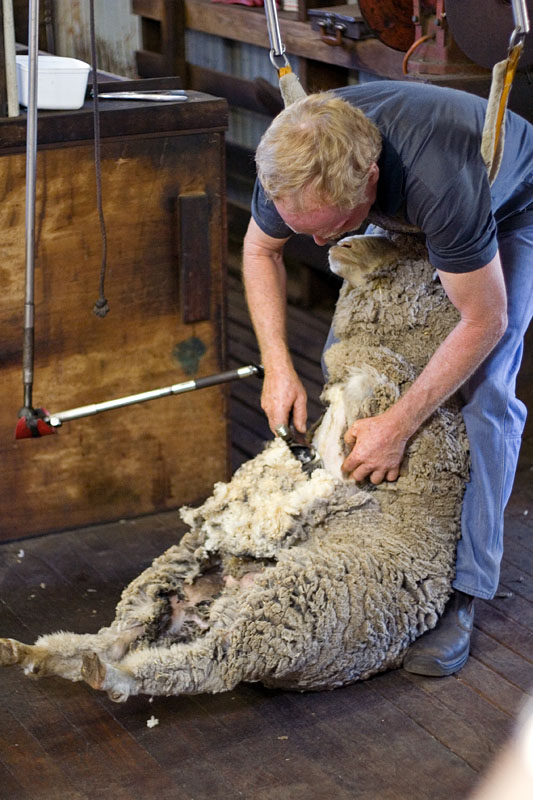
Sheep shearing is the process by which the woollen fleece of a sheep is cut off. The person who removes the sheep's wool is called a shearer. Typically each adult sheep is shorn once each year (depending upon dialect, a sheep may be said to have been "shorn", "sheared" or "shore" [in Australia]). The annual shearing most often occurs in a shearing shed, a facility especially designed to process often hundreds and sometimes more than 3,000 sheep per day. A working group of shearers and accompanying wool workers is known as a shearing gang.
Sheep are shorn in all seasons including winter, depending on the climate, management requirements and the availability of a woolclasser and shearers. Ewes are normally shorn prior to lambing in the warmer months, but consideration is typically made as to the welfare of the lambs by not shearing during cold climate winters. However, in high country regions, pre lamb shearing encourages ewes to seek shelter among the hillsides so that newborn lambs are not completely exposed to the elements. Shorn sheep tolerate frosts well, but young sheep especially will suffer in cold, wet windy weather (even in cold climate summers). In this event they are shedded for several nights until the weather clears. Some sheep may also be shorn with stud combs commonly known as cover combs which leave more wool on the animal in colder months, giving greater protection.
Sheep shearing is also considered a sport with competitions held around the world. It is often done between spring and summer.
Europe's oldest city, Knossos, derived its wealth from the sheep wool industry. The largest group of Linear B tablets is the great archive principally of shearing records though also of sheep breeding.
The medieval English wool trade was one of the most important factors in the English economy. The main sheep-shearing was an annual midsummer (June) event in medieval England culminating in the sheep-shearing feast.[citation needed] It had always been conventional practice to wash sheep.
In Australia, until the 1870s, squatters washed their sheep in nearby creeks prior to shearing. Later some expensive hot water installations were constructed on some of the larger stations for the washing. Australian growers were influenced by the Spanish practice of washing their very fine wool after shearing.[citation needed] There were three main reasons for the custom in Australia:[citation needed]
The practice of washing the wool rather than the sheep evolved from the fact that hotter water could be used to wash the wool, than that used to wash the sheep. When the practice of selling wool in the grease occurred in the 1890s, wool washing became obsolete.[citation needed]
Australia and New Zealand had to discard the old methods of wool harvesting and evolve more efficient systems to cope with the huge numbers of sheep involved. Shearing was revolutionized by the invention of an Australian sheepgrower, Frederick York Wolseley. His machines made in Birmingham, England, by his business The Wolseley Sheep Shearing Machine Company were introduced after 1888, reducing second cuts and shearing time. By 1915 most large sheep station sheds in Australia had installed machines, driven by steam or later by internal combustion engines.
Hub AI
Sheep shearing AI simulator
(@Sheep shearing_simulator)
Sheep shearing
Sheep shearing is the process by which the woollen fleece of a sheep is cut off. The person who removes the sheep's wool is called a shearer. Typically each adult sheep is shorn once each year (depending upon dialect, a sheep may be said to have been "shorn", "sheared" or "shore" [in Australia]). The annual shearing most often occurs in a shearing shed, a facility especially designed to process often hundreds and sometimes more than 3,000 sheep per day. A working group of shearers and accompanying wool workers is known as a shearing gang.
Sheep are shorn in all seasons including winter, depending on the climate, management requirements and the availability of a woolclasser and shearers. Ewes are normally shorn prior to lambing in the warmer months, but consideration is typically made as to the welfare of the lambs by not shearing during cold climate winters. However, in high country regions, pre lamb shearing encourages ewes to seek shelter among the hillsides so that newborn lambs are not completely exposed to the elements. Shorn sheep tolerate frosts well, but young sheep especially will suffer in cold, wet windy weather (even in cold climate summers). In this event they are shedded for several nights until the weather clears. Some sheep may also be shorn with stud combs commonly known as cover combs which leave more wool on the animal in colder months, giving greater protection.
Sheep shearing is also considered a sport with competitions held around the world. It is often done between spring and summer.
Europe's oldest city, Knossos, derived its wealth from the sheep wool industry. The largest group of Linear B tablets is the great archive principally of shearing records though also of sheep breeding.
The medieval English wool trade was one of the most important factors in the English economy. The main sheep-shearing was an annual midsummer (June) event in medieval England culminating in the sheep-shearing feast.[citation needed] It had always been conventional practice to wash sheep.
In Australia, until the 1870s, squatters washed their sheep in nearby creeks prior to shearing. Later some expensive hot water installations were constructed on some of the larger stations for the washing. Australian growers were influenced by the Spanish practice of washing their very fine wool after shearing.[citation needed] There were three main reasons for the custom in Australia:[citation needed]
The practice of washing the wool rather than the sheep evolved from the fact that hotter water could be used to wash the wool, than that used to wash the sheep. When the practice of selling wool in the grease occurred in the 1890s, wool washing became obsolete.[citation needed]
Australia and New Zealand had to discard the old methods of wool harvesting and evolve more efficient systems to cope with the huge numbers of sheep involved. Shearing was revolutionized by the invention of an Australian sheepgrower, Frederick York Wolseley. His machines made in Birmingham, England, by his business The Wolseley Sheep Shearing Machine Company were introduced after 1888, reducing second cuts and shearing time. By 1915 most large sheep station sheds in Australia had installed machines, driven by steam or later by internal combustion engines.