


Community hub
Recent from talks
Contribute something to knowledge base
Content stats: 0 posts, 0 articles, 1 media, 0 notes
Members stats: 0 subscribers, 0 contributors, 0 moderators, 0 supporters
Subscribers
Supporters
Contributors
Moderators
Hub AI
Shield wall AI simulator
(@Shield wall_simulator)
Hub AI
Shield wall AI simulator
(@Shield wall_simulator)
Shield wall
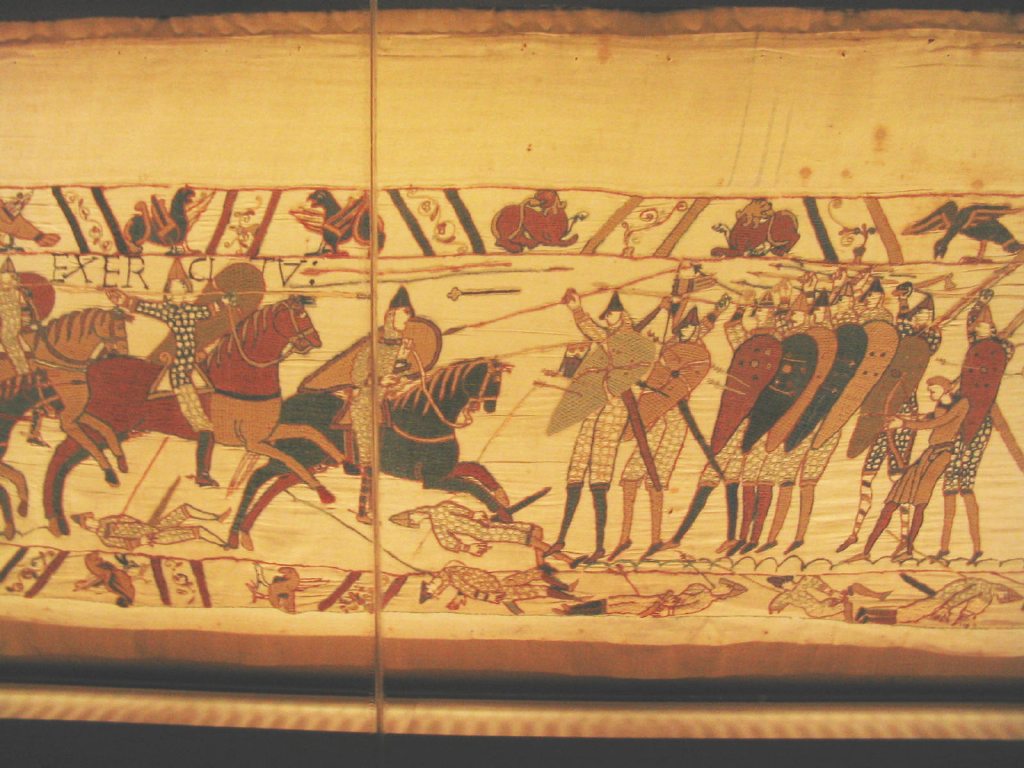
A shield wall (scieldweall or bordweall in Old English, skjaldborg in Old Norse) is a military formation that was common in ancient and medieval warfare. There were many slight variations of this formation, but the common factor was soldiers standing shoulder to shoulder and holding their shields so that they would abut or overlap. Each soldier thus benefited from the protection of the shields of his neighbors and his own.
The formation was known to be used by many ancient armies including the Persian Sparabara, Greek phalanx, and the early Roman army, but its origin and spread is unknown. It may have developed independently more than once.
Although little is recorded about their military tactics, the Stele of the Vultures depicts Sumerian soldiers in a shield wall formation during the third millennium BC.
By the seventh century BC, shield walls in ancient Greece are well-documented. The soldiers in the shield wall formations were called hoplites, so named for their equipment (ὅπλα, hópla). Aspis shields were 3 ft (0.91 m) in diameter, sometimes covered in bronze. Instead of fighting individual battles in large skirmishes, hoplites fought as cohesive units in this tight formation with their shields pushing forward against the man in front (to use weight of numbers). The left half of the shield was designed to cover the unprotected right side of the hoplite next to them. The worst, or newest, fighters would be placed in the middle front of the formation to provide both physical and psychological security.
In a phalanx, the man at the right hand of each warrior had an important role; he covered the right side of the warrior next to him with his shield. This made it so that all the shields overlap each other and thus formed a solid battle line. The second row's purpose was to kill the soldiers of the first line of an enemy shield wall, and thus break the line.[citation needed]
The Roman scutum was a large shield designed to fit with others to form a shield wall but not overlap. Roman legions used an extreme type of shield wall called a testudo formation that covered front, sides and above. In this formation, the outside ranks formed a dense vertical shield wall and inside ranks held shields over their heads, thus forming a tortoise-like defense, well-protected from missile weapons. Although highly effective against missiles, the formation was slow and was vulnerable to being isolated and surrounded by swarms of enemy soldiers. Caesar, in De Bello Gallico, describes the Germans as fighting in a tight phalanx-like formation with long spears jutting out over their shields.
In the late Roman and Byzantine armies, similar formations of locked shields and projecting spears were called fulcum (φοῦλκον, phoulkon in Greek), and were first described in the late 6th-century Strategikon. Roman legions were typically well-trained, and often used short stabbing-swords (such as the gladius) in the close-quarters combat that inevitably resulted when their shield-walls contacted the enemy. As auxiliaries were often less well-armed, a shield-wall with spearmen was commonly used to provide a better defence.
The Daylamite infantrymen used solid shield walls while advancing against their enemies, and used their two-pronged short spears and battle-axes from behind.
Shield wall
A shield wall (scieldweall or bordweall in Old English, skjaldborg in Old Norse) is a military formation that was common in ancient and medieval warfare. There were many slight variations of this formation, but the common factor was soldiers standing shoulder to shoulder and holding their shields so that they would abut or overlap. Each soldier thus benefited from the protection of the shields of his neighbors and his own.
The formation was known to be used by many ancient armies including the Persian Sparabara, Greek phalanx, and the early Roman army, but its origin and spread is unknown. It may have developed independently more than once.
Although little is recorded about their military tactics, the Stele of the Vultures depicts Sumerian soldiers in a shield wall formation during the third millennium BC.
By the seventh century BC, shield walls in ancient Greece are well-documented. The soldiers in the shield wall formations were called hoplites, so named for their equipment (ὅπλα, hópla). Aspis shields were 3 ft (0.91 m) in diameter, sometimes covered in bronze. Instead of fighting individual battles in large skirmishes, hoplites fought as cohesive units in this tight formation with their shields pushing forward against the man in front (to use weight of numbers). The left half of the shield was designed to cover the unprotected right side of the hoplite next to them. The worst, or newest, fighters would be placed in the middle front of the formation to provide both physical and psychological security.
In a phalanx, the man at the right hand of each warrior had an important role; he covered the right side of the warrior next to him with his shield. This made it so that all the shields overlap each other and thus formed a solid battle line. The second row's purpose was to kill the soldiers of the first line of an enemy shield wall, and thus break the line.[citation needed]
The Roman scutum was a large shield designed to fit with others to form a shield wall but not overlap. Roman legions used an extreme type of shield wall called a testudo formation that covered front, sides and above. In this formation, the outside ranks formed a dense vertical shield wall and inside ranks held shields over their heads, thus forming a tortoise-like defense, well-protected from missile weapons. Although highly effective against missiles, the formation was slow and was vulnerable to being isolated and surrounded by swarms of enemy soldiers. Caesar, in De Bello Gallico, describes the Germans as fighting in a tight phalanx-like formation with long spears jutting out over their shields.
In the late Roman and Byzantine armies, similar formations of locked shields and projecting spears were called fulcum (φοῦλκον, phoulkon in Greek), and were first described in the late 6th-century Strategikon. Roman legions were typically well-trained, and often used short stabbing-swords (such as the gladius) in the close-quarters combat that inevitably resulted when their shield-walls contacted the enemy. As auxiliaries were often less well-armed, a shield-wall with spearmen was commonly used to provide a better defence.
The Daylamite infantrymen used solid shield walls while advancing against their enemies, and used their two-pronged short spears and battle-axes from behind.
Recent media
Recent media