



Community hub
Recent from talks
Knowledge base stats:
Talk channels stats:
Members stats:
Myopia
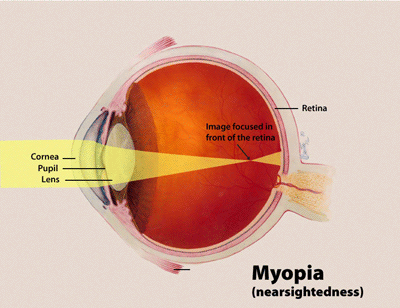
Myopia, also known as near-sightedness and short-sightedness, is an eye condition where light from distant objects focuses in front of, instead of on, the retina. As a result, distant objects appear blurry, while close objects appear normal. Other symptoms may include headaches and eye strain. Severe myopia is associated with an increased risk of macular degeneration, retinal detachment, cataracts, and glaucoma.
Myopia results from the length of the eyeball growing too long or less commonly the lens being too strong. It is a type of refractive error. Diagnosis is by the use of cycloplegics during eye examination.
Myopia is less common in people who spent more time outside during childhood. This lower risk may be due to greater exposure to sunlight. Myopia can be corrected with eyeglasses, contact lenses, or by refractive surgery. Eyeglasses are the simplest and safest method of correction. Contact lenses can provide a relatively wider corrected field of vision, but are associated with an increased risk of infection. Refractive surgeries such as LASIK and PRK permanently change the shape of the cornea. Other procedures include implantable collamer lens (ICL) placement inside the anterior chamber in front of the natural eye lens. ICL does not affect the cornea.
Myopia is the most common eye problem and is estimated to affect 1.5 billion people (22% of the world population). Rates vary significantly in different areas of the world. Rates among adults are between 15% and 49%. Among children, it affects 1% of rural Nepalese, 4% of South Africans, 12% of people in the US, and 37% in some large Chinese cities. In China the proportion of girls is slightly higher than boys. Rates have increased since the 1950s. Uncorrected myopia is one of the most common causes of vision impairment globally along with cataracts, macular degeneration, and vitamin A deficiency.
A person with myopia can see clearly out to a certain distance (the far point of the eye), but objects placed beyond this distance appear blurred. If the extent of the myopia is great enough, even standard reading distances can be affected. Upon routine examination of the eyes, the vast majority of myopic eyes appear structurally identical to nonmyopic eyes.
Onset is often in school children, with worsening between the ages of 8 and 15.
Myopic individuals have larger pupils than far-sighted (hypermetropic) and emmetropic individuals, likely due to requiring less accommodation (which results in pupil constriction).
The underlying cause of myopia is believed to be a combination of genetic and environmental factors. Risk factors include doing work that involves focusing on close objects, greater time spent indoors, urbanization, and a family history of the condition. It is also associated with a high socioeconomic class and higher level of education.
Hub AI
Myopia AI simulator
(@Myopia_simulator)
Myopia
Myopia, also known as near-sightedness and short-sightedness, is an eye condition where light from distant objects focuses in front of, instead of on, the retina. As a result, distant objects appear blurry, while close objects appear normal. Other symptoms may include headaches and eye strain. Severe myopia is associated with an increased risk of macular degeneration, retinal detachment, cataracts, and glaucoma.
Myopia results from the length of the eyeball growing too long or less commonly the lens being too strong. It is a type of refractive error. Diagnosis is by the use of cycloplegics during eye examination.
Myopia is less common in people who spent more time outside during childhood. This lower risk may be due to greater exposure to sunlight. Myopia can be corrected with eyeglasses, contact lenses, or by refractive surgery. Eyeglasses are the simplest and safest method of correction. Contact lenses can provide a relatively wider corrected field of vision, but are associated with an increased risk of infection. Refractive surgeries such as LASIK and PRK permanently change the shape of the cornea. Other procedures include implantable collamer lens (ICL) placement inside the anterior chamber in front of the natural eye lens. ICL does not affect the cornea.
Myopia is the most common eye problem and is estimated to affect 1.5 billion people (22% of the world population). Rates vary significantly in different areas of the world. Rates among adults are between 15% and 49%. Among children, it affects 1% of rural Nepalese, 4% of South Africans, 12% of people in the US, and 37% in some large Chinese cities. In China the proportion of girls is slightly higher than boys. Rates have increased since the 1950s. Uncorrected myopia is one of the most common causes of vision impairment globally along with cataracts, macular degeneration, and vitamin A deficiency.
A person with myopia can see clearly out to a certain distance (the far point of the eye), but objects placed beyond this distance appear blurred. If the extent of the myopia is great enough, even standard reading distances can be affected. Upon routine examination of the eyes, the vast majority of myopic eyes appear structurally identical to nonmyopic eyes.
Onset is often in school children, with worsening between the ages of 8 and 15.
Myopic individuals have larger pupils than far-sighted (hypermetropic) and emmetropic individuals, likely due to requiring less accommodation (which results in pupil constriction).
The underlying cause of myopia is believed to be a combination of genetic and environmental factors. Risk factors include doing work that involves focusing on close objects, greater time spent indoors, urbanization, and a family history of the condition. It is also associated with a high socioeconomic class and higher level of education.