Community hub
Recent from talks
Contribute something
Nothing was collected or created yet.
Quercus turbinella
View on Wikipedia
| Quercus turbinella | |
|---|---|

| |

| |
Scientific classification 
| |
| Kingdom: | Plantae |
| Clade: | Tracheophytes |
| Clade: | Angiosperms |
| Clade: | Eudicots |
| Clade: | Rosids |
| Order: | Fagales |
| Family: | Fagaceae |
| Genus: | Quercus |
| Subgenus: | Quercus subg. Quercus |
| Section: | Quercus sect. Quercus |
| Species: | Q. turbinella
|
| Binomial name | |
| Quercus turbinella | |

| |
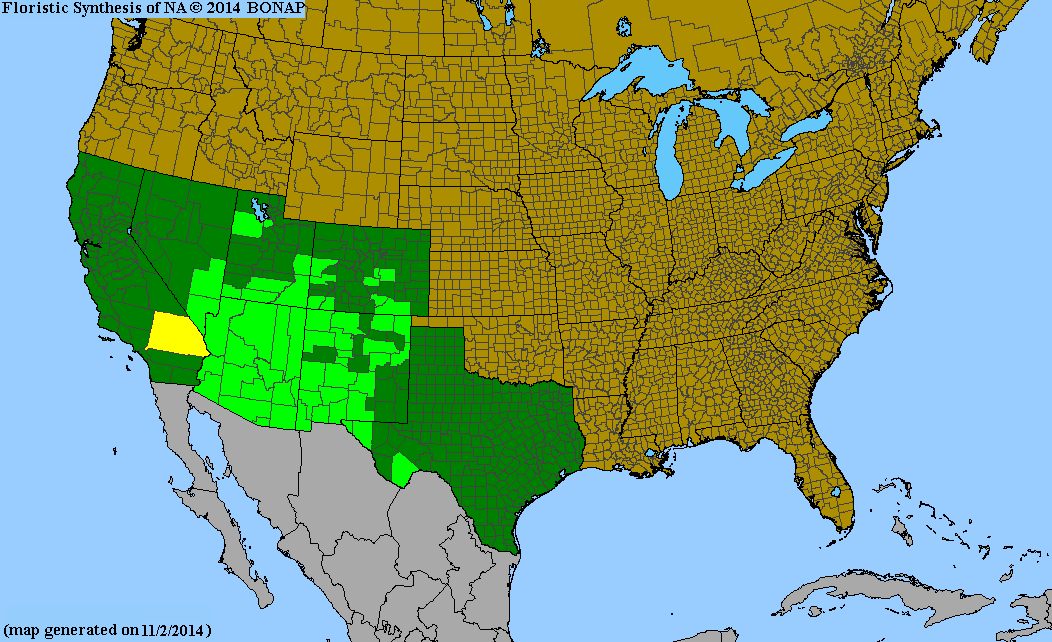
| Natural range | |
| Synonyms[3] | |
|
List
| |


Quercus turbinella is a North American species of oak known by the common names shrub oak, turbinella oak, shrub live oak, and gray oak.[4][5][6] It is native to Arizona, California, New Mexico, Utah, Colorado, and Nevada in the western United States.[4] It also occurs in northern Mexico.[7]

Description
[edit]Quercus turbinella is a shrub growing 2–5 metres (6+1⁄2–16+1⁄2 feet) in height but sometimes becoming treelike and exceeding 6 m (20 ft). The branches are gray or brown, the twigs often coated in short woolly fibers when young and becoming scaly with age. The thick, leathery evergreen leaves are up to 3 centimetres (1+1⁄4 inches) long by 2 cm (3⁄4 in) wide and are edged with large, spine-tipped teeth. They are gray-green to yellowish in color and waxy in texture on the upper surfaces, and yellowish and hairy or woolly and glandular on the lower surfaces. The males catkins are yellowish-green and the female flowers are in short spikes in the leaf axils, appearing at the same time as the new growth of leaves. The fruit is a yellowish brown acorn up to two centimeters long with a shallow warty cup about a centimeter wide.[7] This oak reproduces sexually via its acorns if there is enough moisture present, but more often it reproduces vegetatively by sprouting from its rhizome and root crown.[6][4]
Distribution
[edit]Quercus turbinella has been found in Arizona, New Mexico, Colorado, Utah, Nevada, southern California, and western Texas, as well as Baja California.[8][5] In California, it occurs in the New York mountains and a few eastern California desert ranges. The populations on the desert mountains in the western Mojave desert and the inner coastal ranges are now considered Quercus john-tuckeri.[9][10] It grows in woodland, chaparral, forest, and other habitat. It is most common in chaparral habitat in central Arizona,[6] through the transition zone of the Mogollon Rim–White Mountains, but also southeast Arizona in the Madrean Sky Island mountain ranges of sky islands.[11]
Ecology
[edit]Quercus turbinella easily hybridizes with other oak species, including Quercus gambelii, Q. havardii, Q. arizonica, and Q. grisea.[6] Many species of animals use it for food, with wild and domesticated ungulates browsing the foliage and many birds and mammals eating the acorns.[6] Animals also use the shrub as cover, and mountain lions hide their kills in the thickets.[6]
See also
[edit]References
[edit]
- ^ Beckman, E. (2016). "Quercus turbinella". IUCN Red List of Threatened Species. 2016 e.T194242A2305742. doi:10.2305/IUCN.UK.2016-1.RLTS.T194242A2305742.en. Retrieved 11 November 2021.
- ^ NatureServe (2024). "Quercus turbinella". Arlington, Virginia. Retrieved 1 September 2024.
- ^ "Quercus turbinella Greene". Plants of the World Online. Royal Botanic Gardens, Kew. Retrieved 5 September 2024.
- ^ a b c Nixon, Kevin C. (1997). "Quercus turbinella". In Flora of North America Editorial Committee (ed.). Flora of North America North of Mexico (FNA). Vol. 3. New York and Oxford: Oxford University Press – via eFloras.org, Missouri Botanical Garden, St. Louis, MO & Harvard University Herbaria, Cambridge, MA.
- ^ a b "Quercus turbinella". Calflora. Berkeley, California: The Calflora Database.
- ^ a b c d e f Tirmenstein, D. (1999). "Quercus turbinella". Fire Effects Information System (FEIS). US Department of Agriculture (USDA), Forest Service (USFS), Rocky Mountain Research Station, Fire Sciences Laboratory.
- ^ a b Virginia Tech: Shrub live oak Archived May 9, 2011, at the Wayback Machine
- ^ Kartesz, John T. (2014). "Quercus turbinella". County-level distribution map from the North American Plant Atlas (NAPA). Biota of North America Program (BONAP).
- ^ Calflora
- ^ SEINet, Southwestern Biodiversity, Arizona chapter photos, description, interactive distribution map
- ^ Little Jr., Elbert L. (1976). "Map 147, Quercus turbinella". Atlas of United States Trees. Vol. 3 (Minor Western Hardwoods). US Government Printing Office. LCCN 79-653298. OCLC 4053799.