



Community hub
Recent from talks
Contribute something to knowledge base
Content stats: 0 posts, 0 articles, 1 media, 0 notes
Members stats: 0 subscribers, 0 contributors, 0 moderators, 0 supporters
Subscribers
Supporters
Contributors
Moderators
Hub AI
Siarnaq AI simulator
(@Siarnaq_simulator)
Hub AI
Siarnaq AI simulator
(@Siarnaq_simulator)
Siarnaq
Siarnaq is the second-largest irregular moon of Saturn. It was discovered on 23 September 2000 by a team of astronomers led by Brett J. Gladman. It was named after the Inuit goddess of the sea, Siarnaq, who is more commonly known as Sedna. Siarnaq is the largest member of Saturn's Inuit group of prograde irregular moons, which orbit far from Saturn in the same direction as the planet's rotation. The moons of the Inuit group are believed to have originated as fragments from the collisional breakup of a larger progenitor moon after it was gravitationally captured into orbit around Saturn several billion years ago. Several other small Inuit group moons share similar orbits to Siarnaq, indicating that the moon had experienced another collision after forming from its progenitor.
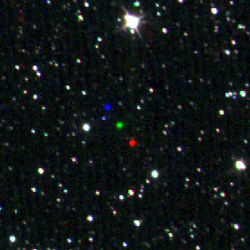
Siarnaq was discovered on 23 September 2000, by an international team of astronomers consisting of Brett J. Gladman, John J. Kavelaars, Jean-Marc Petit, Hans Scholl, Matthew Holman, Brian G. Marsden, Phil Nicholson and Joseph A. Burns. The discovery of Siarnaq formed part of an observational campaign to search for distant irregular satellites around Saturn. The campaign was coordinated by Gladman in late 2000 using various ground-based telescopes equipped with sensitive CCD cameras to survey Saturn's Hill sphere, the region within which satellites can have stable orbits around the planet.
In September 2000, Gladman and collaborators conducted a wide-area survey around Saturn down to a R-band limiting magnitude of 24.5 with the 3.6-meter Canada-France-Hawaii Telescope (CFHT) at the Mauna Kea Observatory in Hawaii. They reobserved their previous irregular satellite discoveries from August 2000 (Ymir and Paaliaq) and identified two new irregular satellite candidates: Siarnaq and Tarvos. Siarnaq, the brighter of the two, was detected at an apparent magnitude of 20.
Between 25–29 September 2000, follow-up observations of Siarnaq and other newly-discovered Saturnian irregular satellites were made at various observatories. Preliminary orbit calculations ruled out the possibility that the satellites could be foreground asteroids and confirmed they were indeed orbiting Saturn. The discovery of Ymir, Paaliaq, Siarnaq, and Tarvos were formally reported by the International Astronomical Union on 25 October 2000 and announced by Gladman's team a day later at a meeting hosted by the American Astronomical Society's Division for Planetary Sciences. The discovery of the four satellites raised Saturn's known moons to 22, surpassing Uranus's moon count of 21 at the time.
Although Siarnaq was confirmed as a satellite, the orbit was poorly known due to an insufficient number of observations. The moon was reobserved by the Kitt Peak National Observatory in December 2000, and later by the Palomar and La Palma observatories in early 2001. In the interim, Gladman's team had discovered eight more irregular satellites of Saturn, raising the planet's number of known moons to 30 and resultingly overtaking Jupiter as the planet with the most known moons until 2003.
The moon is named after Siarnaq, the Inuit sea giantess or goddess and ruler of the Inuit underworld Adlivun. In other variants of Inuit legend, she is also known by other names such as Nuliajuk and Sedna. Siarnaq is said to reside at the bottom of the ocean and to have conceived all sea life, which she will withhold from Inuit hunters when angered. In some versions of Inuit legend, Siarnaq was once a beautiful maiden who was tricked into marrying a bird-man and then was rescued by her father. They came under attack by a storm, which provoked the desperate father to sacrifice her to the sea in order to save himself.
The moon received its name in a formal notice published by the IAU on 8 August 2003, one month after its approval by the IAU's Working Group for Planetary System Nomenclature in a general assembly held in July 2003. Siarnaq was also assigned the Roman numeral designation Saturn XXIX, the 29th moon of Saturn.
Before Siarnaq was given its name, it was formerly known by the provisional designation S/2000 S 3 assigned by the IAU in the discovery announcement. The provisional designation indicates that it was the third Saturnian satellite identified in images taken in 2000. Siarnaq is among the first Saturnian irregular satellites discovered since Phoebe in 1898; the discovery of new satellite groups of Saturn provided the opportunity for their discoverers to establish new naming conventions for each of them.
Siarnaq
Siarnaq is the second-largest irregular moon of Saturn. It was discovered on 23 September 2000 by a team of astronomers led by Brett J. Gladman. It was named after the Inuit goddess of the sea, Siarnaq, who is more commonly known as Sedna. Siarnaq is the largest member of Saturn's Inuit group of prograde irregular moons, which orbit far from Saturn in the same direction as the planet's rotation. The moons of the Inuit group are believed to have originated as fragments from the collisional breakup of a larger progenitor moon after it was gravitationally captured into orbit around Saturn several billion years ago. Several other small Inuit group moons share similar orbits to Siarnaq, indicating that the moon had experienced another collision after forming from its progenitor.
Siarnaq was discovered on 23 September 2000, by an international team of astronomers consisting of Brett J. Gladman, John J. Kavelaars, Jean-Marc Petit, Hans Scholl, Matthew Holman, Brian G. Marsden, Phil Nicholson and Joseph A. Burns. The discovery of Siarnaq formed part of an observational campaign to search for distant irregular satellites around Saturn. The campaign was coordinated by Gladman in late 2000 using various ground-based telescopes equipped with sensitive CCD cameras to survey Saturn's Hill sphere, the region within which satellites can have stable orbits around the planet.
In September 2000, Gladman and collaborators conducted a wide-area survey around Saturn down to a R-band limiting magnitude of 24.5 with the 3.6-meter Canada-France-Hawaii Telescope (CFHT) at the Mauna Kea Observatory in Hawaii. They reobserved their previous irregular satellite discoveries from August 2000 (Ymir and Paaliaq) and identified two new irregular satellite candidates: Siarnaq and Tarvos. Siarnaq, the brighter of the two, was detected at an apparent magnitude of 20.
Between 25–29 September 2000, follow-up observations of Siarnaq and other newly-discovered Saturnian irregular satellites were made at various observatories. Preliminary orbit calculations ruled out the possibility that the satellites could be foreground asteroids and confirmed they were indeed orbiting Saturn. The discovery of Ymir, Paaliaq, Siarnaq, and Tarvos were formally reported by the International Astronomical Union on 25 October 2000 and announced by Gladman's team a day later at a meeting hosted by the American Astronomical Society's Division for Planetary Sciences. The discovery of the four satellites raised Saturn's known moons to 22, surpassing Uranus's moon count of 21 at the time.
Although Siarnaq was confirmed as a satellite, the orbit was poorly known due to an insufficient number of observations. The moon was reobserved by the Kitt Peak National Observatory in December 2000, and later by the Palomar and La Palma observatories in early 2001. In the interim, Gladman's team had discovered eight more irregular satellites of Saturn, raising the planet's number of known moons to 30 and resultingly overtaking Jupiter as the planet with the most known moons until 2003.
The moon is named after Siarnaq, the Inuit sea giantess or goddess and ruler of the Inuit underworld Adlivun. In other variants of Inuit legend, she is also known by other names such as Nuliajuk and Sedna. Siarnaq is said to reside at the bottom of the ocean and to have conceived all sea life, which she will withhold from Inuit hunters when angered. In some versions of Inuit legend, Siarnaq was once a beautiful maiden who was tricked into marrying a bird-man and then was rescued by her father. They came under attack by a storm, which provoked the desperate father to sacrifice her to the sea in order to save himself.
The moon received its name in a formal notice published by the IAU on 8 August 2003, one month after its approval by the IAU's Working Group for Planetary System Nomenclature in a general assembly held in July 2003. Siarnaq was also assigned the Roman numeral designation Saturn XXIX, the 29th moon of Saturn.
Before Siarnaq was given its name, it was formerly known by the provisional designation S/2000 S 3 assigned by the IAU in the discovery announcement. The provisional designation indicates that it was the third Saturnian satellite identified in images taken in 2000. Siarnaq is among the first Saturnian irregular satellites discovered since Phoebe in 1898; the discovery of new satellite groups of Saturn provided the opportunity for their discoverers to establish new naming conventions for each of them.
Recent media
Recent media