


Community hub
Recent from talks
Contribute something
Nothing was collected or created yet.
Sicherman dice
View on Wikipedia | This article includes a list of references, related reading, or external links, but its sources remain unclear because it lacks inline citations. (March 2024) |

Sicherman dice /ˈsɪkərmən/ are a pair of 6-sided dice with non-standard numbers—one with the sides 1, 2, 2, 3, 3, 4 and the other with the sides 1, 3, 4, 5, 6, 8. They are notable as the only pair of 6-sided dice that are not normal dice, bear only positive integers, and have the same probability distribution for the sum as normal dice. They were invented in 1978 by George Sicherman of Buffalo, New York.
Mathematics
[edit]
A standard exercise in elementary combinatorics is to calculate the number of ways of rolling any given value with a pair of fair six-sided dice (by taking the sum of the two rolls). The table shows the number of such ways of rolling a given value :

| n | 2 | 3 | 4 | 5 | 6 | 7 | 8 | 9 | 10 | 11 | 12 |
|---|---|---|---|---|---|---|---|---|---|---|---|
| Number of ways | 1 | 2 | 3 | 4 | 5 | 6 | 5 | 4 | 3 | 2 | 1 |
Crazy dice is a mathematical exercise in elementary combinatorics, involving a re-labeling of the faces of a pair of six-sided dice to reproduce the same frequency of sums as the standard labeling. The Sicherman dice are crazy dice that are re-labeled with only positive integers. (If the integers need not be positive, to get the same probability distribution, the number on each face of one die can be decreased by k and that of the other die increased by k, for any natural number k, giving infinitely many solutions.)
The table below lists all possible totals of dice rolls with standard dice and Sicherman dice. One Sicherman die is colored for clarity: 1–2–2–3–3–4, and the other is all black, 1–3–4–5–6–8.
| 2 | 3 | 4 | 5 | 6 | 7 | 8 | 9 | 10 | 11 | 12 | |
|---|---|---|---|---|---|---|---|---|---|---|---|
| Standard dice | 1+1 |
|
|
|
|
|
|
|
|
|
6+6 |
| Sicherman dice | 1+1 |
|
|
|
|
|
|
|
|
|
4+8 |

Properties other than sum need not mimic regular dice; for example, the probability of rolling doubles is 1/6 with regular dice (1+1, 2+2, 3+3, 4+4, 5+5 and 6+6 out of 36 possible combinations), but 1/9 with Sicherman dice (1+1, 3+3, 3+3 and 4+4).[1]
History
[edit]The Sicherman dice were discovered by George Sicherman of Buffalo, New York and were originally reported by Martin Gardner in a 1978 article in Scientific American.
The numbers can be arranged so that all pairs of numbers on opposing sides sum to equal numbers, 5 for the first and 9 for the second.
Later, in a letter to Sicherman, Gardner mentioned that a magician he knew had anticipated Sicherman's discovery. For generalizations of the Sicherman dice to more than two dice and noncubical dice, see Broline (1979), Gallian and Rusin (1979), Brunson and Swift (1997/1998), and Fowler and Swift (1999).
Mathematical justification
[edit]Let a canonical n-sided die be an n-hedron whose faces are marked with the integers [1,n] such that the probability of throwing each number is 1/n. Consider the canonical cubical (six-sided) die. The generating function for the throws of such a die is . The product of this polynomial with itself yields the generating function for the throws of a pair of dice: .


We can analyze this polynomial using either cyclotomic polynomials, or elementary factoring.
Option 1: cyclotomic polynomials:
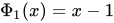
We know that: where d ranges over the divisors of n and is the d-th cyclotomic polynomial, and
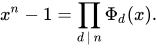

- .

We therefore derive the generating function of a single n-sided canonical die as being

and is canceled. Thus the factorization of the generating function of a six-sided canonical die is

Option 2: Elementary factoring:
.

.

Thus,

The generating function for the throws of two dice is the product of two copies of each of these factors: . How can we partition them to form two legal dice whose pips are not arranged traditionally? Here legal means that the coefficients are non-negative and sum to six, so that each die has six sides and every face has at least one spot. That is, the generating function of each die must be a polynomial with all positive exponents and no constant term (representing the die face values), and with positive coefficients (representing the number of faces showing each value) that sum to 6. So, and .


Plugging in in the factors (to sum the coefficients) gives: , and . To make both products of factors equal to 6, each factor must be paired with . The remaining pair of terms (both ) must either be separated (which gives the symmetrical solution, representing traditional dice), or be combined, representing Sicherman dice:



and

This gives us the distribution of pips on the faces of a pair of Sicherman dice as being {1,2,2,3,3,4} and {1,3,4,5,6,8}, as above.
This technique can be extended for dice with an arbitrary number of sides.
References
[edit]- Broline, D. (1979), "Renumbering of the faces of dice", Mathematics Magazine, 52 (5), Mathematics Magazine, Vol. 52, No. 5: 312–315, doi:10.2307/2689786, JSTOR 2689786
- Brunson, B. W.; Swift, Randall J. (1998), "Equally likely sums", Mathematical Spectrum, 30 (2): 34–36
- Fowler, Brian C.; Swift, Randall J. (1999), "Relabeling dice", College Mathematics Journal, 30 (3), The College Mathematics Journal, Vol. 30, No. 3: 204–208, doi:10.2307/2687599, JSTOR 2687599
- Gallian, J. A.; Rusin, D. J. (1979), "Cyclotomic polynomials and nonstandard dice", Discrete Mathematics, 27 (3): 245–259, doi:10.1016/0012-365X(79)90161-4, MR 0541471
- Gardner, Martin (1978), "Mathematical Games", Scientific American, 238 (2): 19–32, Bibcode:1978SciAm.238b..19G, doi:10.1038/scientificamerican0278-19
- Newman, Donald J. (1998). Analytic Number Theory. Springer-Verlag. ISBN 0-387-98308-2.
See also
[edit]References
[edit]- ^ DataGenetics, Rolling Dice, June 2013.
External links
[edit]This article incorporates material from Crazy dice on PlanetMath, which is licensed under the Creative Commons Attribution/Share-Alike License.
Sicherman dice
View on GrokipediaOverview
Definition
Sicherman dice are a pair of six-sided dice that bear positive integers on their faces but deviate from the standard labeling of 1 through 6 on each die, yet produce the identical probability distribution for sums ranging from 2 to 12 as two standard dice.[1] They represent the only known such pair, excluding the standard configuration, where all face values are positive integers.[4] The unconventional labeling was discovered by George Sicherman in 1977.[1] Specifically, one die is marked with the numbers 1, 2, 2, 3, 3, and 4, while the other features 1, 3, 4, 5, 6, and 8.[1] For clarity, the face configurations are presented below:| Die | Faces |
|---|---|
| 1 | 1, 2, 2, 3, 3, 4 |
| 2 | 1, 3, 4, 5, 6, 8 |
Key Properties
Sicherman dice exhibit the same probability distribution for the sum of their faces as a pair of standard six-sided dice numbered 1 through 6. Specifically, when rolled together, the possible sums range from 2 to 12 with the following probabilities: 1/36 for sums of 2 and 12, 2/36 for 3 and 11, 3/36 for 4 and 10, 4/36 for 5 and 9, 5/36 for 6 and 8, and 6/36 for 7.[5] Unlike standard dice, which each have an average face value of 3.5, the Sicherman dice have non-standard averages: the first die (with faces 1, 2, 2, 3, 3, 4) averages 2.5, while the second (with faces 1, 3, 4, 5, 6, 8) averages 4.5, though their combined average remains 7.[5] Both dice use only positive integers for labeling, avoiding zeros, negatives, or non-integer values.[5] This equivalence in sum probabilities allows Sicherman dice to substitute for standard dice in games where the total roll determines outcomes, such as craps—preserving critical odds like the 1/6 chance of rolling a 7—while altering the distribution of individual rolls and reducing the frequency of doubles.[6][2]Mathematical Background
Standard Dice Sums
Standard six-sided dice, often simply called standard dice, are fair polyhedral dice with six faces numbered from 1 to 6, where each face has an equal probability of 1/6 of landing face up on a roll.[7] When two such dice are rolled independently, the sum of the numbers shown on the top faces ranges from a minimum of 2 (1+1) to a maximum of 12 (6+6).[7] There are 36 equally likely outcomes in total for the two dice, as each die has 6 possible results. The number of ways to achieve each possible sum varies, leading to a non-uniform probability distribution symmetric around 7: 1 way for 2, 2 ways for 3, 3 ways for 4, 4 ways for 5, 5 ways for 6, 6 ways for 7, 5 ways for 8, 4 ways for 9, 3 ways for 10, 2 ways for 11, and 1 way for 12.[7] The probabilities for each sum are thus these counts divided by 36, yielding fractions such as 1/36 for sums of 2 or 12, 6/36 = 1/6 for 7 (the most probable sum), and so on.[7] The following table summarizes the sums, number of ways, and corresponding probabilities:| Sum | Number of Ways | Probability |
|---|---|---|
| 2 | 1 | 1/36 |
| 3 | 2 | 2/36 |
| 4 | 3 | 3/36 |
| 5 | 4 | 4/36 |
| 6 | 5 | 5/36 |
| 7 | 6 | 6/36 |
| 8 | 5 | 5/36 |
| 9 | 4 | 4/36 |
| 10 | 3 | 3/36 |
| 11 | 2 | 2/36 |
| 12 | 1 | 1/36 |
Generating Functions for Dice
Generating functions provide a powerful algebraic tool for analyzing the probability distributions of sums obtained from rolling dice. For a single standard six-sided die, with faces numbered 1 through 6 each occurring with equal probability of , the probability generating function is defined as the polynomialwhere the coefficient of each (for to ) represents the probability of rolling that face value.[9] When two such independent dice are rolled, the generating function for their sum is the product , which expands to
The coefficient of in this expansion gives the probability of obtaining a sum of , equivalent to the number of ways to achieve that sum divided by the total number of outcomes, 36.[9] This approach highlights the combinatorial structure underlying the sum probabilities, as the coefficients directly count the favorable outcomes for each possible total. To reveal further algebraic properties, consider the unnormalized generating function for the faces of a single die, . Squaring this yields
where the factor accounts for the minimum sum of 2, and the squared geometric series term encodes the distribution of excesses over this minimum.[10]
Description of Sicherman Dice
Face Configurations
Sicherman dice consist of two six-sided dice with non-standard positive integer labels that replicate the sum distribution of conventional dice. The first die, often referred to as Die A, features the numbers 1 once, 2 twice, 3 twice, and 4 once.[3] The second die, Die B, is labeled with the distinct numbers 1, 3, 4, 5, 6, and 8, each appearing once.[3] To ensure balanced weight distribution similar to standard dice, the opposite faces on Die A are arranged such that they sum to 5: the 1 is opposite the 4, one 2 is opposite one 3, and the other 2 is opposite the other 3.[1] On Die B, opposite faces sum to 9: the 1 is opposite the 8, the 3 is opposite the 6, and the 4 is opposite the 5.[1] The total number of pips on Die A is 15, while Die B has 27, in contrast to the 21 pips on each standard die numbered 1 through 6.[1] Manufacturing Sicherman dice involves custom engraving or printing of the non-standard numbers, often using spot patterns adapted from traditional dice designs. For instance, the 8 on Die B may employ a configuration of eight spots arranged in a specific pattern to distinguish it clearly, and early production pairs were handmade by specialty firms like George & Company.[1] Commercial versions have been produced with either pips or numerals, ensuring the dice remain fair and visually distinct from standard sets.[1]Equivalence to Standard Dice
Sicherman dice consist of one die with faces 1, 2, 2, 3, 3, 4 and another with faces 1, 3, 4, 5, 6, 8, producing the same 36 equally likely outcomes for sums ranging from 2 to 12 as a pair of standard six-sided dice numbered 1 through 6.[1][11] This equivalence arises because the combined rolls of the Sicherman pair replicate the exact frequency distribution of sums seen in standard dice, with one way to get a 2, two ways for a 3, up to six ways for a 7, and symmetrically decreasing thereafter.[12] Although the individual dice have shifted ranges— the first covering 1 to 4 and the second 1 to 8—their pairing ensures the overall sum probabilities remain identical to those of standard dice.[12] For instance, the minimum sum of 2 can only be achieved by rolling a 1 on the first die and a 1 on the second, mirroring the standard 1+1 outcome. Similarly, the maximum sum of 12 occurs solely from a 4 on the first die plus an 8 on the second, equivalent to the standard 6+6.[1] Other sums, such as 7, arise in six different combinations, just as with standard dice. Sicherman dice produce the same sum probabilities as standard dice, making them suitable substitutes in games that depend solely on the total, but the lower probability of doubles (4 out of 36 outcomes vs. 6 for standard) may affect games like backgammon or Monopoly that treat doubles specially.[12] However, differences become apparent when observing individual dice rolls, such as the absence of numbers like 5, 6, or 7 on the first die, or the presence of an 8 on the second, which could affect games relying on single-die results or specific face values.[12]Analysis and Proof
Verification of Probability Distribution
To verify that Sicherman dice produce the same probability distribution for sums as a pair of standard six-sided dice, one can use generating functions, which encode the probabilities of outcomes on each die. The generating function for the first Sicherman die, with faces labeled 1, 2, 2, 3, 3, 4, is .[2] For the second die, with faces 1, 3, 4, 5, 6, 8, it is .[2] The probability generating function for the sum is the product , and its coefficients must match those of the standard dice product .[6] The product simplifies to , which exactly reproduces the standard distribution.[5] To confirm this, multiply the numerator polynomials and , then divide by 36. For the lowest sum, the coefficient of arises solely from the term (one way). For , it comes from and (two ways total). Similarly, for , the combinations are , , , , (wait, no duplicate), but enumerating all pairs yields exactly six contributing terms with multiplicity.[6] This process, carried out for all powers from 2 to 12, confirms the coefficients match. The following table compares the number of ways to obtain each sum (out of 36 possible outcomes) for standard and Sicherman dice, demonstrating identical distributions:| Sum | Standard Dice Ways | Sicherman Dice Ways |
|---|---|---|
| 2 | 1 | 1 |
| 3 | 2 | 2 |
| 4 | 3 | 3 |
| 5 | 4 | 4 |
| 6 | 5 | 5 |
| 7 | 6 | 6 |
| 8 | 5 | 5 |
| 9 | 4 | 4 |
| 10 | 3 | 3 |
| 11 | 2 | 2 |
| 12 | 1 | 1 |
Uniqueness Proof
To prove the uniqueness of the Sicherman dice among pairs of six-sided dice labeled with positive integers that replicate the sum distribution of standard dice (faces 1 through 6), consider the generating function approach. The generating function for a single standard die is , so for two standard dice it is . The polynomial factors over the integers as , yielding the full squared form .[13] Any alternative pair of dice must have generating functions and , each a sum of six terms with positive integers , such that and the coefficients of and are non-negative integers summing to 6 (reflecting six faces). Due to unique factorization in , the factors must be distributed between and , each resulting in a degree-6 polynomial starting with (no constant term) and satisfying the coefficient sum condition. Evaluating at , the factors contribute as follows: , , and . Thus, each polynomial must receive exactly one and one to achieve sum 6, along with one ; the two copies of must then be distributed between them.[13] The possible distributions of the factors are: one to each polynomial, or both to one and none to the other (the latter two cases are symmetric by swapping dice). For one per polynomial, each becomes , the standard die. For both to one (say ) and none to the other (), then . Expanding the latter yields after coefficient adjustment, with faces 1, 3, 4, 5, 6, 8—all positive integers and coefficients summing to 6. No other distributions are possible, as assigning zero or more than one or to a polynomial violates the sum-6 condition or produces negative coefficients in .[13] Thus, up to ordering of the dice, there are exactly two such pairs: the standard pair and the Sicherman pair (faces 1,2,2,3,3,4 and 1,3,4,5,6,8). This exhausts all possibilities for positive integer labelings on six-sided dice matching the standard sum distribution.[13]Generalizations and Variants
Extensions to Other Dice
The concept of Sicherman dice extends beyond six-sided pairs to dice with arbitrary numbers of sides, where non-standard labelings using positive integers produce the same sum probability distribution as standard n-sided dice. For n=4, one such pair consists of the faces {1, 2, 2, 3} and {1, 3, 3, 5}, whose generating functions multiply to match that of two standard d4 dice: This is the only non-standard pair for tetrahedral dice under positive integer constraints.[14] For larger n, multiple non-standard pairs emerge. For n=8, Broline identified three distinct pairs of octahedral dice that replicate the sum distribution of two standard d8:- {1, 2, 2, 3, 3, 4, 4, 5} and {1, 3, 5, 5, 7, 7, 9, 11},
- {1, 2, 2, 3, 5, 6, 6, 7} and {1, 3, 3, 5, 5, 7, 7, 9},
- {1, 2, 3, 3, 4, 4, 5, 6} and {1, 2, 5, 5, 6, 6, 9, 10}.
These configurations allow labels exceeding 8 while preserving the required probabilities.[15]