



Community hub
Recent from talks
Contribute something
Nothing was collected or created yet.
Constant term
View on WikipediaIn mathematics, a constant term (sometimes referred to as a free term) is a term in an algebraic expression that does not contain any variables and therefore is constant. For example, in the quadratic polynomial,
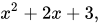
The number 3 is a constant term.[1]
After like terms are combined, an algebraic expression will have at most one constant term. Thus, it is common to speak of the quadratic polynomial
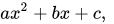
where is the variable, as having a constant term of If the constant term is 0, then it will conventionally be omitted when the quadratic is written out.


Any polynomial written in standard form has a unique constant term, which can be considered a coefficient of In particular, the constant term will always be the lowest degree term of the polynomial. This also applies to multivariate polynomials. For example, the polynomial


has a constant term of −4, which can be considered to be the coefficient of where the variables are eliminated by being exponentiated to 0 (any non-zero number exponentiated to 0 becomes 1). For any polynomial, the constant term can be obtained by substituting in 0 instead of each variable; thus, eliminating each variable. The concept of exponentiation to 0 can be applied to power series and other types of series, for example in this power series:


is the constant term.

Constant of integration
[edit]The derivative of a constant term is 0, so when a term containing a constant term is differentiated, the constant term vanishes, regardless of its value. Therefore the antiderivative is only determined up to an unknown constant term, which is called "the constant of integration" and added in symbolic form (usually denoted as ).[2]

For example, the antiderivative of is , since the derivative of is equal to based on the properties of trigonometric derivatives.


However, the integral of is equal to (the antiderivative), plus an arbitrary constant:

because for any constant , the derivative of the right-hand side of the equation is equal to the left-hand side of the equation.
See also
[edit]References
[edit]- ^ Fred Safier (2012). Schaum's Outline of Precalculus (3rd ed.). McGraw-Hill Education. p. 7. ISBN 978-0-07-179560-9.
- ^ Arthur Sherburne Hardy (1892). Elements of the Differential and Integral Calculus. Ginn & Company. p. 168.
Constant term
View on GrokipediaDefinitions in Algebra
In Polynomials
In a polynomial expression, the constant term is defined as the term that contains no variables, equivalent to the coefficient of the degree-zero term.[5] For a univariate polynomial written in standard form as , where each is a constant coefficient, the constant term is .[1] This term represents a fixed numerical value independent of the variable . Consider the polynomial ; here, the constant term is -5, as it is the standalone numerical component after combining like terms.[1] In multivariate polynomials, such as , the constant term is similarly the term without any variables, which is 7.[5] The notation distinguishing constant terms from variable terms emerged in the late 16th century through the work of French mathematician François Viète, who pioneered the use of letters to represent both constants and unknowns in polynomial expressions, facilitating clearer algebraic manipulation.[6] A key property of the constant term in polynomials is its invariance under substitution of the variable; regardless of the value assigned to (or other variables), the constant term remains unchanged, preserving its fixed value within the expression.[7]In General Expressions
In any algebraic expression, the constant term refers to the numerical or fixed-value component that does not depend on the variables present, typically identified after fully expanding the expression into its simplest form.[8] For instance, in the product , expansion yields , where 2 is the constant term as it remains unchanged regardless of the value of .[9] This definition applies broadly to expressions involving sums, products, or more complex forms, where the constant is the portion independent of variable substitution.[10] Examples extend to rational functions, such as , the constant term is 2 after considering the form, representing the part unaffected by the variable dependence.[11] To identify the constant term, one collects all variable-independent parts during expansion of sums and products; for example, in a sum like , simplification to isolates 4 as the constant.[9] This process involves distributing and combining like terms without relying on degree ordering specific to polynomials.[8] While coefficients are fixed numerical multipliers attached to variable terms—such as the 3 in —the constant term specifically denotes the zero-degree or standalone fixed value in the expanded expression, distinguishing it as the intercept-like component when variables are set to zero.[10] This differentiation ensures clarity in evaluating or manipulating general expressions.[12]Properties and Evaluation
Extraction Methods
One straightforward method for extracting the constant term from a univariate polynomial is direct substitution by evaluating , which isolates since all higher-degree terms vanish. For instance, consider ; substituting yields , the constant term. This approach is particularly efficient for simple evaluation without needing to expand or manipulate the expression further. For products of binomials, such as , the binomial theorem provides a systematic way to identify the constant term by examining the general term , where the constant arises when , giving . This term corresponds to the expansion's first component, free of the variable . An adaptation of Horner's method, implemented via synthetic division with divisor (root 0), allows extraction of the constant term as the remainder without fully evaluating higher coefficients unnecessarily.[13] For a cubic polynomial , set up synthetic division using 0:- Coefficients: 4 | 5 | -2 | 7
- Bring down 4.
- Multiply by 0: 4 × 0 = 0; add to 5: 5.
- Multiply by 0: 5 × 0 = 0; add to -2: -2.
- Multiply by 0: -2 × 0 = 0; add to 7: 7.