


Community hub
Recent from talks
Contribute something to knowledge base
Content stats: 0 posts, 0 articles, 1 media, 0 notes
Members stats: 0 subscribers, 0 contributors, 0 moderators, 0 supporters
Subscribers
Supporters
Contributors
Moderators
Hub AI
Sicilian wolf AI simulator
(@Sicilian wolf_simulator)
Hub AI
Sicilian wolf AI simulator
(@Sicilian wolf_simulator)
Sicilian wolf
The Sicilian wolf (Canis lupus cristaldii) is an extinct subspecies of the gray wolf that was endemic to Sicily. It was smaller than the mainland Italian wolf and had paler fur.
It colonised Sicily during the Pleistocene, together with several other large carnivorans, but it was the only one to have survived to the Holocene. The subspecies reportedly went extinct due to human persecution in the 1920s, though there were several possible sightings up to the 1970s.
It was identified as a distinct subspecies in 2018 through morphological examinations of the few remaining mounted specimens and skulls, as well as mtDNA analyses.
Its trinomial name is in honor of Italian mammalogist Mauro Cristaldi.
In Sicilian, the male is referred to as lupu, the female lupa and a pup as lupacchiu or lupacchiolu, while the terms lupazzu and lupiceddu are respectively a pejorative and a diminutive.
Regional names in Sicilian Gallo-Italic languages include dàuv in San Fratello, ddùvu in Nicosia, and lup, lùpu or suarázz in Piazza Armerina.
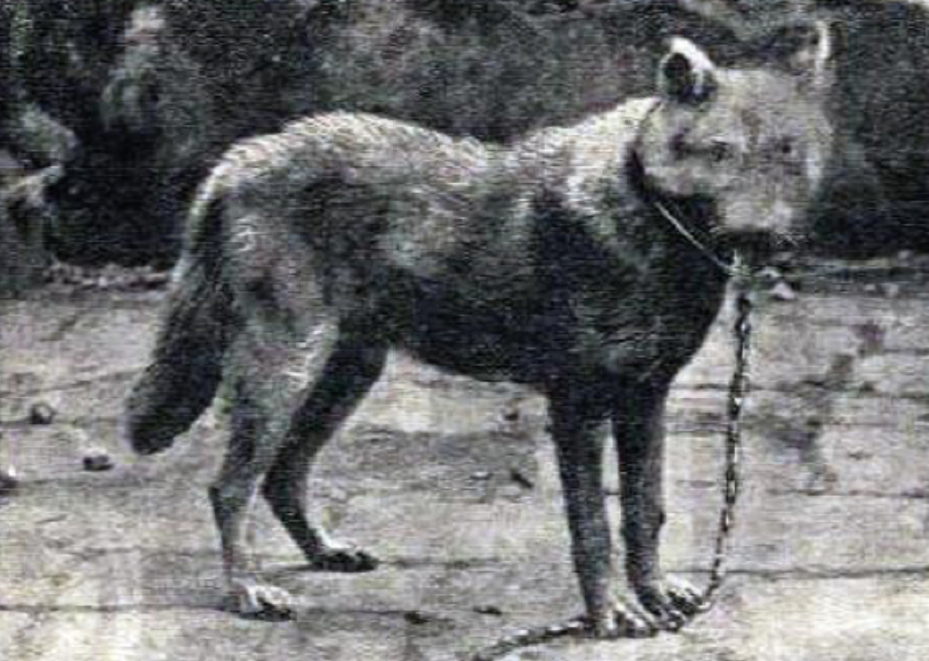
The Sicilian wolf was a slender, short-legged subspecies with light, tawny coloured fur. The dark band present on the forelimbs of the mainland Italian wolf were absent or poorly defined in the Sicilian wolf. Measurements taken from mounted museum specimens show that adults had a mean head to body length of 105.4 cm and a shoulder height of 54.6 cm, thus making them slightly smaller than the mainland Italian wolf, which measures 105.8-109.1 cm in length and 65–66.9 cm in shoulder height.
According to Francesco Minà Palumbo, the Sicilian wolf typically lived alone or in pairs in mountainous valley areas. It didn't dig its own dens, and primarily hunted during evening hours, unless hunger compelled it to hunt by day. In such cases, it would enter inhabited areas, despite fearing humans. Palumbo further described it as not particularly cunning, but ferocious when defending itself.
Sicilian wolf
The Sicilian wolf (Canis lupus cristaldii) is an extinct subspecies of the gray wolf that was endemic to Sicily. It was smaller than the mainland Italian wolf and had paler fur.
It colonised Sicily during the Pleistocene, together with several other large carnivorans, but it was the only one to have survived to the Holocene. The subspecies reportedly went extinct due to human persecution in the 1920s, though there were several possible sightings up to the 1970s.
It was identified as a distinct subspecies in 2018 through morphological examinations of the few remaining mounted specimens and skulls, as well as mtDNA analyses.
Its trinomial name is in honor of Italian mammalogist Mauro Cristaldi.
In Sicilian, the male is referred to as lupu, the female lupa and a pup as lupacchiu or lupacchiolu, while the terms lupazzu and lupiceddu are respectively a pejorative and a diminutive.
Regional names in Sicilian Gallo-Italic languages include dàuv in San Fratello, ddùvu in Nicosia, and lup, lùpu or suarázz in Piazza Armerina.
The Sicilian wolf was a slender, short-legged subspecies with light, tawny coloured fur. The dark band present on the forelimbs of the mainland Italian wolf were absent or poorly defined in the Sicilian wolf. Measurements taken from mounted museum specimens show that adults had a mean head to body length of 105.4 cm and a shoulder height of 54.6 cm, thus making them slightly smaller than the mainland Italian wolf, which measures 105.8-109.1 cm in length and 65–66.9 cm in shoulder height.
According to Francesco Minà Palumbo, the Sicilian wolf typically lived alone or in pairs in mountainous valley areas. It didn't dig its own dens, and primarily hunted during evening hours, unless hunger compelled it to hunt by day. In such cases, it would enter inhabited areas, despite fearing humans. Palumbo further described it as not particularly cunning, but ferocious when defending itself.
Recent media
Recent media