
Recent from talks
Sihanouk Trail
Knowledge base stats:
Talk channels stats:
Members stats:
Sihanouk Trail
The Sihanouk Trail was a logistical supply system in Cambodia used by the People's Army of Vietnam (PAVN) and its Viet Cong (VC) guerrillas during the Vietnam War (1960–1975). Between 1966 and 1970, this system operated in the same manner and served the same purposes as the much better known Ho Chi Minh trail (the Truong Son Road to the North Vietnamese) which ran through the southeastern portion of the Kingdom of Laos. The name is of American derivation. Since the North Vietnamese considered the system integral to the supply route mentioned above. U.S. attempts to interdict this system began in 1969.
Prince Norodom Sihanouk had ruled Cambodia since he had wrested independence from the French on 9 November 1953. He had accomplished this task by political maneuvering between both the left and the right to achieve what no other ruler or political group in Indochina had managed, a relatively bloodless transition to independence. During the next ten years, while the conflicts in neighboring Laos and South Vietnam heated up, Sihanouk managed to sustain his delicate domestic political balance while at the same time maintaining his nation's neutrality (guaranteed by the 1954 Geneva Conference that ended the First Indochina War).
This was no small accomplishment considering that Cambodia was wedged between its perennial enemies: Thailand to the west and South Vietnam to the east, both of whom were increasingly supported by the United States.[citation needed]
Sihanouk came to believe that communist triumph in Southeast Asia was inevitable and that Cambodia's military was incapable of defeating the North Vietnamese, even with U.S. support. If Cambodia (and his rule) was to survive, he would have to make a bargain with the devil. On 10 April 1965 he broke off diplomatic relations with the U.S. and swung politically to the left. This move was not without reason. To gain foreign support, both economic and political, Sihanouk turned to the People's Republic of China. One of the terms of the agreement between Sihanouk and Premier Zhou Enlai was that Cambodia would allow the use of its eastern border by the North Vietnamese in their effort to reunify the two Vietnams.
In the earliest days of the Vietnam War, North Vietnam supplied the VC in the South by two methods. The first was to extend the Ho Chi Minh Trail southward into the tri-border region of Laos/Cambodia/South Vietnam. The Trail, a labyrinth of paths, roads, river transportation systems and way-stations, was constantly being expanded and improved. It served as a logistical jugular vein, for both men and material, for the North Vietnamese war effort against South Vietnam. The second method was to transport supplies by sea. Estimates of this seaborne traffic ran as high as 70 percent. It was carried out due to the higher volume of material that could be transported by sea, as opposed to the overland route.
After direct American intervention in 1965, the increased presence of U.S. naval vessels in coastal waters under Operation Market Time nullified the seaborne route into South Vietnam. Following on the agreement between Sihanouk and the Chinese, an arrangement was also struck between the prince and the North Vietnamese government. In October military supplies were shipped directly from North Vietnam on communist-flagged (especially of the Eastern bloc) ships to the Cambodian port of Sihanoukville, where Cambodia's neutrality guaranteed their delivery.
The supplies were unloaded and then transferred to trucks which transported them to the frontier zones that served as PAVN/VC base areas. These base areas also served as sanctuaries for PAVN/VC troops, who simply crossed the border from South Vietnam and then rested, reinforced, and refitted for their next campaign in safety. None of this could have been accomplished without the acquiescence of Sihanouk.[citation needed]
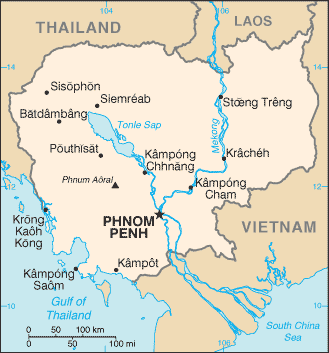
During 1965 the PAVN had already begun construction of new supply routes to connect the segments of the Ho Chi Minh Trail that ran through southern Laos and into Cambodia. The following year, U.S. intelligence discovered that a new road (Route 110), coming up from Cambodia, was now linked to those in Laos. The discovery of Route 110 was the origin of the term "Sihanouk Trail", but it quickly came to encompass the entire Cambodian logistical system. The new PAVN overland logistical effort, and its seaborne corollary was now directed by PAVN Unit K-20, located in the Cambodian capital of Phnom Penh. K-20 worked under the guise of a commercial company owned by local ethnic Vietnamese.
Hub AI
Sihanouk Trail AI simulator
(@Sihanouk Trail_simulator)
Sihanouk Trail
The Sihanouk Trail was a logistical supply system in Cambodia used by the People's Army of Vietnam (PAVN) and its Viet Cong (VC) guerrillas during the Vietnam War (1960–1975). Between 1966 and 1970, this system operated in the same manner and served the same purposes as the much better known Ho Chi Minh trail (the Truong Son Road to the North Vietnamese) which ran through the southeastern portion of the Kingdom of Laos. The name is of American derivation. Since the North Vietnamese considered the system integral to the supply route mentioned above. U.S. attempts to interdict this system began in 1969.
Prince Norodom Sihanouk had ruled Cambodia since he had wrested independence from the French on 9 November 1953. He had accomplished this task by political maneuvering between both the left and the right to achieve what no other ruler or political group in Indochina had managed, a relatively bloodless transition to independence. During the next ten years, while the conflicts in neighboring Laos and South Vietnam heated up, Sihanouk managed to sustain his delicate domestic political balance while at the same time maintaining his nation's neutrality (guaranteed by the 1954 Geneva Conference that ended the First Indochina War).
This was no small accomplishment considering that Cambodia was wedged between its perennial enemies: Thailand to the west and South Vietnam to the east, both of whom were increasingly supported by the United States.[citation needed]
Sihanouk came to believe that communist triumph in Southeast Asia was inevitable and that Cambodia's military was incapable of defeating the North Vietnamese, even with U.S. support. If Cambodia (and his rule) was to survive, he would have to make a bargain with the devil. On 10 April 1965 he broke off diplomatic relations with the U.S. and swung politically to the left. This move was not without reason. To gain foreign support, both economic and political, Sihanouk turned to the People's Republic of China. One of the terms of the agreement between Sihanouk and Premier Zhou Enlai was that Cambodia would allow the use of its eastern border by the North Vietnamese in their effort to reunify the two Vietnams.
In the earliest days of the Vietnam War, North Vietnam supplied the VC in the South by two methods. The first was to extend the Ho Chi Minh Trail southward into the tri-border region of Laos/Cambodia/South Vietnam. The Trail, a labyrinth of paths, roads, river transportation systems and way-stations, was constantly being expanded and improved. It served as a logistical jugular vein, for both men and material, for the North Vietnamese war effort against South Vietnam. The second method was to transport supplies by sea. Estimates of this seaborne traffic ran as high as 70 percent. It was carried out due to the higher volume of material that could be transported by sea, as opposed to the overland route.
After direct American intervention in 1965, the increased presence of U.S. naval vessels in coastal waters under Operation Market Time nullified the seaborne route into South Vietnam. Following on the agreement between Sihanouk and the Chinese, an arrangement was also struck between the prince and the North Vietnamese government. In October military supplies were shipped directly from North Vietnam on communist-flagged (especially of the Eastern bloc) ships to the Cambodian port of Sihanoukville, where Cambodia's neutrality guaranteed their delivery.
The supplies were unloaded and then transferred to trucks which transported them to the frontier zones that served as PAVN/VC base areas. These base areas also served as sanctuaries for PAVN/VC troops, who simply crossed the border from South Vietnam and then rested, reinforced, and refitted for their next campaign in safety. None of this could have been accomplished without the acquiescence of Sihanouk.[citation needed]
During 1965 the PAVN had already begun construction of new supply routes to connect the segments of the Ho Chi Minh Trail that ran through southern Laos and into Cambodia. The following year, U.S. intelligence discovered that a new road (Route 110), coming up from Cambodia, was now linked to those in Laos. The discovery of Route 110 was the origin of the term "Sihanouk Trail", but it quickly came to encompass the entire Cambodian logistical system. The new PAVN overland logistical effort, and its seaborne corollary was now directed by PAVN Unit K-20, located in the Cambodian capital of Phnom Penh. K-20 worked under the guise of a commercial company owned by local ethnic Vietnamese.
Recent media