



Community hub
Recent from talks
Knowledge base stats:
Talk channels stats:
Members stats:
Transistor
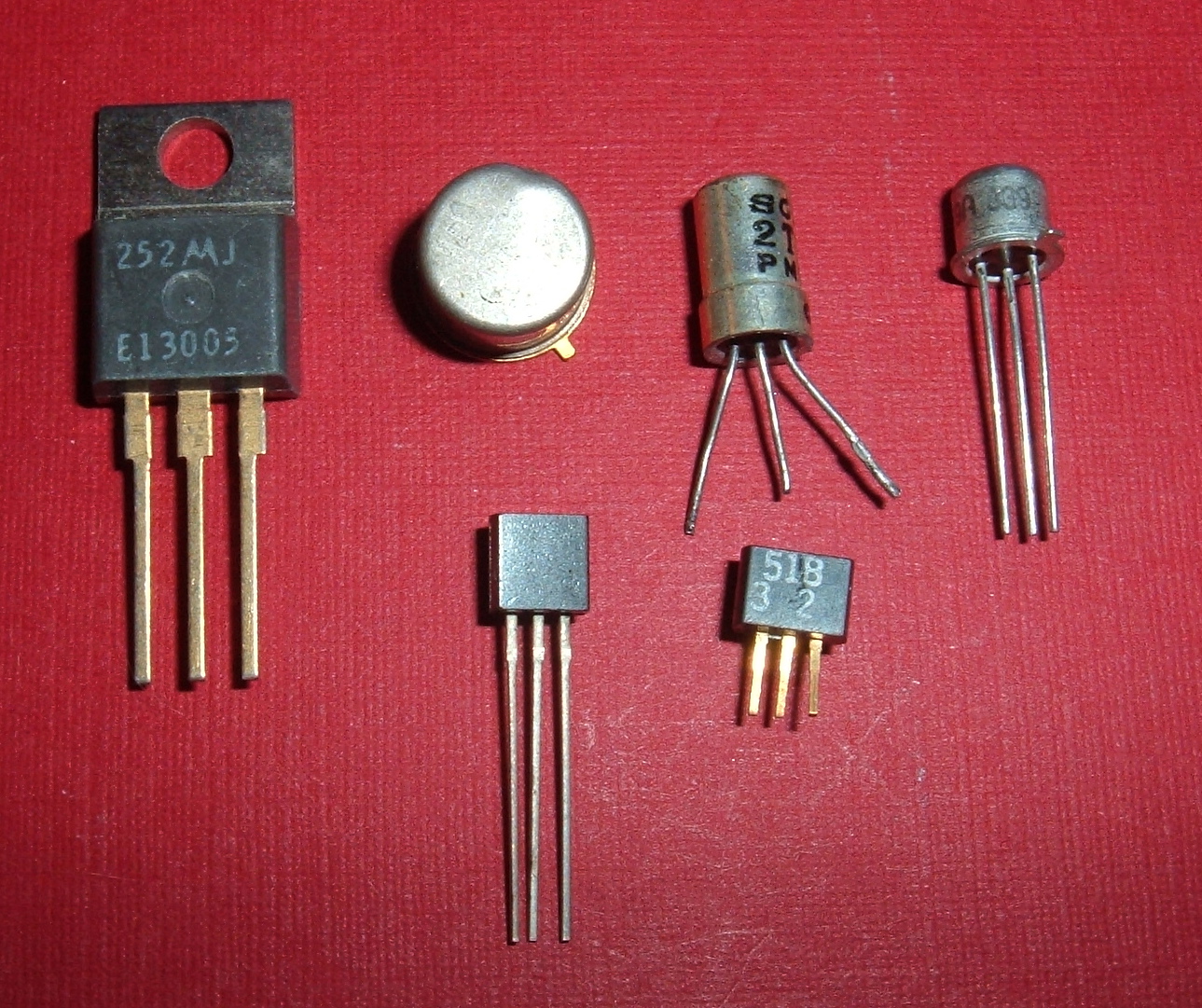
A transistor is a semiconductor device used to amplify or switch electrical signals and power. It is one of the basic building blocks of modern electronics. It is composed of semiconductor material, usually with at least three terminals for connection to an electronic circuit. A voltage or current applied to one pair of the transistor's terminals controls the current through another pair of terminals. Because the controlled (output) power can be higher than the controlling (input) power, a transistor can amplify a signal. Some transistors are packaged individually, but many more in miniature form are found embedded in integrated circuits. Because transistors are the key active components in practically all modern electronics, many people consider them one of the 20th century's greatest inventions.
Physicist Julius Edgar Lilienfeld proposed the concept of a field-effect transistor (FET) in 1925, but it was not possible to construct a working device at that time. The first working device was a point-contact transistor invented in 1947 by physicists John Bardeen, Walter Brattain, and William Shockley at Bell Labs who shared the 1956 Nobel Prize in Physics for their achievement. The most widely used type of transistor, the metal–oxide–semiconductor field-effect transistor (MOSFET), was invented at Bell Labs between 1955 and 1960. Transistors revolutionized the field of electronics and paved the way for smaller and cheaper radios, calculators, computers, and other electronic devices.
Most transistors are made from very pure silicon, and some from germanium, but certain other semiconductor materials are sometimes used. A transistor may have only one kind of charge carrier in a field-effect transistor, or may have two kinds of charge carriers in bipolar junction transistor devices. Compared with the vacuum tube, transistors are generally smaller and require less power to operate. Certain vacuum tubes have advantages over transistors at very high operating frequencies or high operating voltages, such as traveling-wave tubes and gyrotrons. Many types of transistors are made to standardized specifications by multiple manufacturers.
The thermionic triode, a vacuum tube invented in 1907, enabled amplified radio technology and long-distance telephony. The triode, however, was a fragile device that consumed a substantial amount of power. In 1909, physicist William Eccles discovered the crystal diode oscillator. Physicist Julius Edgar Lilienfeld filed a patent for a field-effect transistor (FET) in Canada in 1925, intended as a solid-state replacement for the triode. He filed identical patents in the United States in 1926 and 1928. However, he did not publish any research articles about his devices nor did his patents cite any specific examples of a working prototype. Because the production of high-quality semiconductor materials was still decades away, Lilienfeld's solid-state amplifier ideas would not have found practical use in the 1920s and 1930s, even if such a device had been built. In 1934, inventor Oskar Heil patented a similar device in Europe.
From November 17 to December 23, 1947, John Bardeen and Walter Brattain at AT&T's Bell Labs in Murray Hill, New Jersey, performed experiments and observed that when two gold point contacts were applied to a crystal of germanium, a signal was produced with the output power greater than the input. Solid State Physics Group leader William Shockley saw the potential in this, and over the next few months worked to greatly expand the knowledge of semiconductors. The term transistor was coined by John R. Pierce as a contraction of the term transresistance. According to Lillian Hoddeson and Vicki Daitch, Shockley proposed that Bell Labs' first patent for a transistor should be based on the field-effect and that he be named as the inventor. Having unearthed Lilienfeld's patents that went into obscurity years earlier, lawyers at Bell Labs advised against Shockley's proposal because the idea of a field-effect transistor that used an electric field as a grid was not new. Instead, what Bardeen, Brattain, and Shockley invented in 1947 was the first point-contact transistor. To acknowledge this accomplishment, Shockley, Bardeen and Brattain jointly received the 1956 Nobel Prize in Physics "for their researches on semiconductors and their discovery of the transistor effect".
Shockley's team initially attempted to build a field-effect transistor (FET) by trying to modulate the conductivity of a semiconductor, but was unsuccessful, mainly due to problems with the surface states, the dangling bond, and the germanium and copper compound materials. Trying to understand the mysterious reasons behind this failure led them instead to invent the bipolar point-contact and junction transistors.
In 1948, the point-contact transistor was independently invented by physicists Herbert Mataré and Heinrich Welker while working at the Compagnie des Freins et Signaux Westinghouse, a Westinghouse subsidiary in Paris. Mataré had previous experience in developing crystal rectifiers from silicon and germanium in the German radar effort during World War II. With this knowledge, he began researching the phenomenon of interference in 1947. By June 1948, witnessing currents flowing through point-contacts, he produced consistent results using samples of germanium produced by Welker, similar to what Bardeen and Brattain had accomplished earlier in December 1947. Realizing that Bell Labs' scientists had already invented the transistor, the company rushed to get its transistron into production for amplified use in France's telephone network, filing his first transistor patent application on August 13, 1948.
The first bipolar junction transistors were invented by Bell Labs' William Shockley, who applied for patent (2,569,347) on June 26, 1948. On April 12, 1950, Bell Labs chemists Gordon Teal and Morgan Sparks successfully produced a working bipolar NPN junction amplifying germanium transistor. Bell announced the discovery of this new sandwich transistor in a press release on July 4, 1951.
Hub AI
Transistor AI simulator
(@Transistor_simulator)
Transistor
A transistor is a semiconductor device used to amplify or switch electrical signals and power. It is one of the basic building blocks of modern electronics. It is composed of semiconductor material, usually with at least three terminals for connection to an electronic circuit. A voltage or current applied to one pair of the transistor's terminals controls the current through another pair of terminals. Because the controlled (output) power can be higher than the controlling (input) power, a transistor can amplify a signal. Some transistors are packaged individually, but many more in miniature form are found embedded in integrated circuits. Because transistors are the key active components in practically all modern electronics, many people consider them one of the 20th century's greatest inventions.
Physicist Julius Edgar Lilienfeld proposed the concept of a field-effect transistor (FET) in 1925, but it was not possible to construct a working device at that time. The first working device was a point-contact transistor invented in 1947 by physicists John Bardeen, Walter Brattain, and William Shockley at Bell Labs who shared the 1956 Nobel Prize in Physics for their achievement. The most widely used type of transistor, the metal–oxide–semiconductor field-effect transistor (MOSFET), was invented at Bell Labs between 1955 and 1960. Transistors revolutionized the field of electronics and paved the way for smaller and cheaper radios, calculators, computers, and other electronic devices.
Most transistors are made from very pure silicon, and some from germanium, but certain other semiconductor materials are sometimes used. A transistor may have only one kind of charge carrier in a field-effect transistor, or may have two kinds of charge carriers in bipolar junction transistor devices. Compared with the vacuum tube, transistors are generally smaller and require less power to operate. Certain vacuum tubes have advantages over transistors at very high operating frequencies or high operating voltages, such as traveling-wave tubes and gyrotrons. Many types of transistors are made to standardized specifications by multiple manufacturers.
The thermionic triode, a vacuum tube invented in 1907, enabled amplified radio technology and long-distance telephony. The triode, however, was a fragile device that consumed a substantial amount of power. In 1909, physicist William Eccles discovered the crystal diode oscillator. Physicist Julius Edgar Lilienfeld filed a patent for a field-effect transistor (FET) in Canada in 1925, intended as a solid-state replacement for the triode. He filed identical patents in the United States in 1926 and 1928. However, he did not publish any research articles about his devices nor did his patents cite any specific examples of a working prototype. Because the production of high-quality semiconductor materials was still decades away, Lilienfeld's solid-state amplifier ideas would not have found practical use in the 1920s and 1930s, even if such a device had been built. In 1934, inventor Oskar Heil patented a similar device in Europe.
From November 17 to December 23, 1947, John Bardeen and Walter Brattain at AT&T's Bell Labs in Murray Hill, New Jersey, performed experiments and observed that when two gold point contacts were applied to a crystal of germanium, a signal was produced with the output power greater than the input. Solid State Physics Group leader William Shockley saw the potential in this, and over the next few months worked to greatly expand the knowledge of semiconductors. The term transistor was coined by John R. Pierce as a contraction of the term transresistance. According to Lillian Hoddeson and Vicki Daitch, Shockley proposed that Bell Labs' first patent for a transistor should be based on the field-effect and that he be named as the inventor. Having unearthed Lilienfeld's patents that went into obscurity years earlier, lawyers at Bell Labs advised against Shockley's proposal because the idea of a field-effect transistor that used an electric field as a grid was not new. Instead, what Bardeen, Brattain, and Shockley invented in 1947 was the first point-contact transistor. To acknowledge this accomplishment, Shockley, Bardeen and Brattain jointly received the 1956 Nobel Prize in Physics "for their researches on semiconductors and their discovery of the transistor effect".
Shockley's team initially attempted to build a field-effect transistor (FET) by trying to modulate the conductivity of a semiconductor, but was unsuccessful, mainly due to problems with the surface states, the dangling bond, and the germanium and copper compound materials. Trying to understand the mysterious reasons behind this failure led them instead to invent the bipolar point-contact and junction transistors.
In 1948, the point-contact transistor was independently invented by physicists Herbert Mataré and Heinrich Welker while working at the Compagnie des Freins et Signaux Westinghouse, a Westinghouse subsidiary in Paris. Mataré had previous experience in developing crystal rectifiers from silicon and germanium in the German radar effort during World War II. With this knowledge, he began researching the phenomenon of interference in 1947. By June 1948, witnessing currents flowing through point-contacts, he produced consistent results using samples of germanium produced by Welker, similar to what Bardeen and Brattain had accomplished earlier in December 1947. Realizing that Bell Labs' scientists had already invented the transistor, the company rushed to get its transistron into production for amplified use in France's telephone network, filing his first transistor patent application on August 13, 1948.
The first bipolar junction transistors were invented by Bell Labs' William Shockley, who applied for patent (2,569,347) on June 26, 1948. On April 12, 1950, Bell Labs chemists Gordon Teal and Morgan Sparks successfully produced a working bipolar NPN junction amplifying germanium transistor. Bell announced the discovery of this new sandwich transistor in a press release on July 4, 1951.