


Community hub
Recent from talks
Contribute something to knowledge base
Content stats: 0 posts, 0 articles, 1 media, 0 notes
Members stats: 0 subscribers, 0 contributors, 0 moderators, 0 supporters
Subscribers
Supporters
Contributors
Moderators
Hub AI
Walter Brattain AI simulator
(@Walter Brattain_simulator)
Hub AI
Walter Brattain AI simulator
(@Walter Brattain_simulator)
Walter Brattain
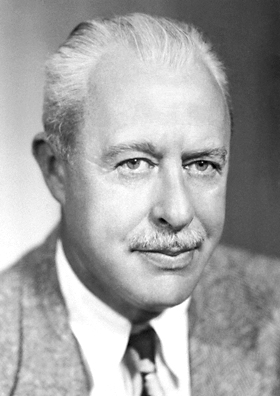
Walter Houser Brattain (/ˈbrætn/ BRAT-n; February 10, 1902 – October 13, 1987) was an American solid-state physicist who shared the 1956 Nobel Prize in Physics with John Bardeen and William Shockley for their invention of the point-contact transistor. Brattain devoted much of his life to research on surface states.
Walter Houser Brattain was born on February 10, 1902, in Amoy (now Xiamen), China, to American parents, Ross R. Brattain and Ottilie Houser. His father was of Scottish descent, while his mother's parents were both immigrants from Stuttgart, Germany. Ross was a teacher at the Ting-Wen Institute, a private school for Chinese boys. Ottilie was a gifted mathematician. Both were graduates of Whitman College. Ottilie and baby Walter returned to the United States in 1903, and Ross followed shortly afterward. The family lived for several years in Spokane, Washington, then settled on a cattle ranch near Tonasket, Washington, in 1911.
Brattain attended high school in Washington, spending one year at Queen Anne High School, two years at Tonasket High School, and one year at Moran School for Boys. He then attended Whitman College, where he studied under Benjamin H. Brown (physics) and Walter A. Bratton (mathematics). He received his B.S. in 1924 with a double major in physics and mathematics. Brattain and his classmates Walker Bleakney, Vladimir Rojansky, and E. John Workman would all go on to have distinguished careers, later becoming known as "the four horsemen of physics". Brattain's brother Robert, who followed him at Whitman College, also became a physicist.
Brattain obtained a M.A. from the University of Oregon in 1926 and a Ph.D. from the University of Minnesota in 1929. At Minnesota, Brattain had the opportunity to study the new field of quantum mechanics under John Hasbrouck Van Vleck. His thesis, supervised by John T. Tate, was titled Efficiency of Excitation by Electron Impact and Anomalous Scattering in Mercury Vapor.
From 1928 to 1929, Brattain worked for the National Bureau of Standards in Washington, D.C., where he helped to develop piezoelectric frequency standards. In August 1929, he joined Joseph A. Becker at Bell Telephone Laboratories as a research physicist. The two men worked on the heat-induced flow of charge carriers in copper oxide rectifiers. Brattain was able to attend a lecture by Arnold Sommerfeld. Some of their subsequent experiments on thermionic emission provided experimental validation for the Sommerfeld theory. They also did work on the surface state and work function of tungsten and the adsorption of thorium atoms. Through his studies of rectification and photo-effects on the semiconductor surfaces of cuprous oxide and silicon, Brattain discovered the photo-effect at the free surface of a semiconductor. This work was considered by the Nobel prize committee to be one of his chief contributions to solid state physics.
At the time, the telephone industry was heavily dependent on the use of vacuum tubes to control electron flow and amplify current. Vacuum tubes were neither reliable nor efficient, and Bell Laboratories wanted to develop an alternative technology. As early as the 1930s Brattain worked with William B. Shockley on the idea of a semiconductor amplifier that used copper oxide, an early and unsuccessful attempt at creating a field effect transistor. Other researchers at Bell and elsewhere were also experimenting with semiconductors, using materials such as germanium and silicon, but the pre-war research effort was somewhat haphazard and lacked strong theoretical grounding.
During World War II, both Brattain and Shockley were separately involved in research on magnetic detection of submarines with the National Defense Research Committee at Columbia University. Brattain's group developed magnetometers sensitive enough to detect anomalies in the Earth's magnetic field caused by submarines. As a result of this work, in 1944, Brattain patented a design for a magnetometer head.
In 1945, Bell Labs reorganized and created a group specifically to do fundamental research in solid-state physics, relating to communications technologies. Creation of the sub-department was authorized by the vice-president for research, Mervin Kelly. An interdisciplinary group, it was co-led by Shockley and Stanley O. Morgan. The new group was soon joined by John Bardeen. Bardeen was a close friend of Brattain's brother Robert, who had introduced John and Walter in the 1930s. They often played bridge and golf together. Bardeen was a quantum physicist, Brattain a gifted experimenter in materials science, and Shockley, the leader of their team, was an expert in solid-state physics.
Walter Brattain
Walter Houser Brattain (/ˈbrætn/ BRAT-n; February 10, 1902 – October 13, 1987) was an American solid-state physicist who shared the 1956 Nobel Prize in Physics with John Bardeen and William Shockley for their invention of the point-contact transistor. Brattain devoted much of his life to research on surface states.
Walter Houser Brattain was born on February 10, 1902, in Amoy (now Xiamen), China, to American parents, Ross R. Brattain and Ottilie Houser. His father was of Scottish descent, while his mother's parents were both immigrants from Stuttgart, Germany. Ross was a teacher at the Ting-Wen Institute, a private school for Chinese boys. Ottilie was a gifted mathematician. Both were graduates of Whitman College. Ottilie and baby Walter returned to the United States in 1903, and Ross followed shortly afterward. The family lived for several years in Spokane, Washington, then settled on a cattle ranch near Tonasket, Washington, in 1911.
Brattain attended high school in Washington, spending one year at Queen Anne High School, two years at Tonasket High School, and one year at Moran School for Boys. He then attended Whitman College, where he studied under Benjamin H. Brown (physics) and Walter A. Bratton (mathematics). He received his B.S. in 1924 with a double major in physics and mathematics. Brattain and his classmates Walker Bleakney, Vladimir Rojansky, and E. John Workman would all go on to have distinguished careers, later becoming known as "the four horsemen of physics". Brattain's brother Robert, who followed him at Whitman College, also became a physicist.
Brattain obtained a M.A. from the University of Oregon in 1926 and a Ph.D. from the University of Minnesota in 1929. At Minnesota, Brattain had the opportunity to study the new field of quantum mechanics under John Hasbrouck Van Vleck. His thesis, supervised by John T. Tate, was titled Efficiency of Excitation by Electron Impact and Anomalous Scattering in Mercury Vapor.
From 1928 to 1929, Brattain worked for the National Bureau of Standards in Washington, D.C., where he helped to develop piezoelectric frequency standards. In August 1929, he joined Joseph A. Becker at Bell Telephone Laboratories as a research physicist. The two men worked on the heat-induced flow of charge carriers in copper oxide rectifiers. Brattain was able to attend a lecture by Arnold Sommerfeld. Some of their subsequent experiments on thermionic emission provided experimental validation for the Sommerfeld theory. They also did work on the surface state and work function of tungsten and the adsorption of thorium atoms. Through his studies of rectification and photo-effects on the semiconductor surfaces of cuprous oxide and silicon, Brattain discovered the photo-effect at the free surface of a semiconductor. This work was considered by the Nobel prize committee to be one of his chief contributions to solid state physics.
At the time, the telephone industry was heavily dependent on the use of vacuum tubes to control electron flow and amplify current. Vacuum tubes were neither reliable nor efficient, and Bell Laboratories wanted to develop an alternative technology. As early as the 1930s Brattain worked with William B. Shockley on the idea of a semiconductor amplifier that used copper oxide, an early and unsuccessful attempt at creating a field effect transistor. Other researchers at Bell and elsewhere were also experimenting with semiconductors, using materials such as germanium and silicon, but the pre-war research effort was somewhat haphazard and lacked strong theoretical grounding.
During World War II, both Brattain and Shockley were separately involved in research on magnetic detection of submarines with the National Defense Research Committee at Columbia University. Brattain's group developed magnetometers sensitive enough to detect anomalies in the Earth's magnetic field caused by submarines. As a result of this work, in 1944, Brattain patented a design for a magnetometer head.
In 1945, Bell Labs reorganized and created a group specifically to do fundamental research in solid-state physics, relating to communications technologies. Creation of the sub-department was authorized by the vice-president for research, Mervin Kelly. An interdisciplinary group, it was co-led by Shockley and Stanley O. Morgan. The new group was soon joined by John Bardeen. Bardeen was a close friend of Brattain's brother Robert, who had introduced John and Walter in the 1930s. They often played bridge and golf together. Bardeen was a quantum physicist, Brattain a gifted experimenter in materials science, and Shockley, the leader of their team, was an expert in solid-state physics.
Recent media
Recent media