Hubbry Logo
Thermionic emissionThermionic emissionMain
Open search
Thermionic emission
Community hub
Thermionic emission
logo
8 pages, 0 posts
0 subscribers
Be the first to start a discussion here.
Thermionic emission
Thermionic emission
from Wikipedia
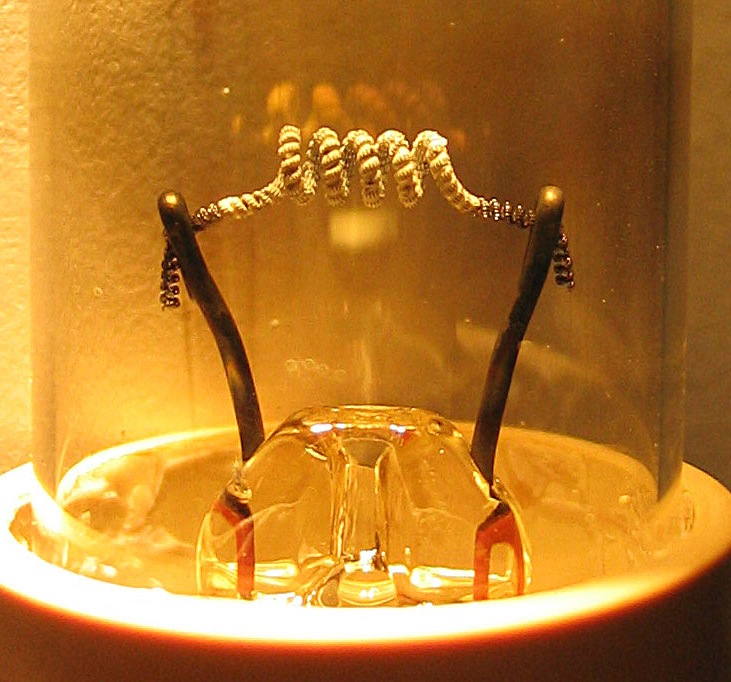
Closeup of the filament in a low pressure mercury gas-discharge lamp showing white thermionic emission mix coating on the central portion of the coil. Typically made of a mixture of barium, strontium and calcium oxides, the coating is sputtered away through normal use, eventually resulting in lamp failure.

Thermionic emission is the liberation of charged particles from a hot electrode whose thermal energy gives some particles enough kinetic energy to escape the material's surface. The particles, sometimes called thermions in early literature, are now known to be ions or electrons. Thermal electron emission specifically refers to emission of electrons and occurs when thermal energy overcomes the material's work function.

After emission, an opposite charge of equal magnitude to the emitted charge is initially left behind in the emitting region. But if the emitter is connected to a battery, that remaining charge is neutralized by charge supplied by the battery as particles are emitted, so the emitter will have the same charge it had before emission. This facilitates additional emission to sustain an electric current. Thomas Edison in 1880 while inventing his light bulb noticed this current, so subsequent scientists referred to the current as the Edison effect, though it wasn't until after the 1897 discovery of the electron that scientists understood that electrons were emitted and why.

Thermionic emission is crucial to the operation of a variety of electronic devices and can be used for electricity generation (such as thermionic converters and electrodynamic tethers) or cooling. Thermionic vacuum tubes emit electrons from a hot cathode into an enclosed vacuum and may steer those emitted electrons with applied voltage. The hot cathode can be a metal filament, a coated metal filament, or a separate structure of metal or carbides or borides of transition metals. Vacuum emission from metals tends to become significant only for temperatures over 1,000 K (730 °C; 1,340 °F). Charge flow increases dramatically with temperature.

The term thermionic emission is now also used to refer to any thermally-excited charge emission process, even when the charge is emitted from one solid-state region into another.

History

[edit]

Because the electron was not identified as a separate physical particle until the work of J. J. Thomson in 1897, the word "electron" was not used when discussing experiments that took place before this date.

The phenomenon was initially reported in 1853 by Edmond Becquerel.[1][2][3] It was observed again in 1873 by Frederick Guthrie in Britain.[4][5] While doing work on charged objects, Guthrie discovered that a red-hot iron sphere with a negative charge would lose its charge (by somehow discharging it into air). He also found that this did not happen if the sphere had a positive charge.[6] Other early contributors included Johann Wilhelm Hittorf (1869–1883),[7][8][9][10][11][12] Eugen Goldstein (1885),[13] and Julius Elster and Hans Friedrich Geitel (1882–1889).[14][15][16][17][18]

Edison effect

[edit]

Thermionic emission was observed again by Thomas Edison in 1880 while his team was trying to discover the reason for breakage of carbonized bamboo filaments[19] and undesired blackening of the interior surface of the bulbs in his incandescent lamps. This blackening was carbon deposited from the filament and was darkest near the positive end of the filament loop, which apparently cast a light shadow on the glass, as if negatively-charged carbon emanated from the negative end and was attracted towards and sometimes absorbed by the positive end of the filament loop. This projected carbon was deemed "electrical carrying" and initially ascribed to an effect in Crookes tubes where negatively-charged cathode rays from ionized gas move from a negative to a positive electrode. To try to redirect the charged carbon particles to a separate electrode instead of the glass, Edison did a series of experiments (a first inconclusive one is in his notebook on 13 February 1880) such as the following successful one:[20]

Experiment demonstrating the Edison effect
One Edison effect bulb consisted of an evacuated bulb with an externally-wired electrode such as a metal plate in this example (variants used platinum foil or extra wire instead) isolated from the carbon filament (hairpin-shaped in this example).
Edison's circuit configured his bulb (large circle) such that its electrode was in series with an ammeter (A) to measure conventional current and a voltage source (separate from the power source heating the filament) to bias the electrode either positively (in which case electrons were attracted and flowed along the arrows from the filament through the partial vacuum to the electrode) or negatively (which resulted in no measurable current). We now know that in addition to carbon molecules, the filament was emitting electrons, which have negative charge and thus are attracted to a positively-charged electrode but not a negatively-charged electrode.

This effect had many applications. Edison found that the current emitted by the hot filament increased rapidly with voltage, and filed a patent for a voltage-regulating device using the effect on 15 November 1883,[21] notably the first US patent for an electronic device. He found that sufficient current would pass through the device to operate a telegraph sounder, which was exhibited at the International Electrical Exhibition of 1884 in Philadelphia. Visiting British scientist William Preece received several bulbs from Edison to investigate. Preece's 1885 paper on them referred to the one-way current through the partial vacuum as the Edison effect,[22][23] although that term is occasionally used to refer to thermionic emission itself. British physicist John Ambrose Fleming, working for the British Wireless Telegraphy Company, discovered that the Edison effect could be used to detect radio waves. Fleming went on to develop a two-element thermionic vacuum tube diode called the Fleming valve (patented 16 November 1904).[24][25][26] Thermionic diodes can also be configured to convert a heat difference to electric power directly without moving parts as a device called a thermionic converter, a type of heat engine.

Richardson's law

[edit]

Following J. J. Thomson's identification of the electron in 1897, the British physicist Owen Willans Richardson began work on the topic that he later called "thermionic emission". He received a Nobel Prize in Physics in 1928 "for his work on the thermionic phenomenon and especially for the discovery of the law named after him".

From band theory, there are one or two electrons per atom in a solid that are free to move from atom to atom. This is sometimes collectively referred to as a "sea of electrons". Their velocities follow a statistical distribution, rather than being uniform, and occasionally an electron will have enough velocity to exit the metal without being pulled back in. The minimum amount of energy needed for an electron to leave a surface is called the work function. The work function is characteristic of the material and for most metals is on the order of several electronvolts (eV). Thermionic currents can be increased by decreasing the work function. This often-desired goal can be achieved by applying various oxide coatings to the wire.

In 1901 Richardson published the results of his experiments: the current from a heated wire seemed to depend exponentially on the temperature of the wire with a mathematical form similar to the modified Arrhenius equation, .[27] Later, he proposed that the emission law should have the mathematical form[28]

where J is the emission current density, T is the temperature of the metal, W is the work function of the metal, k is the Boltzmann constant, and AG is a parameter discussed next.

In the period 1911 to 1930, as physical understanding of the behaviour of electrons in metals increased, various theoretical expressions (based on different physical assumptions) were put forward for AG, by Richardson, Saul Dushman, Ralph H. Fowler, Arnold Sommerfeld and Lothar Wolfgang Nordheim. Over 60 years later, there is still no consensus among interested theoreticians as to the exact expression of AG, but there is agreement that AG must be written in the form:

where λR is a material-specific correction factor that is typically of order 0.5, and A0 is a universal constant given by[29]

where and are the mass and charge of an electron, respectively, and is the Planck constant.

In fact, by about 1930 there was agreement that, due to the wave-like nature of electrons, some proportion rav of the outgoing electrons would be reflected as they reached the emitter surface, so the emission current density would be reduced, and λR would have the value 1 − rav. Thus, one sometimes sees the thermionic emission equation written in the form:

.

However, a modern theoretical treatment by Modinos assumes that the band-structure of the emitting material must also be taken into account. This would introduce a second correction factor λB into λR, giving . Experimental values for the "generalized" coefficient AG are generally of the order of magnitude of A0, but do differ significantly as between different emitting materials, and can differ as between different crystallographic faces of the same material. At least qualitatively, these experimental differences can be explained as due to differences in the value of λR.

Considerable confusion exists in the literature of this area because: (1) many sources do not distinguish between AG and A0, but just use the symbol A (and sometimes the name "Richardson constant") indiscriminately; (2) equations with and without the correction factor here denoted by λR are both given the same name; and (3) a variety of names exist for these equations, including "Richardson equation", "Dushman's equation", "Richardson–Dushman equation" and "Richardson–Laue–Dushman equation". In the literature, the elementary equation is sometimes given in circumstances where the generalized equation would be more appropriate, and this in itself can cause confusion. To avoid misunderstandings, the meaning of any "A-like" symbol should always be explicitly defined in terms of the more fundamental quantities involved.

Because of the exponential function, the current increases rapidly with temperature when kT is less than W.[further explanation needed] (For essentially every material, melting occurs well before kT = W.)

The thermionic emission law has been recently revised for 2D materials in various models.[30][31][32]

Schottky emission

[edit]
Schottky-emitter electron source of an electron microscope

In electron emission devices, especially electron guns, the thermionic electron emitter will be biased negative relative to its surroundings. This creates an electric field of magnitude E at the emitter surface. Without the field, the surface barrier seen by an escaping Fermi-level electron has height W equal to the local work-function. The electric field lowers the surface barrier by an amount ΔW, and increases the emission current. This is known as the Schottky effect (named for Walter H. Schottky) or field enhanced thermionic emission. It can be modeled by a simple modification of the Richardson equation, by replacing W by (W − ΔW). This gives the equation[33][34]

where ε0 is the electric constant (also called the vacuum permittivity).

Electron emission that takes place in the field-and-temperature-regime where this modified equation applies is often called Schottky emission. This equation is relatively accurate for electric field strengths lower than about 108 V⋅m−1. For electric field strengths higher than 108 V⋅m−1, so-called Fowler–Nordheim (FN) tunneling begins to contribute significant emission current. In this regime, the combined effects of field-enhanced thermionic and field emission can be modeled by the Murphy-Good equation for thermo-field (T-F) emission.[35] At even higher fields, FN tunneling becomes the dominant electron emission mechanism, and the emitter operates in the so-called "cold field electron emission (CFE)" regime.

Thermionic emission can also be enhanced by interaction with other forms of excitation such as light.[36] For example, excited Cesium (Cs) vapors in thermionic converters form clusters of Cs-Rydberg matter which yield a decrease of collector emitting work function from 1.5 eV to 1.0–0.7 eV. Due to long-lived nature of Rydberg matter this low work function remains low which essentially increases the low-temperature converter's efficiency.[37]

Photon-enhanced thermionic emission

[edit]

Photon-enhanced thermionic emission (PETE) is a process developed by scientists at Stanford University that harnesses both the light and heat of the sun to generate electricity and increases the efficiency of solar power production by more than twice the current levels. The device developed for the process reaches peak efficiency above 200 °C, while most silicon solar cells become inert after reaching 100 °C. Such devices work best in parabolic dish collectors, which reach temperatures up to 800 °C. Although the team used a gallium nitride semiconductor in its proof-of-concept device, it claims that the use of gallium arsenide can increase the device's efficiency to 55–60 percent, nearly triple that of existing systems,[38][39] and 12–17 percent more than existing 43 percent multi-junction solar cells.[40][41]

See also

[edit]

References

[edit]
[edit]
Revisions and contributorsEdit on WikipediaRead on Wikipedia
from Grokipedia
Thermionic emission is the process by which electrons are emitted from the surface of a heated , typically a metal or , as imparts sufficient to s to overcome the 's , the minimum energy barrier required for escape into a . This phenomenon relies on the high-energy tail of the electron energy distribution, where heating the emitter to temperatures often exceeding 1,200°C or 1,500 increases the fraction of electrons capable of emission. The underlying mechanism follows principles from , approximating the Maxwell-Boltzmann distribution for the high-energy electrons in the emitter, though more precisely governed by Fermi-Dirac statistics in metals. The of emitted electrons is described by the Richardson-Dushman equation: j=AT2exp(ϕ/kBT)j = A T^2 \exp(-\phi / k_B T), where AA is the Richardson constant (approximately 120 A/cm²K²), TT is the emitter temperature in Kelvin, ϕ\phi is the (typically 3–5 eV for common materials like ), kBk_B is Boltzmann's constant, and the exponential term accounts for the probability of electrons surmounting the energy barrier. Factors such as surface coatings (e.g., cesium or to lower ϕ\phi) or (via the Schottky effect) can enhance emission efficiency by reducing the effective . Historically, thermionic emission was first observed in 1853 by and independently noted in 1883 by during experiments with incandescent lamps, where he observed current flow between a heated filament and a nearby plate. Owen W. Richardson developed the theoretical framework in the early 1900s, culminating in Richardson's law in 1911, later refined as the Richardson-Dushman equation by Saul Dushman in 1923, for which he [Richardson] received the 1928 . This discovery enabled key inventions, such as John Ambrose Fleming's in 1904, which laid the foundation for technology. Thermionic emission underpins a range of technologies, including vacuum tubes for amplification and rectification in early , electron guns in cathode-ray tubes and particle accelerators, and tubes for . In modern applications, it is central to thermionic energy converters, which directly transform heat (from solar, nuclear, or waste sources) into with efficiencies up to 15–20% in specialized designs, such as those used in space power systems like the Soviet TOPAZ reactor. Emerging research explores low-work-function materials like or scandates to enable operation at lower temperatures, potentially broadening uses in efficient and topological .

Fundamentals

Definition and Mechanism

Thermionic emission is the thermally driven release of electrons from the surface of a material, typically a metal or semiconductor, into a surrounding vacuum or low-pressure environment when the provided thermal energy surpasses the material's work function—the binding energy that holds electrons to the solid. This phenomenon occurs primarily at elevated temperatures, enabling applications such as electron sources in vacuum tubes and energy conversion devices. The underlying mechanism stems from the statistical distribution of electron energies within the material, governed by Fermi-Dirac statistics, which describe the occupancy of quantum states near the . Heating the material increases the average of electrons, effectively widening the energy distribution and populating the high-energy tail with more electrons possessing sufficient energy to overcome the barrier at the surface. Upon reaching the surface, these electrons face an image charge potential that slightly lowers the effective barrier, but only those with perpendicular components exceeding the escape into the vacuum without reflection. Key parameters influencing thermionic emission include the work function φ (typically measured in electron volts, eV), which varies by material and surface orientation, and the operating temperature T (in Kelvin), which determines the thermal energy scale k_B T, where k_B is the Boltzmann constant. For instance, tungsten, a widely used cathode material due to its high melting point and stability, exhibits a work function of approximately 4.5 eV for polycrystalline surfaces. The emission current density depends strongly on these factors, showing an exponential increase with rising temperature as more electrons gain the requisite energy to surmount the barrier. This qualitative temperature dependence underpins the process's sensitivity to heating, with practical emission often requiring temperatures above 1000 K.

Comparison to Other Emission Processes

Thermionic emission, which relies on thermal excitation to liberate electrons from a material's surface, differs fundamentally from other electron emission processes in its energy source and operational requirements. Photoelectric emission, also known as photoemission, occurs when photons with energy exceeding the material's eject electrons, requiring no heat but a specific threshold frequency of . Field emission involves quantum tunneling of electrons through the surface barrier under a strong applied , enabling operation at ambient temperatures without thermal input. Secondary emission, in contrast, is induced by the impact of high-energy particles such as electrons or ions on the surface, producing multiple per incident particle. These mechanisms are classified based on the primary excitation source: thermal for thermionic, photonic for photoelectric, electrical for field, and kinetic for secondary. A primary distinction lies in the environmental conditions needed for emission. Thermionic emission demands elevated temperatures, typically above 1000 K (often exceeding 1200°C for practical cathodes), to provide electrons with sufficient to surmount the barrier of 3–5 eV, but it requires no external light or . Photoelectric emission operates at and depends solely on incident light wavelength, with quantum efficiency varying by material (e.g., higher for alkali-coated surfaces). Field emission functions at low temperatures but necessitates intense on the order of 3 × 10^7 V/cm to distort the potential barrier, often using sharp emitters like carbon nanotubes. Secondary emission also occurs at ambient conditions, triggered by primary particle energies typically in the keV range, yielding gains of 1–10 per incident particle. Schottky emission represents a hybrid, combining thermal activation with moderate field enhancement to lower the effective barrier.
Emission TypeEnergy SourceTemperature RequirementExternal InputTypical Output
ThermionicHeat>1000 KNone0.01–10 A/cm²
PhotoelectricPhotonsAmbientLight (> threshold frequency)10^{-6}–10^{-3} A/cm²
FieldElectric fieldAmbientHigh field (>10^7 V/cm)Up to 10^4 A/cm² (pulsed)
SecondaryParticle impactAmbientPrimary beam (keV energies)Yield: 1–10 electrons per incident
Thermionic emission offers simplicity in vacuum tube devices due to its reliance on straightforward heating, providing stable, high-current densities (e.g., up to 10 A/cm²) for sustained operation, but it suffers from thermal inefficiencies, including heat losses and space-charge limitations that cap overall at 10–15%. Photoelectric emission excels in quantum efficiency for specific wavelengths but is limited by material selectivity and lower overall currents, making it less suitable for high-power applications. Field emission provides high brightness and room-temperature convenience, advantageous for compact sources like in scanning electron microscopes, yet it demands high voltages and is prone to from emitter degradation. Secondary emission achieves high factors in detectors but requires a continuous primary beam, leading to surface wear over time. In device contexts, thermionic emission is preferred for applications needing reliable, continuous high-current beams, such as in diodes and power converters, where thermal stability outweighs efficiency drawbacks. Photoelectric and field emissions suit specialized, low-power or pulsed scenarios, like photodetectors and high-resolution , respectively, due to their responsiveness without bulk heating. Secondary emission finds niche roles in electron multipliers and particle detectors, amplifying signals via impact cascades rather than direct generation. These contrasts highlight thermionic emission's thermal-centric niche amid diverse emission paradigms.

Theoretical Foundations

Richardson's Law

Richardson's law provides the fundamental theoretical description of the thermionic emission current density from a heated metal surface in the absence of external electric fields. The law states that the saturation current density JJ is given by J=AT2exp(ϕkT),J = A T^2 \exp\left(-\frac{\phi}{k T}\right), where TT is the absolute temperature of the emitter in kelvin, ϕ\phi is the work function of the material in electronvolts, kk is Boltzmann's constant (8.617×1058.617 \times 10^{-5} eV/K), and AA is the Richardson constant. The theoretical value of AA, derived from free electron theory, is approximately 120 A/cm²K², though experimental values often deviate due to surface effects and non-ideal conditions, typically ranging lower for most metals. The derivation of Richardson's law begins with the of electrons in a metal, modeled using Fermi-Dirac statistics to describe the distribution of electron energies near the . To escape the surface, electrons must overcome the barrier, which requires normal to the surface exceeding ϕ\phi. The flux of such electrons is calculated by integrating over the high-energy tail of the distribution, where the occupation probability is low, allowing an approximation using the classical Maxwell-Boltzmann distribution for those energetic electrons. This leads to the exponential temperature dependence, with the T2T^2 prefactor arising from the velocity and density-of-states contributions in the integral. The law assumes an ideal planar surface with no external electric field and neglects quantum reflection or image-force effects, which simplifies the barrier to a rectangular shape. Deviations occur at low temperatures, where the Maxwell-Boltzmann approximation fails and full Fermi-Dirac integration is needed, or at high fields, where the barrier is lowered, requiring modifications. Additionally, real surfaces exhibit variations in work function due to facets or contaminants, leading to effective AA values that differ from theory. Experimental validation of Richardson's law came from Owen W. Richardson's precise measurements in the 1910s using heated filaments in vacuum tubes. By varying filament temperatures from about 1000 K to 2500 K and measuring saturation currents, Richardson demonstrated that the logarithm of versus inverse yielded a straight line, confirming the exponential form and determining ϕ\phi for as approximately 4.5 eV. These results, detailed in his 1913 and subsequent works, provided empirical support for the electron-based of conduction and emission, earning him the 1928 Nobel Prize in Physics.

Schottky Emission

Schottky emission describes the enhancement of from a heated metal surface due to an applied that reduces the surface potential barrier via the mechanism. In this process, an approaching the surface induces an opposite charge in the metal, creating an attractive that, combined with the external field EE, lowers the effective ϕ\phi by an amount Δϕ=[q](/page/Q)3[E](/page/E!)4π[ϵ0](/page/Vacuumpermittivity)\Delta\phi = \sqrt{\frac{[q](/page/Q)^3 [E](/page/E!)}{4 \pi [\epsilon_0](/page/Vacuum_permittivity)}}
Add your contribution
Related Hubs
User Avatar
No comments yet.