
Hubbry Logo
Matrix similarityMatrix similarityMain
Open search
Matrix similarity
Community hub
Matrix similarity
logo
7 pages, 0 posts
0 subscribers
Be the first to start a discussion here.
Matrix similarity
Matrix similarity
from Wikipedia

In linear algebra, two n-by-n matrices A and B are called similar if there exists an invertible n-by-n matrix P such that Two matrices are similar if and only if they represent the same linear map under two possibly different bases, with P being the change-of-basis matrix.[1][2]
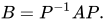
A transformation AP−1AP is called a similarity transformation or conjugation of the matrix A. In the general linear group, similarity is therefore the same as conjugacy, and similar matrices are also called conjugate; however, in a given subgroup H of the general linear group, the notion of conjugacy may be more restrictive than similarity, since it requires that P be chosen to lie in H.

Motivating example

[edit]

When defining a linear transformation, it can be the case that a change of basis can result in a simpler form of the same transformation. For example, the matrix representing a rotation in 3 when the axis of rotation is not aligned with the coordinate axis can be complicated to compute. If the axis of rotation were aligned with the positive z-axis, then it would simply be where is the angle of rotation. In the new coordinate system, the transformation would be written as where x' and y' are respectively the original and transformed vectors in a new basis containing a vector parallel to the axis of rotation. In the original basis, the transform would be written as where vectors x and y and the unknown transform matrix T are in the original basis. To write T in terms of the simpler matrix, we use the change-of-basis matrix P that transforms x and y as and :
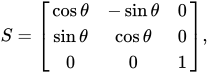
Thus, the matrix in the original basis, , is given by . The transform in the original basis is found to be the product of three easy-to-derive matrices. In effect, the similarity transform operates in three steps: change to a new basis (P), perform the simple transformation (S), and change back to the old basis (P−1).

Properties

[edit]

Similarity is an equivalence relation on the space of square matrices.

Because matrices are similar if and only if they represent the same linear operator with respect to (possibly) different bases, similar matrices share all properties of their shared underlying operator:

Because of this, for a given matrix A, one is interested in finding a simple "normal form" B which is similar to A—the study of A then reduces to the study of the simpler matrix B. For example, A is called diagonalizable if it is similar to a diagonal matrix. Not all matrices are diagonalizable, but at least over the complex numbers (or any algebraically closed field), every matrix is similar to a matrix in Jordan form. Neither of these forms is unique (diagonal entries or Jordan blocks may be permuted) so they are not really normal forms; moreover their determination depends on being able to factor the minimal or characteristic polynomial of A (equivalently to find its eigenvalues). The rational canonical form does not have these drawbacks: it exists over any field, is truly unique, and it can be computed using only arithmetic operations in the field; A and B are similar if and only if they have the same rational canonical form. The rational canonical form is determined by the elementary divisors of A; these can be immediately read off from a matrix in Jordan form, but they can also be determined directly for any matrix by computing the Smith normal form, over the ring of polynomials, of the matrix (with polynomial entries) XInA (the same one whose determinant defines the characteristic polynomial). Note that this Smith normal form is not a normal form of A itself; moreover it is not similar to XInA either, but obtained from the latter by left and right multiplications by different invertible matrices (with polynomial entries).

Similarity of matrices does not depend on the base field: if L is a field containing K as a subfield, and A and B are two matrices over K, then A and B are similar as matrices over K if and only if they are similar as matrices over L. This is so because the rational canonical form over K is also the rational canonical form over L. This means that one may use Jordan forms that only exist over a larger field to determine whether the given matrices are similar.

In the definition of similarity, if the matrix P can be chosen to be a permutation matrix then A and B are permutation-similar; if P can be chosen to be a unitary matrix then A and B are unitarily equivalent. The spectral theorem says that every normal matrix is unitarily equivalent to some diagonal matrix. Specht's theorem states that two matrices are unitarily equivalent if and only if they satisfy certain trace equalities.

See also

[edit]

References

[edit]
Revisions and contributorsEdit on WikipediaRead on Wikipedia
from Grokipedia
In linear algebra, two square matrices AA and BB of the same size are similar if there exists an PP such that A=PBP1A = P B P^{-1}. This relation captures the idea that similar matrices represent the same linear transformation but with respect to different bases, as PP corresponds to the change-of-basis matrix. Similarity is an equivalence relation on the set of n×nn \times n matrices, meaning it is reflexive (every matrix is similar to itself), symmetric (if AA is similar to BB, then BB is similar to AA), and transitive (if AA is similar to BB and BB is similar to CC, then AA is similar to CC). Similar matrices share many fundamental invariants, including the same trace, determinant, characteristic polynomial, eigenvalues (with algebraic multiplicities), and minimal polynomial. For instance, their eigenvalues are identical because the characteristic polynomial det(AλI)=det(PBP1λI)\det(A - \lambda I) = \det(P B P^{-1} - \lambda I) simplifies to det(BλI)\det(B - \lambda I) via properties of determinants and invertibility. Eigenvectors are also related: if vv is an eigenvector of AA with eigenvalue λ\lambda, then P1vP^{-1} v is an eigenvector of BB with the same λ\lambda. Powers of similar matrices remain similar, as Ak=PBkP1A^k = P B^k P^{-1}, which extends to polynomials and exponentials of the matrices. The concept is central to diagonalization, where a matrix AA is diagonalizable if it is similar to a DD via A=PDP1A = P D P^{-1}, with the columns of PP forming a basis of eigenvectors. This occurs precisely when AA has a full set of nn linearly independent eigenvectors, ensuring the geometric multiplicity equals the algebraic multiplicity for each eigenvalue. Beyond diagonalization, similarity underpins the Jordan canonical form, classifying matrices up to similarity into a unique block structure, and plays a key role in solving systems of differential equations and analyzing dynamical systems.

Definition and Interpretation

Formal Definition

In linear algebra, two n×nn \times n square matrices AA and BB over a field FF are similar if there exists an invertible n×nn \times n matrix PP with entries in FF such that B=P1APB = P^{-1} A P. This transformation expresses BB as a conjugate of AA by the invertible matrix PP, preserving essential algebraic structure while allowing for a change in representation. The requirement that both matrices be of the same size n×nn \times n ensures compatibility for the conjugation operation./05%3A_Eigenvalues_and_Eigenvectors/5.3%3A_Similarity) The similarity relation is commonly denoted by the symbol \sim, so ABA \sim B if and only if such a PP exists. This notation highlights the relational nature of similarity among matrices of fixed dimension over FF. Similarity partitions the set of all n×nn \times n matrices over FF into equivalence classes, where matrices within the same class share identical intrinsic properties. Similarity is an equivalence relation, satisfying reflexivity (AAA \sim A via P=IP = I, the identity matrix), symmetry (if ABA \sim B, then BAB \sim A by inverting the relation), and transitivity (if ABA \sim B and BCB \sim C, then ACA \sim C by composing the invertible matrices). These properties follow directly from the group structure of the general linear group GLn(F)\mathrm{GL}_n(F) of invertible matrices under multiplication. While the definition is standard over fields such as the real numbers R\mathbb{R} or complex numbers C\mathbb{C}, it generalizes to matrices over commutative rings, where invertibility is replaced by units in the ring, though canonical forms may not always exist uniquely. In practice, most theoretical developments and applications focus on fields to ensure the existence of inverses and polynomial factorizations.

Change of Basis Perspective

Matrix similarity provides a natural interpretation in the context of linear transformations on a finite-dimensional vector space. Consider a linear map T:VVT: V \to V over a field, such as the real numbers. The matrix representation of TT depends on the choice of basis for VV. If AA is the matrix of TT with respect to basis B\mathcal{B}, and BB is the matrix with respect to basis C\mathcal{C}, then AA and BB are similar matrices, satisfying B=P1APB = P^{-1} A P, where PP is the change-of-basis matrix from B\mathcal{B} to C\mathcal{C}. This relation arises because the coordinates of vectors transform under basis changes, preserving the underlying action of TT while altering the numerical representation. The change-of-basis matrix PP is constructed by expressing the vectors of the new basis C\mathcal{C} in terms of the old basis B\mathcal{B}; specifically, the columns of PP are the coordinate vectors of the basis vectors in C\mathcal{C} with respect to B\mathcal{B}. To find the matrix BB in the new basis, one applies P1P^{-1} to convert input coordinates from C\mathcal{C} to B\mathcal{B}, multiplies by AA, and then uses PP to convert the output back to C\mathcal{C} coordinates. This process ensures that the similarity transformation captures the same without altering its intrinsic properties. A concrete example illustrates this perspective for a rotation in R2\mathbb{R}^2. Consider the counterclockwise by 9090^\circ, represented in the E={e1=(1,0),e2=(0,1)}\mathcal{E} = \{ e_1 = (1,0), e_2 = (0,1) \} by the matrix A=(0110).A = \begin{pmatrix} 0 & -1 \\ 1 & 0 \end{pmatrix}. Now take a new basis F={f1=(1,0),f2=(1,1)}\mathcal{F} = \{ f_1 = (1,0), f_2 = (1,1) \}. The change-of-basis matrix PP from E\mathcal{E} to F\mathcal{F} has columns as the E\mathcal{E}-coordinates of f1f_1 and f2f_2: P=(1101),P1=(1101).P = \begin{pmatrix} 1 & 1 \\ 0 & 1 \end{pmatrix}, \quad P^{-1} = \begin{pmatrix} 1 & -1 \\ 0 & 1 \end{pmatrix}. The matrix of the in F\mathcal{F} is then B=P1AP=(1101)(0110)(1101)=(1211).B = P^{-1} A P = \begin{pmatrix} 1 & -1 \\ 0 & 1 \end{pmatrix} \begin{pmatrix} 0 & -1 \\ 1 & 0 \end{pmatrix} \begin{pmatrix} 1 & 1 \\ 0 & 1 \end{pmatrix} = \begin{pmatrix} -1 & -2 \\ 1 & 1 \end{pmatrix}. Direct computation confirms that BB applies the same to vectors expressed in F\mathcal{F}-coordinates, verifying the similarity. The concept of matrix similarity was formalized during the 19th-century advancements in linear algebra, building on earlier work by Cauchy and further developed by mathematicians such as Weierstrass in the 1860s and in 1870, who explored linear substitutions and their representations.

Properties and Invariants

Trace, Determinant, and Rank

Matrix similarity preserves several fundamental properties of square matrices, including the trace, determinant, and rank. These invariants arise because a similarity transformation B=P1APB = P^{-1} A P represents a change of basis for the linear operator corresponding to AA, and these quantities are basis-independent. The trace of a matrix, defined as the sum of its diagonal entries, is invariant under similarity. Specifically, if AA and BB are similar, then tr(A)=tr(B)\operatorname{tr}(A) = \operatorname{tr}(B). This follows from the cyclic property of the trace, which states that tr(XY)=tr(YX)\operatorname{tr}(XY) = \operatorname{tr}(YX) for compatible matrices XX and YY. For B=P1APB = P^{-1} A P, tr(B)=tr(P1AP)=tr(APP1)=tr(AI)=tr(A),\operatorname{tr}(B) = \operatorname{tr}(P^{-1} A P) = \operatorname{tr}(A P P^{-1}) = \operatorname{tr}(A I) = \operatorname{tr}(A), since PP1=IP P^{-1} = I. This invariance holds for any field and dimension, making the trace a useful scalar invariant for comparing matrices. Similarly, the determinant is preserved under similarity transformations. If ABA \sim B, then det(A)=det(B)\det(A) = \det(B). The proof relies on the multiplicative property of the determinant: for B=P1APB = P^{-1} A P, det(B)=det(P1AP)=det(P1)det(A)det(P)=det(P1P)det(A)=det(I)det(A)=1det(A)=det(A).\det(B) = \det(P^{-1} A P) = \det(P^{-1}) \det(A) \det(P) = \det(P^{-1} P) \det(A) = \det(I) \det(A) = 1 \cdot \det(A) = \det(A). This property underscores that similar matrices represent the same linear transformation up to basis change, preserving volume scaling factors. The rank of a matrix, which is the dimension of its column space (or equivalently, the number of linearly independent rows or columns), is also invariant under similarity. Thus, rank(A)=rank(B)\operatorname{rank}(A) = \operatorname{rank}(B) if ABA \sim B. This preservation stems from the fact that similarity is an isomorphism of vector spaces: the nullity (dimension of the kernel) of BB equals that of AA because an invertible PP bijectively maps bases of the null space of BB to bases of the null space of AA. By the rank-nullity theorem, rank(B)=nnullity(B)=nnullity(A)=rank(A)\operatorname{rank}(B) = n - \operatorname{nullity}(B) = n - \operatorname{nullity}(A) = \operatorname{rank}(A), where nn is the matrix dimension. Beyond these, other non-spectral invariants such as the degree of the minimal polynomial—which is the smallest degree of a monic polynomial annihilating the matrix—are also preserved under similarity, as the minimal polynomial itself is invariant.

Eigenvalues and Characteristic Polynomial

One key invariant under matrix similarity is the characteristic polynomial. For an n×nn \times n matrix AA, the characteristic polynomial is defined as χA(λ)=det(λIA)\chi_A(\lambda) = \det(\lambda I - A), a monic polynomial of degree nn. If two matrices AA and BB are similar, meaning B=P1APB = P^{-1} A P for some invertible matrix PP, then they share the same characteristic polynomial: χB(λ)=χA(λ)\chi_B(\lambda) = \chi_A(\lambda). This follows from the determinant property: χB(λ)=det(λIP1AP)=det(P1(λIA)P)=det(P1)det(λIA)det(P)=det(λIA)=χA(λ),\chi_B(\lambda) = \det(\lambda I - P^{-1} A P) = \det(P^{-1} (\lambda I - A) P) = \det(P^{-1}) \det(\lambda I - A) \det(P) = \det(\lambda I - A) = \chi_A(\lambda), since det(P1)det(P)=1\det(P^{-1}) \det(P) = 1. The eigenvalues of a matrix are the roots of its , and similarity preserves these roots along with their algebraic multiplicities—the multiplicity of each root in the polynomial . Thus, similar matrices have identical eigenvalues, counted with algebraic multiplicity. Similar matrices also share the same geometric multiplicity for each eigenvalue, defined as the of the corresponding eigenspace. For real matrices, eigenvalues may be complex, occurring in conjugate pairs if non-real, yet the remains unchanged under similarity. Similar matrices also share the same minimal polynomial, the mA(λ)m_A(\lambda) of least degree such that mA(A)=0m_A(A) = 0. This invariance arises because if mA(A)=0m_A(A) = 0, then for B=P1APB = P^{-1} A P, we have mA(B)=P1mA(A)P=0m_A(B) = P^{-1} m_A(A) P = 0, so mB(λ)m_B(\lambda) divides mA(λ)m_A(\lambda); yields equality. The minimal polynomial divides the and has the same roots (the eigenvalues), with multiplicities equal to the size of the largest block for each eigenvalue. By the Cayley-Hamilton theorem, every square matrix satisfies its own : χA(A)=0\chi_A(A) = 0. Since similar matrices share the same , both AA and BB satisfy χA(B)=0\chi_A(B) = 0 and χB(A)=0\chi_B(A) = 0. This provides a polynomial equation annihilating the matrix, with the minimal polynomial offering the sparsest such relation.

Canonical Forms

Diagonal Form for Diagonalizable Matrices

A square matrix ACn×nA \in \mathbb{C}^{n \times n} (or over R\mathbb{R}) is diagonalizable if it possesses a full set of nn linearly independent eigenvectors. This condition is equivalent to the algebraic multiplicity of each eigenvalue equaling its geometric multiplicity, ensuring the eigenspaces span the entire vector space. If AA is diagonalizable, there exists an PP and a D=diag(λ1,,λn)D = \operatorname{diag}(\lambda_1, \dots, \lambda_n) such that AA is similar to DD, denoted ADA \sim D, where the diagonal entries λi\lambda_i are the eigenvalues of AA. The similarity transformation preserves the of AA, allowing complex operations on AA to be simplified by working in the diagonal basis. To construct the diagonal form, form PP with columns consisting of the corresponding eigenvectors of AA, so that D=P1APD = P^{-1} A P. The invertibility of PP follows directly from the linear independence of the eigenvectors. For example, consider the real symmetric matrix A=(2112).A = \begin{pmatrix} 2 & 1 \\ 1 & 2 \end{pmatrix}. Its eigenvalues are λ1=3\lambda_1 = 3 and λ2=1\lambda_2 = 1, with eigenvectors v1=(11)\mathbf{v}_1 = \begin{pmatrix} 1 \\ 1 \end{pmatrix} and v2=(11)\mathbf{v}_2 = \begin{pmatrix} -1 \\ 1 \end{pmatrix}, respectively. Thus, P=(1111)P = \begin{pmatrix} 1 & -1 \\ 1 & 1 \end{pmatrix} yields D=P1AP=diag(3,1)D = P^{-1} A P = \operatorname{diag}(3, 1), confirming diagonalization over the reals. Real symmetric matrices are always diagonalizable in this manner, with orthogonal PP possible via the spectral theorem.

Jordan Canonical Form

The Jordan canonical form provides a canonical representation for square matrices over algebraically closed fields, generalizing the diagonal form to handle non-diagonalizable cases through nilpotent perturbations. For an n×nn \times n matrix AA over such a field, there exists an invertible matrix PP such that P1AP=JP^{-1} A P = J, where JJ is a block-diagonal matrix composed of Jordan blocks. Each Jordan block Jk(λ)J_k(\lambda) is a k×kk \times k matrix of the form λIk+Nk\lambda I_k + N_k, with λ\lambda an eigenvalue of AA on the diagonal and NkN_k the having 1s on the superdiagonal and 0s elsewhere: Jk(λ)=(λ1000λ1000λ1000λ).J_k(\lambda) = \begin{pmatrix} \lambda & 1 & 0 & \cdots & 0 \\ 0 & \lambda & 1 & \cdots & 0 \\ \vdots & \vdots & \ddots & \ddots & \vdots \\ 0 & 0 & \cdots & \lambda & 1 \\ 0 & 0 & \cdots & 0 & \lambda \end{pmatrix}.
Add your contribution
Related Hubs
User Avatar
No comments yet.