



Community hub
Recent from talks
Contribute something
Nothing was collected or created yet.
Frobenius normal form
View on WikipediaIn linear algebra, the Frobenius normal form or rational canonical form of a square matrix A with entries in a field F is a canonical form for matrices obtained by conjugation by invertible matrices over F. The form reflects a minimal decomposition of the vector space into subspaces that are cyclic for A (i.e., spanned by some vector and its repeated images under A). Since only one normal form can be reached from a given matrix (whence the "canonical"), a matrix B is similar to A if and only if it has the same rational canonical form as A. Since this form can be found without any operations that might change when extending the field F (whence the "rational"), notably without factoring polynomials, this shows that whether two matrices are similar does not change upon field extensions. The form is named after German mathematician Ferdinand Georg Frobenius.
Some authors use the term rational canonical form for a somewhat different form that is more properly called the primary rational canonical form. Instead of decomposing into a minimum number of cyclic subspaces, the primary form decomposes into a maximum number of cyclic subspaces. It is also defined over F, but has somewhat different properties: finding the form requires factorization of polynomials, and as a consequence the primary rational canonical form may change when the same matrix is considered over an extension field of F. This article mainly deals with the form that does not require factorization, and explicitly mentions "primary" when the form using factorization is meant.
Motivation
[edit]When trying to find out whether two square matrices A and B are similar, one approach is to try, for each of them, to decompose the vector space as far as possible into a direct sum of stable subspaces, and compare the respective actions on these subspaces. For instance if both are diagonalizable, then one can take the decomposition into eigenspaces (for which the action is as simple as it can get, namely by a scalar), and then similarity can be decided by comparing eigenvalues and their multiplicities. While in practice this is often a quite insightful approach, there are various drawbacks this has as a general method. First, it requires finding all eigenvalues, say as roots of the characteristic polynomial, but it may not be possible to give an explicit expression for them. Second, a complete set of eigenvalues might exist only in an extension of the field one is working over, and then one does not get a proof of similarity over the original field. Finally A and B might not be diagonalizable even over this larger field, in which case one must instead use a decomposition into generalized eigenspaces, and possibly into Jordan blocks.
But obtaining such a fine decomposition is not necessary to just decide whether two matrices are similar. The rational canonical form is based on instead using a direct sum decomposition into stable subspaces that are as large as possible, while still allowing a very simple description of the action on each of them. These subspaces must be generated by a single nonzero vector v and all its images by repeated application of the linear operator associated to the matrix; such subspaces are called cyclic subspaces (by analogy with cyclic subgroups) and they are clearly stable under the linear operator. A basis of such a subspace is obtained by taking v and its successive images as long as they are linearly independent. The matrix of the linear operator with respect to such a basis is the companion matrix of a monic polynomial; this polynomial (the minimal polynomial of the operator restricted to the subspace, which notion is analogous to that of the order of a cyclic subgroup) determines the action of the operator on the cyclic subspace up to isomorphism, and is independent of the choice of the vector v generating the subspace.
A direct sum decomposition into cyclic subspaces always exists, and finding one does not require factoring polynomials. However it is possible that cyclic subspaces do allow a decomposition as direct sum of smaller cyclic subspaces (essentially by the Chinese remainder theorem). Therefore, just having for both matrices some decomposition of the space into cyclic subspaces, and knowing the corresponding minimal polynomials, is not in itself sufficient to decide their similarity. An additional condition is imposed to ensure that for similar matrices one gets decompositions into cyclic subspaces that exactly match: in the list of associated minimal polynomials each one must divide the next (and the constant polynomial 1 is forbidden to exclude trivial cyclic subspaces). The resulting list of polynomials are called the invariant factors of (the K[X]-module defined by) the matrix, and two matrices are similar if and only if they have identical lists of invariant factors. The rational canonical form of a matrix A is obtained by expressing it on a basis adapted to a decomposition into cyclic subspaces whose associated minimal polynomials are the invariant factors of A; two matrices are similar if and only if they have the same rational canonical form.
Example
[edit]Consider the following matrix A, over Q:
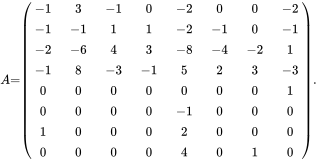
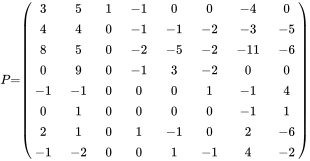
A has minimal polynomial , so that the dimension of a subspace generated by the repeated images of a single vector is at most 6. The characteristic polynomial is , which is a multiple of the minimal polynomial by a factor . There always exist vectors such that the cyclic subspace that they generate has the same minimal polynomial as the operator has on the whole space; indeed most vectors will have this property, and in this case the first standard basis vector does so: the vectors for are linearly independent and span a cyclic subspace with minimal polynomial . There exist complementary stable subspaces (of dimension 2) to this cyclic subspace, and the space generated by vectors and is an example. In fact one has , so the complementary subspace is a cyclic subspace generated by ; it has minimal polynomial . Since is the minimal polynomial of the whole space, it is clear that must divide (and it is easily checked that it does), and we have found the invariant factors and of A. Then the rational canonical form of A is the block diagonal matrix with the corresponding companion matrices as diagonal blocks, namely










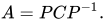
A basis on which this form is attained is formed by the vectors above, followed by for ; explicitly this means that for

- ,
one has
General case and theory
[edit]Fix a base field F and a finite-dimensional vector space V over F. Given a polynomial P ∈ F[X], there is associated to it a companion matrix CP whose characteristic polynomial and minimal polynomial are both equal to P.
Theorem: Let V be a finite-dimensional vector space over a field F, and A a square matrix over F. Then V (viewed as an F[X]-module with the action of X given by A) admits a F[X]-module isomorphism
- V ≅ F[X]/f1 ⊕ … ⊕ F[X]/fk
where the fi ∈ F[X] may be taken to be monic polynomials of positive degree (so they are non-units in F[X]) that satisfy the relations
- f1 | f2 | … | fk
(where "a | b" is notation for "a divides b"); with these conditions the list of polynomials fi is unique.
Sketch of Proof: Apply the structure theorem for finitely generated modules over a principal ideal domain to V, viewing it as an F[X]-module. The structure theorem provides a decomposition into cyclic factors, each of which is a quotient of F[X] by a proper ideal; the zero ideal cannot be present since the resulting free module would be infinite-dimensional as F vector space, while V is finite-dimensional. For the polynomials fi one then takes the unique monic generators of the respective ideals, and since the structure theorem ensures containment of every ideal in the preceding ideal, one obtains the divisibility conditions for the fi. See [DF] for details.
Given an arbitrary square matrix, the elementary divisors used in the construction of the Jordan normal form do not exist over F[X], so the invariant factors fi as given above must be used instead. The last of these factors fk is then the minimal polynomial, which all the invariant factors therefore divide, and the product of the invariant factors gives the characteristic polynomial. Note that this implies that the minimal polynomial divides the characteristic polynomial (which is essentially the Cayley-Hamilton theorem), and that every irreducible factor of the characteristic polynomial also divides the minimal polynomial (possibly with lower multiplicity).
For each invariant factor fi one takes its companion matrix Cfi, and the block diagonal matrix formed from these blocks yields the rational canonical form of A. When the minimal polynomial is identical to the characteristic polynomial (the case k = 1), the Frobenius normal form is the companion matrix of the characteristic polynomial. As the rational canonical form is uniquely determined by the unique invariant factors associated to A, and these invariant factors are independent of basis, it follows that two square matrices A and B are similar if and only if they have the same rational canonical form.
A rational normal form generalizing the Jordan normal form
[edit]The Frobenius normal form does not reflect any form of factorization of the characteristic polynomial, even if it does exist over the ground field F. This implies that it is invariant when F is replaced by a different field (as long as it contains the entries of the original matrix A). On the other hand, this makes the Frobenius normal form rather different from other normal forms that do depend on factoring the characteristic polynomial, notably the diagonal form (if A is diagonalizable) or more generally the Jordan normal form (if the characteristic polynomial splits into linear factors). For instance, the Frobenius normal form of a diagonal matrix with distinct diagonal entries is just the companion matrix of its characteristic polynomial.
There is another way to define a normal form, that, like the Frobenius normal form, is always defined over the same field F as A, but that does reflect a possible factorization of the characteristic polynomial (or equivalently the minimal polynomial) into irreducible factors over F, and which reduces to the Jordan normal form when this factorization only contains linear factors (corresponding to eigenvalues). This form[1] is sometimes called the generalized Jordan normal form, or primary rational canonical form. It is based on the fact that the vector space can be canonically decomposed into a direct sum of stable subspaces corresponding to the distinct irreducible factors P of the characteristic polynomial (as stated by the lemme des noyaux[2]), where the characteristic polynomial of each summand is a power of the corresponding P. These summands can be further decomposed, non-canonically, as a direct sum of cyclic F[x]-modules (like is done for the Frobenius normal form above), where the characteristic polynomial of each summand is still a (generally smaller) power of P. The primary rational canonical form is a block diagonal matrix corresponding to such a decomposition into cyclic modules, with a particular form called generalized Jordan block in the diagonal blocks, corresponding to a particular choice of a basis for the cyclic modules. This generalized Jordan block is itself a block matrix of the form
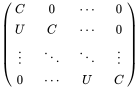
where C is the companion matrix of the irreducible polynomial P, and U is a matrix whose sole nonzero entry is a 1 in the upper right-hand corner. For the case of a linear irreducible factor P = x − λ, these blocks are reduced to single entries C = λ and U = 1 and, one finds a (transposed) Jordan block. In any generalized Jordan block, all entries immediately below the main diagonal are 1. A basis of the cyclic module giving rise to this form is obtained by choosing a generating vector v (one that is not annihilated by Pk−1(A) where the minimal polynomial of the cyclic module is Pk), and taking as basis

where d = deg P.
See also
[edit]References
[edit]- [DF] David S. Dummit and Richard M. Foote. Abstract Algebra. 2nd Edition, John Wiley & Sons. pp. 442, 446, 452-458. ISBN 0-471-36857-1.
External links
[edit]Frobenius normal form
View on GrokipediaIntroduction
Definition
The Frobenius normal form, also known as the rational canonical form, of a linear transformation on a finite-dimensional vector space of dimension over a field , or equivalently of an matrix with entries in , is the unique block diagonal matrix (up to permutation of blocks) that is similar to the matrix of (or to ) with respect to some basis of , where the diagonal blocks are companion matrices of monic polynomials (the invariant factors of ) satisfying and .[5][6] The block structure consists of companion matrix blocks arranged along the diagonal, with zeros elsewhere. For each monic invariant factor of degree , the corresponding companion matrix is the matrix whose entries are 1's on the subdiagonal (positions for ), the negated coefficients in the last row (positions for ), and zeros elsewhere.[5][7] This form assumes familiarity with matrix similarity, where similarity means there exists an invertible matrix such that equals the Frobenius normal form.[6] The invariant factors and companion matrices are detailed in subsequent sections.Historical Background
The Frobenius normal form was introduced by the German mathematician Ferdinand Georg Frobenius in his seminal 1879 paper "Theorie der linearen Formen mit ganzen Coefficienten," published in the Journal für die reine und angewandte Mathematik, where he developed canonical representations for linear forms with integer coefficients, generalizing to matrices over fields.[1] This work built on his earlier 1878 paper "Über lineare Substitutionen und bilineare Formen," which applied similar ideas to classify pairs of bilinear forms under linear substitutions, demonstrating utility in reducing complex systems to standard structures, though readily generalizing to single endomorphisms.[3] Frobenius's contribution built directly on earlier efforts by Karl Weierstrass and Leopold Kronecker, who had explored special cases of canonical forms for matrices and linear transformations in 1868 and 1874, respectively; Frobenius extended these to a more general framework, citing their results as foundational.[3] This development marked a key advancement in the theory of matrix equivalence and similarity, emphasizing invariant properties under change of basis. Also known as the rational canonical form, it serves as a "rational" alternative to other normal forms like the Jordan form, which often require extensions of the base field to achieve diagonalization over algebraically closed fields.[1] Over time, the Frobenius normal form became integral to invariant theory, particularly in classifying finitely generated modules over principal ideal domains (PIDs), such as the polynomial ring over a field, where it provides a unique decomposition into cyclic components.[8]Fundamental Concepts
Invariant Factors
In the context of the Frobenius normal form, also known as the rational canonical form, the invariant factors provide a complete invariant for the similarity class of a linear transformation on a finite-dimensional vector space over a field . For a linear transformation with , the invariant factors are monic polynomials satisfying and , such that the -module structure on (where acts as ) is isomorphic to the direct sum . This decomposition captures the cyclic structure of the module into indecomposable summands. These invariant factors emerge from the Smith normal form of the characteristic matrix , where is a matrix representation of . The Smith normal form is a diagonal matrix over obtained via elementary row and column operations, and its diagonal entries are the invariant factors up to multiplication by units in (which are the nonzero constants in ). This connection underscores the role of invariant factors in rational canonical forms, distinguishing them from other decompositions like the Jordan form, which relies on field extensions. Key properties of the invariant factors include the fact that their product equals the characteristic polynomial of , ensuring the total degree matches the dimension of . Additionally, the last invariant factor is precisely the minimal polynomial of , as it annihilates and is the generator of the annihilator ideal in the module. These relations highlight how invariant factors encode both the full spectrum and the cyclic dependencies in the action of . The invariant factors are unique for matrices in the same similarity class: two matrices over are similar if and only if they possess the same sequence of invariant factors. This uniqueness theorem guarantees that the Frobenius normal form, constructed as a block diagonal matrix with companion matrix blocks for each , is well-defined up to permutation of the blocks.Companion Matrices
In the Frobenius normal form, also known as the rational canonical form, the building blocks are companion matrices associated to monic invariant factors, which are monic polynomials that divide each other in a chain.[9] For a monic polynomial of degree , the companion matrix is the matrix over the base field with 1's on the subdiagonal, the negatives of the coefficients in the last column, and 0's elsewhere.[9] This specific form, often called the Frobenius companion matrix, ensures a structured representation that aligns with the module-theoretic interpretation of linear transformations.[9] The characteristic polynomial of is precisely , and since the matrix acts cyclically on the space, its minimal polynomial is also exactly .[9] For instance, when , the companion matrix is whose characteristic polynomial computation yields .[9] A key property of the companion matrix is that it generates a cyclic subspace of dimension : there exists a vector such that the set forms a basis for the -dimensional space, with the action of shifting the basis vectors and applying the polynomial relation to close the cycle.[9] This cyclicity underscores why companion matrices serve as the indecomposable blocks in the Frobenius normal form, reflecting the primary decomposition into cyclic modules.[9]Construction
Determining the Invariant Factors
The invariant factors of a matrix , where is a field, are monic polynomials in of positive degree such that the degrees sum to and is similar over to the block diagonal matrix consisting of the companion matrices of the .[10] To determine these factors, form the characteristic matrix . Since is a principal ideal domain (PID), this matrix admits a Smith normal form, obtained via elementary row and column operations over (additions of multiples of rows/columns, swaps, and multiplications by units in ).[11] The diagonal entries of the Smith normal form are precisely the invariant factors , normalized to be monic with and leading entries possibly equal to .[12] The computation proceeds by iteratively applying polynomial division and gcd operations to reduce the matrix: select a pivot entry of minimal degree, eliminate it from other positions using Euclidean algorithm analogs, and recurse on submatrices, ensuring divisibility conditions hold at each step.[10] This leverages the PID structure of , where ideals are principal, allowing unique factorization up to units and guaranteeing the existence and uniqueness of the normal form.[11] Equivalently, the invariant factors arise from the determinantal divisors of . The -th determinantal divisor is the monic gcd of all minors of , with . Then, for , yielding the chain of invariant factors where each divides the next.[12] An alternative approach decomposes the -module (isomorphic to the module associated to ) into a direct sum of cyclic submodules, each generated by a vector whose annihilator ideal is principal, generated by an invariant factor. To identify these, find a maximal cyclic subspace by selecting a vector not in the kernel of any proper power of for eigenvalues , compute its minimal annihilating polynomial as the first invariant factor, quotient out the subspace, and repeat on the remainder until the space is exhausted.[10] Kernel dimensions of powers of may assist in locating suitable generators, but the core relies on the PID property ensuring cyclic decompositions correspond to the invariant factors.[11]Assembling the Form
Once the invariant factors of a matrix , where is a field and each is a monic polynomial of degree at least 1, have been determined, the Frobenius normal form is assembled by constructing the companion matrix for each invariant factor .[13] The companion matrix for a polynomial is the matrix with 1's on the subdiagonal, the negatives of the coefficients in the last column, and zeros elsewhere.[5] The full Frobenius normal form is then the block diagonal matrix , where the blocks are arranged in order of increasing degree.[1] This block diagonal structure ensures that the Frobenius normal form captures the cyclic decomposition of the underlying vector space into invariant subspaces, each corresponding to one invariant factor.[13] By the theory of rational canonical forms, there exists an invertible matrix such that , meaning is similar to its Frobenius normal form over the base field .[5] This similarity preserves the minimal and characteristic polynomials of , with the product equaling the characteristic polynomial and the minimal polynomial.[1] A key verification step in assembly is the dimension check: the sum of the degrees , confirming that the blocks span the full matrix size without overlap or deficiency.[13] For explicit illustration, consider two invariant factors yielding blocks of sizes and ; the resulting matrix with has the form where the zero blocks are appropriately dimensioned to fill the off-diagonal positions.[5] This direct sum structure reflects the primary decomposition theorem for modules over polynomial rings.[1]Examples
Basic Example
To illustrate the Frobenius normal form, consider the matrix over the real numbers . The characteristic polynomial of is , which is irreducible over since its discriminant .[14] Since is and the minimal polynomial equals the characteristic polynomial (both ), there is a single invariant factor . The Frobenius normal form is thus the companion matrix of this polynomial, given by where the companion matrix convention places the negatives of the polynomial coefficients (except the leading 1) in the last column, with 1's on the subdiagonal.[15][14] This form is achieved via similarity: is similar to over . A change-of-basis matrix with columns forming a rational canonical basis , where and , satisfies . Here, and direct computation verifies , confirming the similarity.[14]Advanced Example
Consider a 6×6 matrix over the rational numbers whose characteristic polynomial is and minimal polynomial is . The invariant factors are and , determined via the Smith normal form of the characteristic matrix , where each subsequent factor divides the next and their product yields the characteristic polynomial.[7] The Frobenius normal form is the block diagonal matrix consisting of the companion matrices of these invariant factors. The companion matrix for is the 2×2 block with characteristic and minimal polynomials both . The companion matrix for is the 4×4 block with characteristic polynomial and minimal polynomial the same. Thus, is F = \begin{pmatrix} 0 & -1 & 0 & 0 & 0 & 0 \\ 1 & 0 & 0 & 0 & 0 & 0 \\ 0 & 0 & 0 & 0 & 0 & -1 \\ 0 & 0 & 1 & 0 & 0 & 0 \\ 0 & 0 & 0 & 1 & 0 & -2 \\ 0 & 0 & 0 & 0 & 1 & 0 \end{pmatrix}.[](https://mathworld.wolfram.com/RationalCanonicalForm.html)[](https://mathworld.wolfram.com/CompanionMatrix.html) There exists an [invertible matrix](/page/Invertible_matrix) $P$ over $\mathbb{Q}$ such that $P^{-1} A P = F$, establishing the similarity; the columns of $P$ form a basis of cyclic subspaces corresponding to the invariant factors.[](https://mathworld.wolfram.com/RationalCanonicalForm.html) ## Theoretical Properties ### Uniqueness and Similarity Invariants The Frobenius normal form of a square matrix over a field $F$ is unique up to the ordering of its [companion matrix](/page/Companion_matrix) blocks. This uniqueness follows from the structure theorem for finitely generated modules over the principal ideal domain $F$, where the matrix $A$ corresponds to [multiplication](/page/Multiplication) by $x$ on the module $F^n / (xI_n - A) F^n$. Specifically, the invariant factors of this module, which are the monic polynomials $d_1(x) \mid d_2(x) \mid \cdots \mid d_k(x)$ appearing on the diagonal of the [Smith normal form](/page/Smith_normal_form) of $xI_n - A$, determine the block structure of the form, with each block being the [companion matrix](/page/Companion_matrix) of $d_i(x)$. Since the Smith normal form over a PID is unique up to units in $F$ (which are the nonzero constants), the invariant factors—and thus the Frobenius normal form—are uniquely determined.[](https://people.math.osu.edu/leibman.1/algebra2/modules.pdf)[](https://www.math.uwaterloo.ca/~cgodsil/quagmire/linalg2/pdfs/L3-frobenius.pdf) The [multiset](/page/Multiset) of companion blocks in the Frobenius normal form completely determines the similarity class of the matrix over $F$. Two matrices are similar [if and only if](/page/If_and_only_if) their Frobenius normal forms coincide, as similarity preserves the module structure and hence the invariant factors. This provides a complete set of similarity invariants, extending beyond partial invariants like the characteristic or minimal [polynomial](/page/Polynomial).[](https://people.math.osu.edu/leibman.1/algebra2/modules.pdf)[](https://www.math.uwaterloo.ca/~cgodsil/quagmire/linalg2/pdfs/L3-frobenius.pdf) This uniqueness result generalizes to the classification of finitely generated torsion modules over any [principal ideal domain](/page/Principal_ideal_domain) $R$, where the Frobenius normal form analogue arises from the invariant factor decomposition, again unique via the [Smith normal form](/page/Smith_normal_form).[](https://people.math.osu.edu/leibman.1/algebra2/modules.pdf) ### Relation to Polynomials The Frobenius normal form of a matrix $A$, also known as the rational canonical form, establishes a direct connection to the [characteristic polynomial](/page/Characteristic_polynomial) of $A$. Specifically, if the invariant factors of $A$ are the monic polynomials $f_1, f_2, \dots, f_k$ such that $f_i$ divides $f_{i+1}$ for each $i$, then the [characteristic polynomial](/page/Characteristic_polynomial) $\chi_A(X)$ is the product $\chi_A(X) = \prod_{i=1}^k f_i(X)$. This holds because the Frobenius form is a block-diagonal matrix consisting of companion matrices for each $f_i$, and the [characteristic polynomial](/page/Characteristic_polynomial) of the entire form coincides with that of $A$ under similarity.[](https://cs.uwaterloo.ca/~astorjoh/cpoly.pdf) The minimal polynomial $m_A(X)$ of $A$ is likewise tied to the invariant factors, being equal to the last invariant factor $f_k(X)$, the one of highest degree. This reflects the fact that the minimal polynomial annihilates $A$ and is the [least common multiple](/page/Least_common_multiple) of the minimal polynomials of the cyclic components in the [decomposition](/page/Decomposition), which in this case is dominated by the largest invariant factor.[](https://cs.uwaterloo.ca/~astorjoh/cpoly.pdf) This polynomial relationship manifests explicitly in the [determinant](/page/Determinant) [formula](/page/Formula) for the Frobenius form $F$: \[ \det(XI - F) = \prod_{i=1}^k f_i(X), since the companion matrix of has characteristic polynomial , and the block-diagonal structure multiplies these determinants. Consequently, the degrees of the invariant factors determine the sizes of the cyclic blocks in the form, providing the dimensions of the invariant subspaces in the rational canonical decomposition.[16]Comparison with Jordan Normal Form
Key Similarities
Both the Frobenius normal form and the Jordan normal form serve as canonical representations of square matrices under similarity transformations, providing a standardized block-diagonal structure that uniquely identifies the similarity class of the matrix up to the ordering of the blocks.[15] This uniqueness stems from the invariant factors for the Frobenius form and the elementary divisors for the Jordan form, ensuring that similar matrices yield identical forms after permutation of blocks.[17] A core similarity lies in their decompositions: both forms express the underlying vector space as a direct sum of indecomposable invariant subspaces, where each block corresponds to factors of the minimal polynomial of the matrix.[18] In the Frobenius form, these are cyclic subspaces generated by companion matrices of the invariant factors, which are monic polynomials satisfying successive divisibility, while in the Jordan form, they are generalized eigenspaces structured as Jordan blocks for eigenvalues; the minimal polynomial in each case is the least common multiple of the annihilating polynomials of these blocks.[15] When the minimal polynomial splits completely into linear factors over an algebraically closed field, both forms elucidate the eigenvalue structure of the matrix, highlighting the multiplicities and the dimensions of the associated generalized eigenspaces.[17] This alignment occurs because the irreducible factors reduce to linear terms, allowing the block structures to reflect the same spectral information. Over the complex numbers , the companion matrix for a power is similar to a single Jordan block of size for the eigenvalue .[9] The companion matrix and Jordan block thus share the same characteristic and minimal polynomials in this setting, differing only in their explicit matrix shapes but representing equivalent cyclic structures. Over , the overall Frobenius normal form is similar to the Jordan normal form, though the block structure may differ due to the way invariant factors combine contributions from different eigenvalues.[9]Key Differences
One key distinction between the Frobenius normal form and the Jordan normal form lies in their field dependence and applicability. The Frobenius normal form is defined over any field, allowing for the decomposition of linear transformations without requiring the characteristic polynomial to split into linear factors. In contrast, the Jordan normal form necessitates an algebraically closed field, such as the complex numbers, to fully resolve eigenvalues and ensure the existence of the form for all matrices. This limitation restricts the Jordan form's use over fields like the reals when irreducible polynomials of higher degree appear. Another fundamental difference concerns the block basis used in each form. The Frobenius normal form employs invariant factors, which are monic polynomials formed as products of the elementary divisors (powers of irreducible polynomials over the base field), with each block corresponding to one such invariant factor. The Jordan normal form, however, directly utilizes the elementary divisors themselves as the basis for its blocks, presenting each power of an irreducible (typically linear, given the algebraically closed field) separately without grouping. Note that the rational canonical form also has a primary presentation using companion blocks directly for the elementary divisors (powers of irreducibles), which aligns more closely with the Jordan form over splitting fields, where each such block is similar to a Jordan block. The structural composition of the blocks further highlights their divergence. In the Frobenius normal form, each block is a companion matrix that fully realizes a cyclic invariant subspace for its associated invariant factor, emphasizing the module structure over the polynomial ring. Jordan blocks, by comparison, consist of the eigenvalue along the diagonal with unities on the superdiagonal, capturing the nilpotent part within generalized eigenspaces for each elementary divisor power. Although both forms are determined by the same underlying elementary divisors, the Frobenius normal form aggregates them into invariant factors via successive divisibility, whereas the Jordan form isolates each one; the two coincide if and only if all elementary divisors are powers of distinct linear factors. The invariant factors versus elementary divisors distinction arises from the former being cumulative products divided by the preceding ones in the chain (i.e., each is divisible by the previous).Computational Methods
Algorithms for Computation
The primary algorithm for computing the Frobenius normal form of an matrix over a field relies on determining the invariant factors via the Smith normal form of the characteristic matrix over the polynomial ring . This involves applying row and column operations—analogous to Gaussian elimination but adapted for polynomials, using division and greatest common divisor computations—to transform into a diagonal matrix , where the are monic polynomials satisfying and the non-constant are the invariant factors. The Frobenius form is then the block-diagonal matrix consisting of the companion matrices of these invariant factors.[11][19] An alternative approach uses an iterative method to decompose the underlying vector space into cyclic subspaces. Start by identifying a cyclic generator vector such that its annihilator polynomial is the minimal polynomial of ; the subspace generated by is invariant and cyclic. Deflate by restricting to the quotient space modulo this subspace, and repeat the process on the quotient until the space is exhausted, yielding the invariant factors and the corresponding companion blocks for the Frobenius form.[20] For dense matrices, both methods achieve arithmetic operations over , where polynomial operations such as GCDs are performed using subresultant algorithms to ensure efficiency and exactness.[21] Over the rationals , fraction-free elimination variants of these algorithms are employed to maintain integer coefficients and avoid intermediate fraction growth, enhancing numerical stability.[19]Software Implementations
Several computational software systems offer built-in or dedicated functions for computing the Frobenius normal form of a matrix, facilitating practical applications in linear algebra research and education. These implementations typically rely on underlying algorithms for finding invariant factors and companion matrices, but focus here on the user-facing tools. In the Wolfram Language used by Mathematica, the functionFrobeniusDecomposition[m] returns a tuple {p, q, c}, where c is the Frobenius normal form (also known as the rational canonical form) of the square matrix m over the rationals or integers, along with change-of-basis matrices p and q such that m = p c q.[22] This function handles symbolic and numerical inputs efficiently for matrices up to moderate sizes.
Maple provides the LinearAlgebra[FrobeniusForm](A) command in its LinearAlgebra package, which computes the Frobenius normal form F of a square matrix A, optionally returning the transformation matrix P such that A = P F P^{-1}; it is equivalent to RationalCanonicalForm for the standard construction.[23]
SageMath, an open-source mathematics software system, includes the method M.frobenius_form(flag=0, var='x') for a matrix M over the integers or rationals, which returns the Frobenius form as a block diagonal matrix of companion blocks corresponding to the invariant factors; it leverages the PARI/GP library's matfrobenius function for the core computation and supports extensions to finite fields.[24]
MATLAB lacks a built-in function for the Frobenius normal form, but users can implement it via the Symbolic Math Toolbox by computing the Smith normal form of the characteristic matrix xI - A to obtain invariant factors, followed by constructing companion blocks; custom scripts based on this approach are commonly shared in academic contexts.
In open-source environments, Python's SymPy library does not yet include a direct Matrix.rational_canonical_form method as of recent releases, though community efforts continue toward implementation, and users often rely on SageMath's Python interface for this functionality.[25] Similarly, Julia's GenericLinearAlgebra.jl package extends linear algebra operations to generic types but does not provide a specific function for the rational canonical form, requiring custom implementations using polynomial arithmetic from packages like AbstractAlgebra.jl.[26]